Publication, Part of NCARDRS Congenital Anomaly Statistics: Annual Data
NCARDRS Congenital Condition Official Statistics Report, 2022
Official statistics
Minor change in title
The name of this collection of official statistics has been changed to NCARDRS Congenital Condition Statistics Report
17 October 2025 16:08 PM
Timing of the first detection of a baby with a congenital condition
In cases where more than one congenital condition was identified in a baby, the timing of detection refers to the first condition detected in that baby.
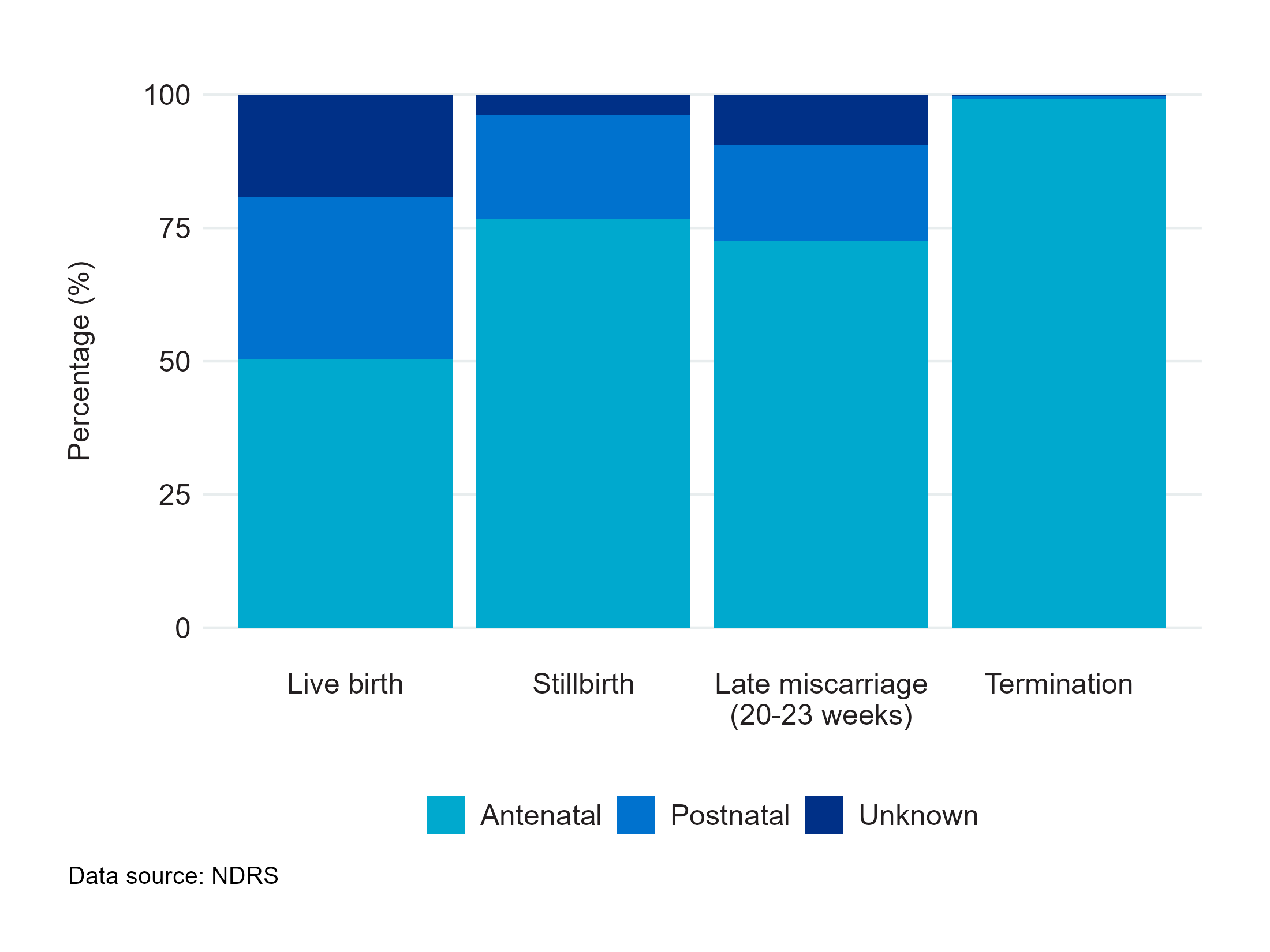
The timing of first detection of a baby with a congenital condition was known for 12,675 (85.8%) babies in 2022 (Figure 4; Data table 4). Of these, 9,276 (73.2%) babies with a congenital condition were identified antenatally.
Of those babies identified antenatally, 5,461 (58.9%) were born alive, 164 (1.8%) were stillborn, 69 (0.7%) were a late miscarriage and 3,582 (38.6%) resulted in a termination (Data table 4).
Where a congenital condition was first detected in a baby postnatally, 3,327 (97.9%) were detected following a live birth, 42 following a still birth, 17 following a fetal loss after 20 weeks and 13 following a termination.
Figure 4 (Data table 4) shows that of all live births where the timing of detection was known, 62.1% of babies with a congenital condition were detected antenatally. This may be an over-estimate as conditions diagnosed postnatally are more difficult to ascertain and may be identified later. Where a baby was stillborn with a congenital condition, the condition had been detected antenatally in 164 (79.6%) cases.
Last edited: 3 November 2025 11:38 am