Publication, Part of NCARDRS Congenital Anomaly Statistics: Annual Data
NCARDRS Congenital Condition Official Statistics Report, 2022
Official statistics
Minor change in title
The name of this collection of official statistics has been changed to NCARDRS Congenital Condition Statistics Report
17 October 2025 16:08 PM
Important public health indicators: age at delivery
Prevalence of congenital conditions by genomic association status and age at delivery
A woman’s age is a known risk factor for having a baby with a congenital condition.
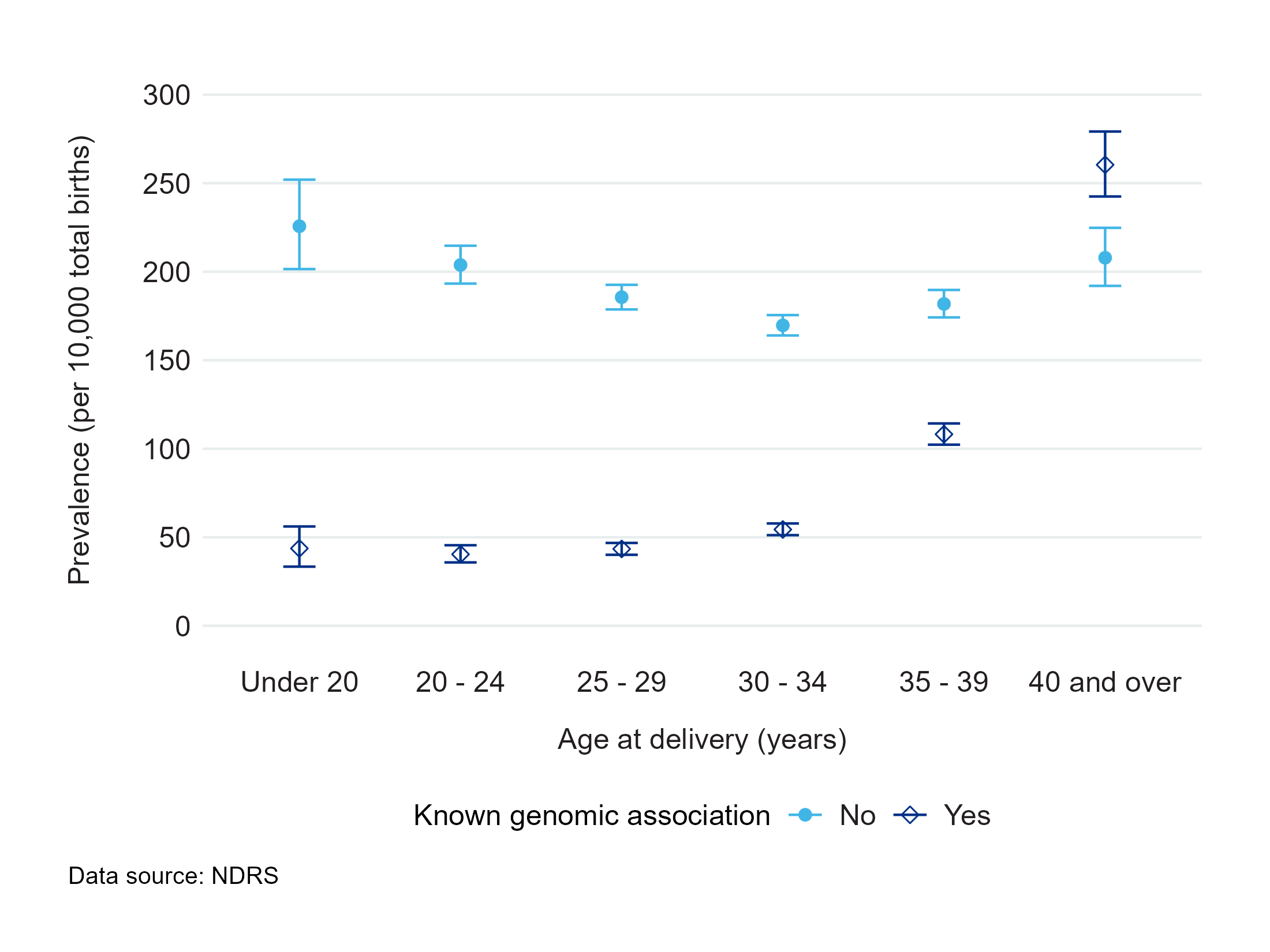
Data table 9 and Figure 9 present the rate of conditions with and without a known genomic association in babies by age of the woman at delivery.
For conditions that have no known genomic association, the rates in babies born to women under 25 years of age were significantly higher than the rates in women between 25-39 years of age. The rate in the 40-and-over age group was also comparatively high (207.9 per 10,000 total births, 95% CI 192.0-224.8) and significantly higher than the 30-34 and 35-39 age groups.
As observed in previous reports, the rate of genomic conditions in babies born to women aged 40 and over (260.4 per 10,000 total births, 95% CI 242.5-279.2) was significantly higher than in all other age groups, followed by women aged 35-39 (108.2 per 10,000 total births, 95% CI 102.3-114.3). Women aged 40 years and older were 6 times more likely to have a baby with a congenital condition of known genomic association compared to the age group with the lowest prevalence (RR 6.3, 5.5-7.2 compared to those aged 20 to 24).
The types of congenital condition, by age at delivery and genomic association status
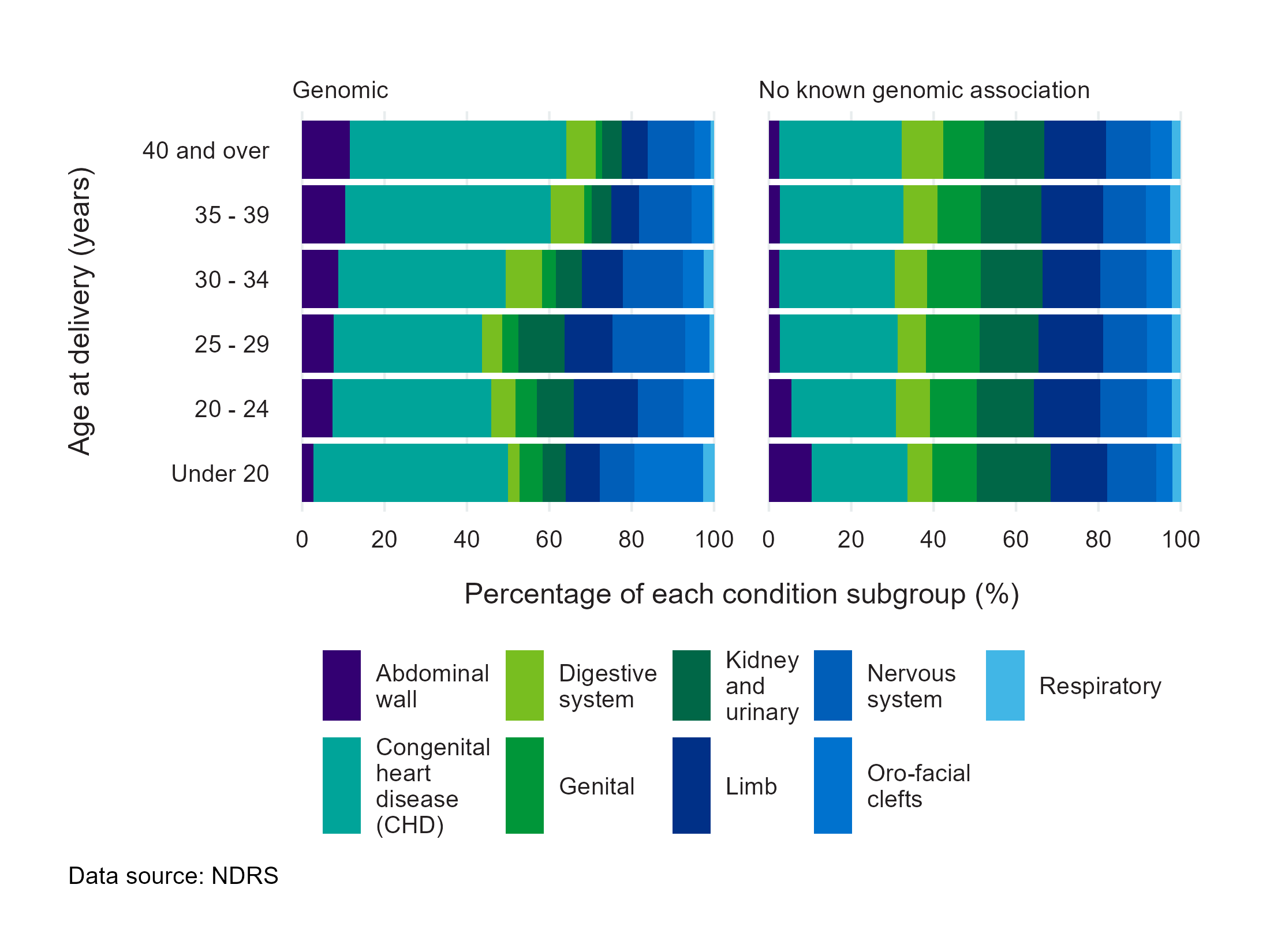
The distribution of the different major condition subgroups by age at delivery and by whether the baby had a known genomic condition is presented in Figure 10.
Data table 10a reports the prevalence of congenital conditions by the woman's age at delivery and by congenital condition subgroup, excluding conditions in babies with a confirmed genomic association (non-genomic). Across all conditions with no identified genomic association, congenital condition birth prevalence was lower in women aged 25-39 compared to those aged under 25 years, and 40 years and over (Figure 9), however with no clear pattern in the distribution of condition subgroups (Figure 10). The high prevalence of conditions with no known genomic association in babies born to women under 20 years of age was primarily driven by the significantly higher prevalence of abdominal wall conditions (24.4 per 10,000 total births, 95% CI 16.9-34.0) compared to the other age groups, with the second most prevalent age group being women aged 20-24 (11.7 per 10,000 total births, 95% CI 9.3-14.6). Gastroschisis, an abdominal wall condition, is known to be associated with lower age at delivery. The highest prevalence rates for congenital heart disease (CHD) were observed in the oldest age group (40 years and over, 66.0 per 10,000 total births, 95% CI 57.2-75.8) compared to the average across all age groups (53.9 per 10,000 total births, 95% CI 52.0-55.8).
Data table 10b reports the prevalence of congenital conditions by woman's age at delivery and by congenital condition subgroup for conditions in babies with a known genomic association (genomic). The prevalence was highest in women aged 40 and over for all condition subgroups with a known genomic association.
Figure 10 illustrates that, in babies and fetuses with a known genomic condition (genomic), the percentage of abdominal wall conditions diminished as with younger women's age groups, contrary to what was observed for this same condition subgroup where a genomic aetiology had not been found or reported (non-genomic).
Last edited: 3 November 2025 11:38 am