Publication, Part of NCARDRS Congenital Anomaly Statistics: Annual Data
NCARDRS Congenital Anomaly Official Statistics Report, 2021
Official statistics
2.4 Pregnancy outcome
As shown in Table 2.1, of the 14,085 babies with one or more congenital anomaly, the majority (10,119, 71.8%) resulted in a live birth. Of the remaining 3,966 babies, 240 (1.7%) were stillbirths (24 and over complete weeks gestation), 95 (0.7%) were late miscarriages (20 to 23 complete weeks gestation) and 3,631 (25.8%) were terminations of pregnancy at any gestation. Throughout this report, the 3,631 terminations analysed are terminations of pregnancy at any gestation for any reason and where a fetal anomaly was present.
|
Pregnancy outcome |
Number of babies |
Percentage |
|
Live birth |
10,119 |
71.8 |
|
Stillbirth |
240 |
1.7 |
|
Late miscarriage (20-23 weeks) |
95 |
0.7 |
|
Termination |
3,631 |
25.8 |
|
Total |
14,085 |
100.0 |
Outcome of pregnancy for babies with Down’s syndrome, Edwards’ syndrome and Patau’s syndrome
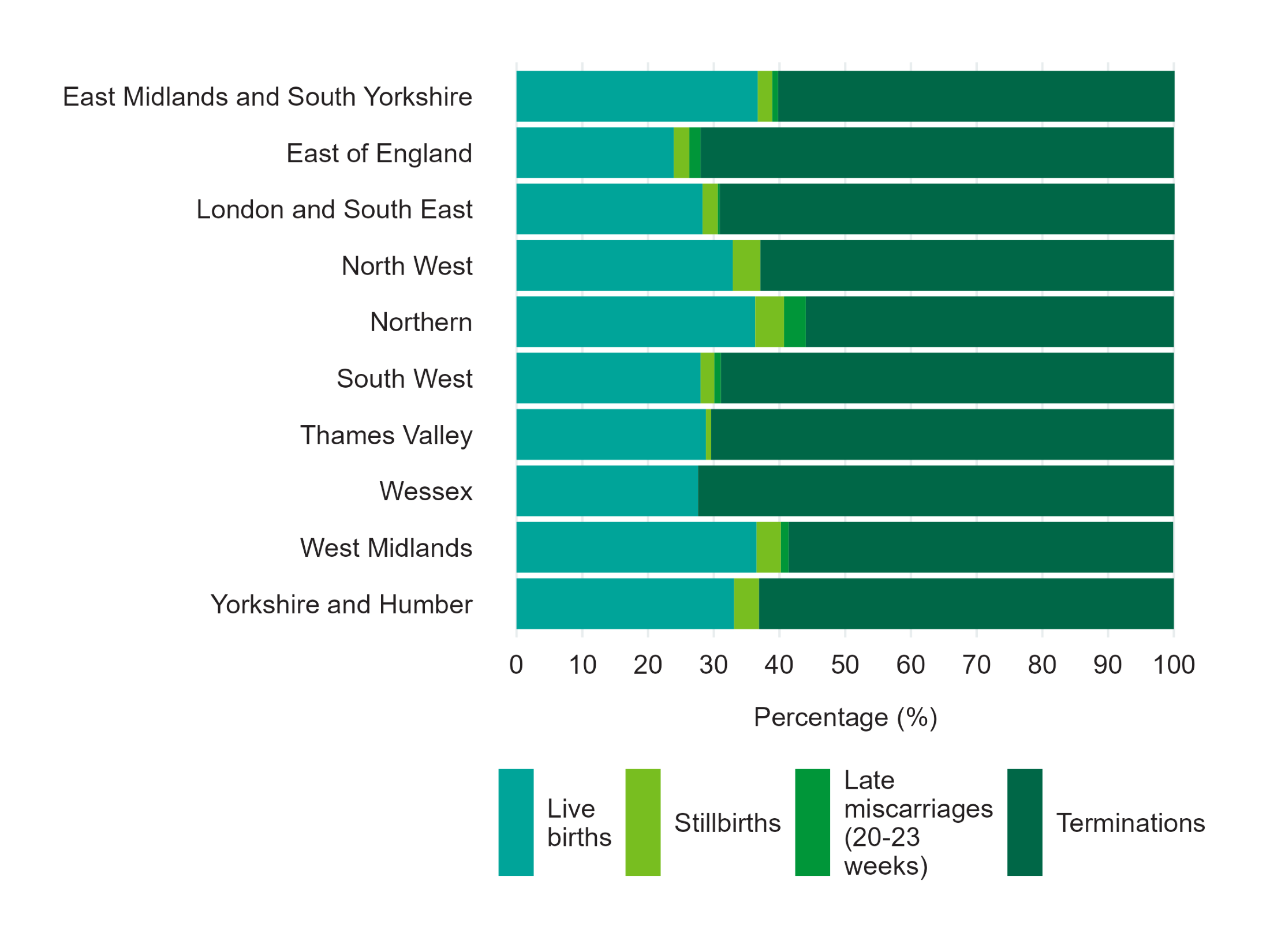
For pregnancies with Down’s syndrome, Edwards’ syndrome and Patau’s syndrome there are some differences in the proportion of different birth outcomes across different regions. The proportion of pregnancies with these conditions that resulted in a live birth ranged from 23.9% in the East of England to 36.7% in the East Midlands and South Yorkshire region (Figure 4; Data table 3). There are likely to be several reasons behind this, including differences in the demographic composition of the population, such as differences in pregnant person age distribution, and uptake of screening. There may also be some regional variation in ascertainment and data completeness, which could underestimate the number of miscarriages and terminations.
Figure 4: Outcome of pregnancy for babies with Down’s syndrome, Edwards’ syndrome and Patau’s syndrome delivered in England and the Crown Dependencies by region, 2021
Last edited: 27 March 2024 2:26 pm