Publication, Part of NCARDRS Congenital Anomaly Statistics: Annual Data
NCARDRS Congenital Anomaly Official Statistics Report, 2020
Official statistics
2.3 Prevalence of babies with Down’s syndrome, Edwards’ syndrome and Patau’s syndrome
Trisomy is a condition that results in an extra copy of a chromosome in all or some of an individual’s cells. Down’s syndrome (Trisomy 21), Edwards syndrome (Trisomy 18) and Patau syndrome (Trisomy 13) are the most common forms of trisomy associated with pregnancies that can progress to full term. For the first time, to ensure consistency throughout the report and internationally, partial trisomies are also included in the trisomy groups for prevalence reporting.
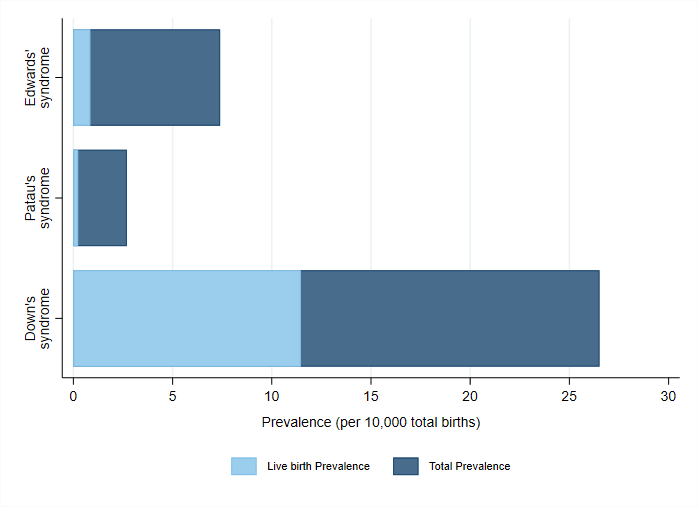
Figure 3 (Data Table 1) shows the prevalence of Down’s syndrome was 26.5 (95% CI 25.2-27.9) per 10,000 total births or one in every 377 births, 7.4 (95% CI 6.7-8.1) per 10,000 total births or one in every 1,352 births for Edwards syndrome and 2.7 (95% CI 2.3-3.2) per 10,000 total births or one in every 3,707 births for Patau’s syndrome.
The live birth prevalence remains consistent with previous years’ data, with 11.5 (95% CI 10.6-12.4) per 10,000 live births or one in 873 live births for Down’s syndrome, 0.9 (95% CI 0.6-1.1) per 10,000 live births or one in 11,744 for Edwards’ syndrome and 0.2 (95% CI 0.1-0.4) per 10,000 live births, or one in 41,944 for Patau’s syndrome respectively.
Figure 3 Prevalence of Down’s syndrome, Edwards’ syndrome and Patau’s syndrome per 10,000 births in 2020.
Last edited: 1 December 2022 10:17 am