Publication, Part of Health Survey England Additional Analyses
Health Survey England Additional Analyses, Ethnicity and Health, 2011-2019 Experimental statistics
Experimental statistics, Official statistics in development
Longstanding conditions
Longstanding illness is an important indicator of the health of the population. Some longstanding conditions can be managed but not cured and may affect people for the rest of their lives. Longstanding conditions become more common with increasing age and therefore as the population ages, the number of people with a longstanding illness or condition is expected to rise. Longstanding illness disproportionately affects different groups within the population and is higher among those on lower incomes or living in more deprived areas.1
1 Reported in HSE 2018: Longstanding conditions. https://files.digital.nhs.uk/AA/E265E0/HSE18-Longstanding-Conditions-rep.pdf
Definitions
Longstanding conditions are those lasting or expected to last 12 months or more, and include physical and mental health conditions. Conditions that reduce a person’s ability to carry out day-to-day activities are described as limiting longstanding conditions.
How are longstanding conditions measured?
The HSE includes a question, first asked in 2012: ‘Do you have any physical or mental health conditions or illnesses lasting or expected to last 12 months or more?’
In surveys between 2012 and 2018, participants who reported a longstanding health condition were asked to describe it in their own words.
Participants who reported any longstanding conditions were asked what they were and could list up to six. These coded into 42 types of condition, which were then grouped into one of 14 ICD-10 chapter categories. The number of conditions refers to the number of different ICD-10 chapter categories reported by each individual.
Finally, anyone who reported a longstanding health condition was asked whether it reduced their ability to carry out day-to-day activities.
This analysis refers to the years 2012 to 2018, when the current questions about longstanding conditions were asked, including specific types of condition.
Trends in longstanding conditions
The proportions of HSE participants reporting longstanding conditions increased slightly between 2012 and 2018. The proportion of adults with one or more longstanding conditions varied between 38% and 43%.2
Between 2012 and 2018, the prevalence of limiting longstanding illness increased from 22% to 25%. Women were more likely than men to have limiting conditions.
Analysis of data from 2017 and 2018 showed that the most common longstanding conditions were:
- conditions of the musculo-skeletal system (17% of all adults)
- conditions of the heart and circulatory system (11%)
- mental, behavioural and neurodevelopmental conditions (9%)
- diabetes and other endocrine and metabolic conditions (8%)
- respiratory conditions (both 8%).
2 HSE 2018: Adults’ health. https://files.digital.nhs.uk/E4/DAA235/HSE18-Adult-Health-rep.pdf
Longstanding conditions and ethnicity
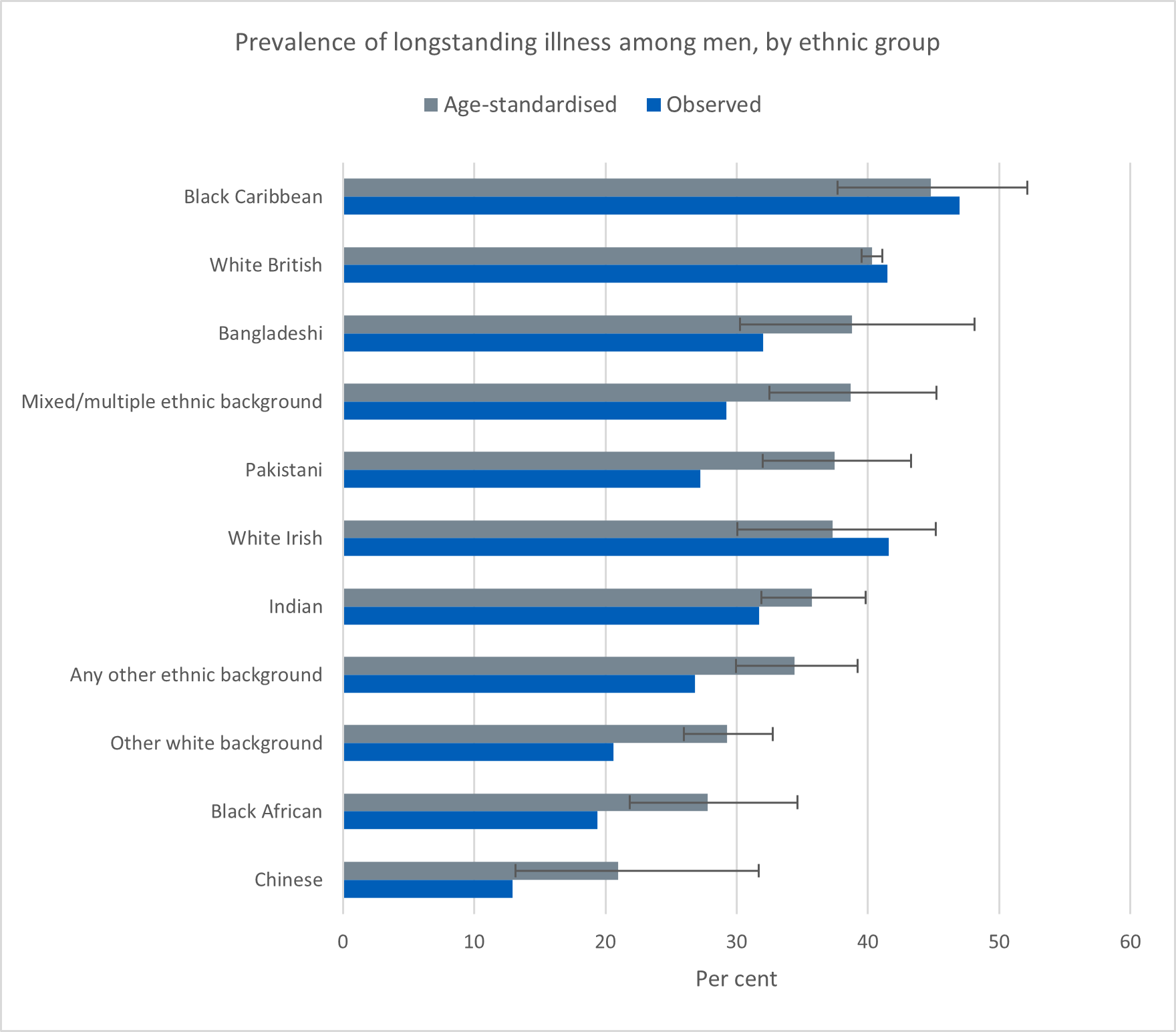
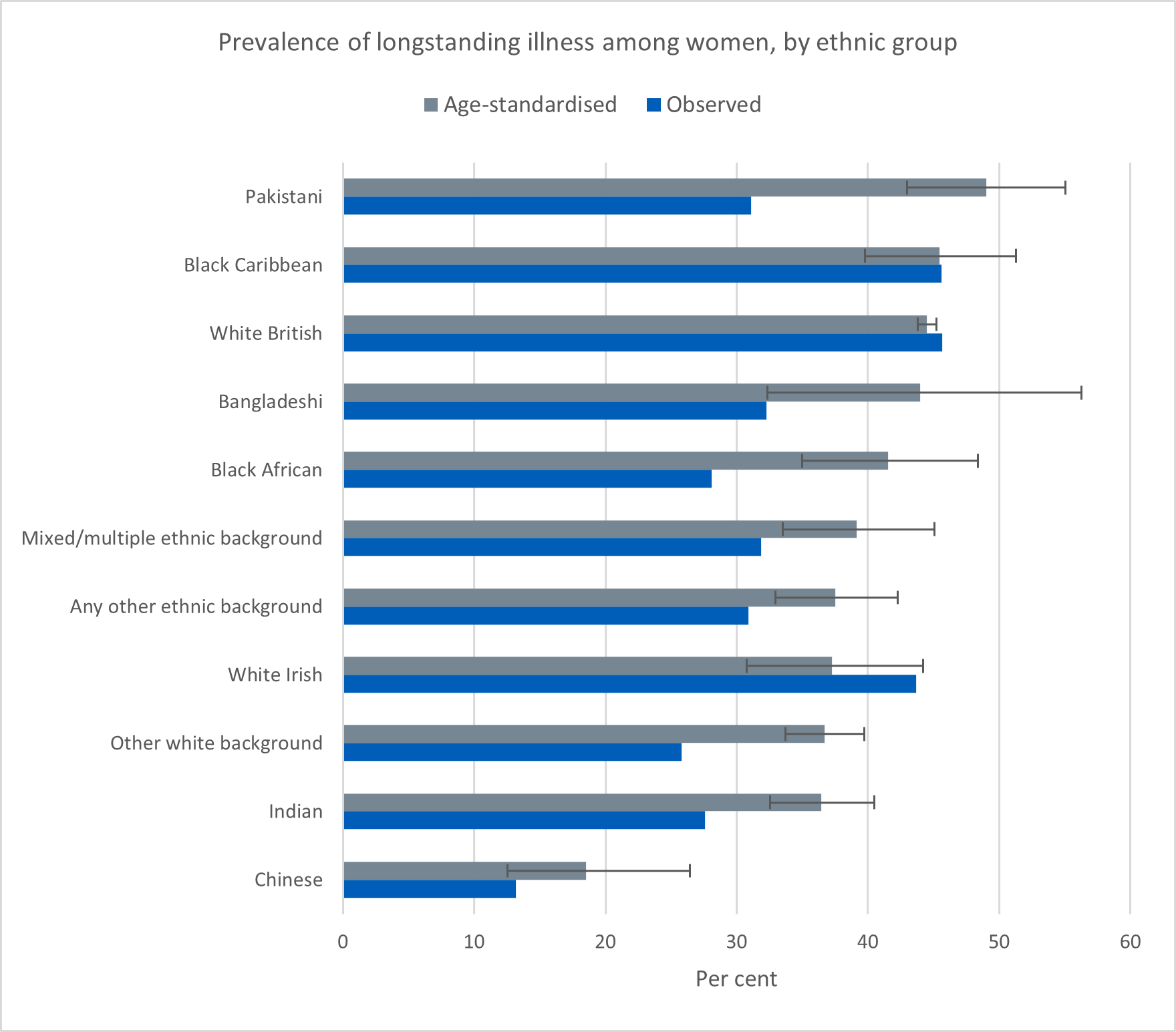
The prevalence of one or more longstanding conditions differed by ethnic group. Chinese men and women were least likely to report such conditions: 13% of each did so. Among other groups, prevalence varied from 19% to 47% of men and from 26% to 46% of women.
Once age was taken into account, black Caribbean and white British men were most likely to report at least one longstanding condition. The lowest rates of longstanding illness were found among men from Chinese, black African and Other white backgrounds.3
Among women, no group stood out as having particularly high rates of longstanding illness. The lowest rates of longstanding illness were found among women from Chinese backgrounds.
Black Caribbean and white British men and Pakistani women were also more likely to have two or more conditions.4
3 Ethnicity: p<0.001, Ethnicity*Sex p=0.096.
4 Ethnicity: p<0.001, Ethnicity*Sex p=0.270
Limiting longstanding conditions and ethnicity
The proportions with limiting longstanding conditions varied between 6% and 28% of men and between 8% and 28% of women.
Once age was taken into account, Pakistani and Bangladeshi men and black Caribbean men were most likely to have a limiting longstanding condition. This was least common among Chinese and black African men.
Pakistani and Bangladeshi women were most likely and Chinese women were least likely to have a limiting longstanding condition.5
5 Ethnicity: p<0.001, Ethnicity*Sex p=0.048
Individual longstanding conditions and ethnicity
Across the population as a whole, the most commonly reported conditions were:
- musculo-skeletal conditions
- heart and circulatory conditions
- endocrine and other metabolic conditions, including diabetes
- respiratory conditions
- mental, behavioural and neurodevelopmental conditions
Men were more likely than women to have heart and circulatory conditions; all other types of condition were more common among women than men.
There were variations in prevalence across adults in different groups.
- The prevalence of musculo-skeletal conditions varied from 5% to 19%
- The prevalence of heart and circulatory conditions varied from 4% to 15%
- The prevalence of endocrine and other metabolic conditions, including diabetes, varied from 3% to 14%
- The prevalence of respiratory conditions varied from 2% to 8%
- The proportions with mental, behavioural and neurodevelopmental problems varied from 1% to 8%.
Once age was taken into account, no group stood out as having particularly high or low prevalence of these conditions. 6
6 Musculo-skeletal: ethnicity p<0.001, ethnicity*sex p=0.128
Heart and circulatory: ethnicity p<0.001, ethnicity*sex p=0.096
Endocrine and metabolic: ethnicity p<0.001, ethnicity*sex p=0.096
Respiratory: ethnicity p<0.001, ethnicity*sex p=0.325
Mental, behavioural and neurodevelopmental conditions: ethnicity p<0.001, ethnicity*sex p=0.123
Last edited: 30 June 2022 9:33 am