Publication, Part of Health Survey England Additional Analyses
Health Survey England Additional Analyses, Ethnicity and Health, 2011-2019 Experimental statistics
Experimental statistics, Official statistics in development
Blood pressure
Persistent high blood pressure (hypertension) is an important public health challenge worldwide because of its high prevalence and the associated risk of cardiovascular (circulatory) diseases (CVD). It is one of the most important modifiable risk factors for stroke, ischaemic heart disease (such as angina, heart attacks, and heart failure), and renal disease, and is one of the most preventable and treatable causes of premature deaths worldwide1.
1. World Health Organization. Global Health Observatory (GHO) Data, Raised blood pressure: situation and trends. 2016. www.who.int/gho/ncd/risk_factors/blood_pressure_prevalence_text/en/
Definitions
Participants are defined as having high blood pressure if they have systolic blood pressure (SBP) at or above 140mmHg or diastolic blood pressure (DBP) at or above 90mmHg, or if they are taking medication prescribed for high blood pressure2. Participants are classified into one of four groups as follows:
- Normotensive untreated: SBP below 140mmHg and DBP below 90mmHg, not currently taking medication for blood pressure.
- Hypertensive controlled: SBP below 140mmHg and DBP below 90mmHg, currently taking medication for blood pressure.
- Hypertensive uncontrolled: SBP at or greater than 140mmHg and/or DBP at or greater than 90mmHg, currently taking medication for blood pressure.
- Hypertensive untreated: SBP at or greater than 140mmHg and/or DBP at or greater than 90mmHg, not currently taking medication for blood pressure.
The total prevalence of hypertension includes controlled, uncontrolled and untreated hypertension.
2. The HSE cannot be completely accurate in identifying people with hypertension as the definition requires persistently raised blood pressure; HSE measures the blood pressure of each participant three times but on a single occasion.
How is hypertension measured?
Blood pressure measurements are taken by a nurse during the nurse visit using an Omron HEM207 sphygmomanometer.
The nurses also collect information on prescribed medicines to enable the identification of treated hypertension if the participant is taking any medication for their blood pressure.
Trends in hypertension
The prevalence of hypertension among all adults was 30% in 2011. It varied between 2011 and 2019, with an overall downward trend and was 28% in 20193. In general, more men than women had hypertension. In 2019, 30% of men had hypertension compared with 25% of women.
The proportion of adults in the population with untreated hypertension fluctuated between 11% and 14% from 2011 to 2019.
3. Health Survey for England 2019: Adult Health data tables, available via the website https://digital.nhs.uk/data-and-information/publications/statistical/health-survey-for-england/2019/health-survey-for-england-2019-data-tables
Hypertension and ethnicity
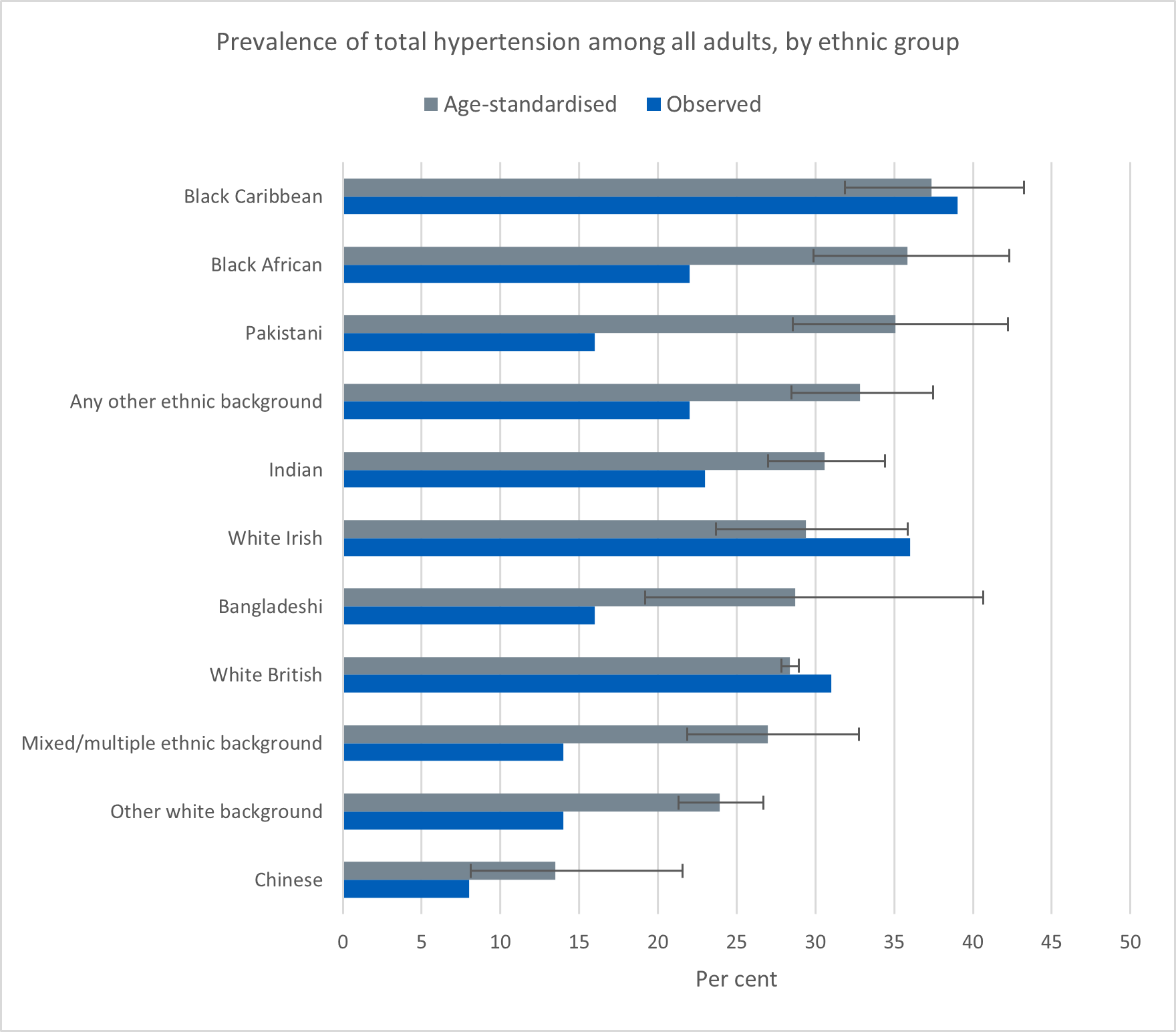
The prevalence of hypertension varied between 8% and 39% in different ethnic groups.
After accounting for age, hypertension was highest among black Caribbean, black African and Pakistani adults and was lowest among adults from Chinese and Other white backgrounds4.
Among different ethnicities, the proportion of adults with untreated hypertension was between 5% and 15%. After accounting for age, differences between groups were less obvious and variations were on the edge of statistical significance5.
4. Ethnicity: p<0.001
5. Ethnicity: p=0.056
Last edited: 30 June 2022 9:33 am