Publication, Part of Cancer Survival in England
Cancer Survival in England, cancers diagnosed 2018 to 2022, followed up to 2023
National statistics, Accredited official statistics

Replaced the lifetables file with correct IMD labelling.
15 April 2026 13:41 PM
Survival by cancer group - adults
This chapter examines adults (aged 15 to 99 years) diagnosed with the 25 most common cancers in males and females. Survival estimates are age-standardised and show 1-year and 5-year net survival for adults diagnosed between 2018 and 2022, with follow-up through to the end of 2023. Table 1 in the data download includes both net and overall survival estimates for 103 cancer groups. The appendix provides plots of age-standardised 1-year and 5-year net survival estimates for 13 sites.
Figure 1: Age-standardised 1-year and 5-year net survival estimates for males (aged 15 to 99 years) diagnosed with one of the 25 most common cancers in the period 2018 to 2022 and followed up to 2023
Abbreviations: Chronic lymphocytic leukaemia (CLL) or small lymphocytic lymphoma (SLL) is abbreviated to ‘CLL or SLL’. Diffuse large B-cell lymphoma and other high grade mature B-cell neoplasms is abbreviated to ‘DLBCL’.
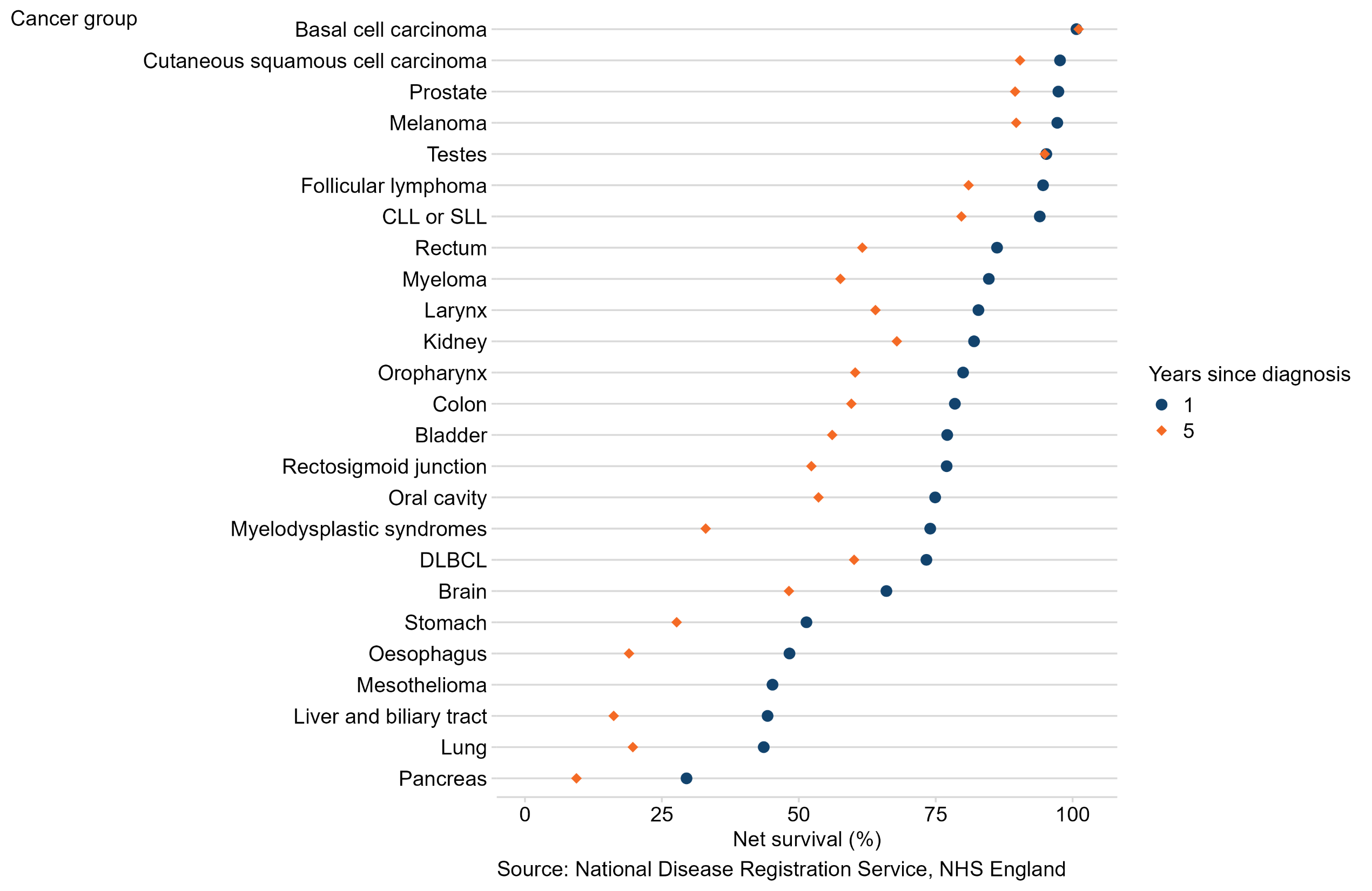
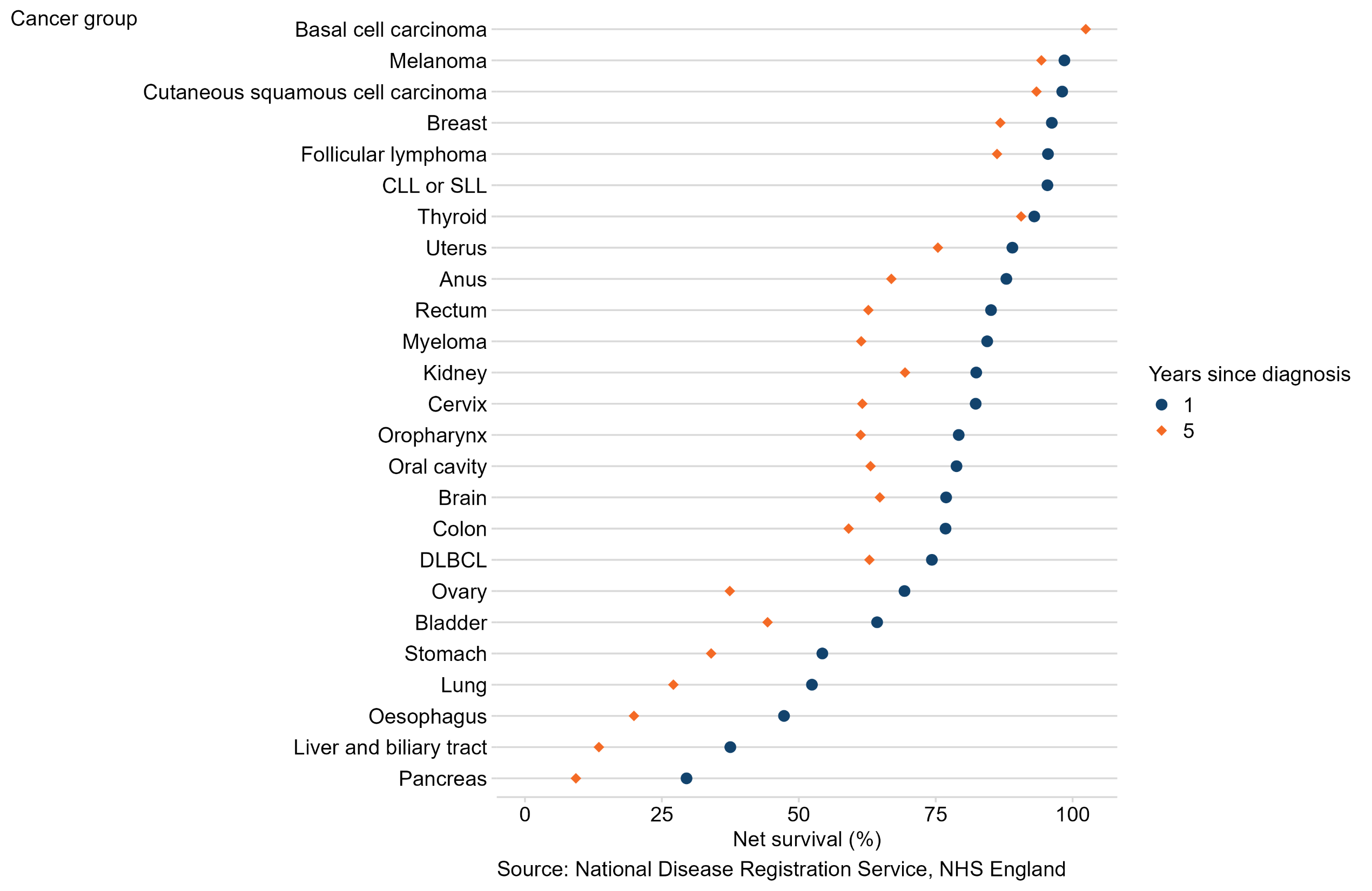
Figure 2: Age-standardised 1-year and 5-year net survival estimates for females (aged 15 to 99 years) diagnosed with one of the 25 most common cancers in the period 2018 to 2022 and followed up to 2023
Abbreviations: Chronic lymphocytic leukaemia (CLL) or small lymphocytic lymphoma (SLL) is abbreviated to ‘CLL or SLL’. Diffuse large B-cell lymphoma (DLBCL) and other high grade mature B-cell neoplasms is abbreviated to ‘DLBCL’.
Notes:
-
Survival estimates were age-standardised using a standard set of age-specific weights provided by the International Cancer Survival Standard (ICSS).
-
The following estimates are not presented as they did not pass the validation rules set out in Cancer Survival Methodology document: 1-year estimates for basal cell carcinoma (females only); 5-year estimates for mesothelioma (males) and CLL or SLL (females)
-
NDRS standard cancer group definitions are used to define cancer groups.
Among all 25 cancer groups presented in figures 1 and 2, skin cancers had some of the highest survival at both one year and five years after diagnosis. For males and females, survival at five years after diagnosis was highest for basal cell carcinoma (BCC) (males: 101.1%; females: 102.4%).
In males, excluding BCC, 1-year survival is highest for cutaneous squamous cell carcinoma (97.7%), prostate cancer (97.4%), melanoma (97.2%), and cancer of the testes (95.2%). 5-year survival is highest for cancer of the testes (94.9%), cutaneous squamous cell carcinoma (90.4%), melanoma (89.7%), and prostate cancer (89.5%).
In females, excluding BCC, 1-year survival is highest for melanoma (98.5%), cutaneous squamous cell carcinoma (98.1%), breast cancer (96.2%), and follicular lymphoma (95.5%). 5-year survival is highest for melanoma (94.3%), cutaneous squamous cell carcinoma (93.4%), thyroid cancer (90.6%), and breast cancer (86.8%).
Cancer of the pancreas had both the lowest 1-year survival and 5-year survival for males (29.5% and 9.4%) and females (29.5% and 9.3%).
Last edited: 15 April 2026 1:41 pm