Publication, Part of Cancer Survival in England
Cancer Survival in England, cancers diagnosed 2018 to 2022, followed up to 2023
National statistics, Accredited official statistics

Replaced the lifetables file with correct IMD labelling.
15 April 2026 13:41 PM
Cancer survival by deprivation - adults
Deprivation quintiles were defined using the Index of Multiple Deprivation (IMD). For more information see the Methods chapter.
Within this chapter, survival estimates for 103 cancer groups are age-standardised and show 1-year and 5-year net survival for adults diagnosed between 2018 and 2022, with follow-up through to the end of 2023. Table 3 in the data download includes both net and overall survival estimates by deprivation quintile.
For most cancers, survival is generally lower in patients diagnosed in areas that are the most deprived and higher in areas that are the least deprived. One exception was small cell lung cancer, where survival for persons living in the least deprived areas was 0.7 percentage points lower when compared to people living in the most deprived areas.
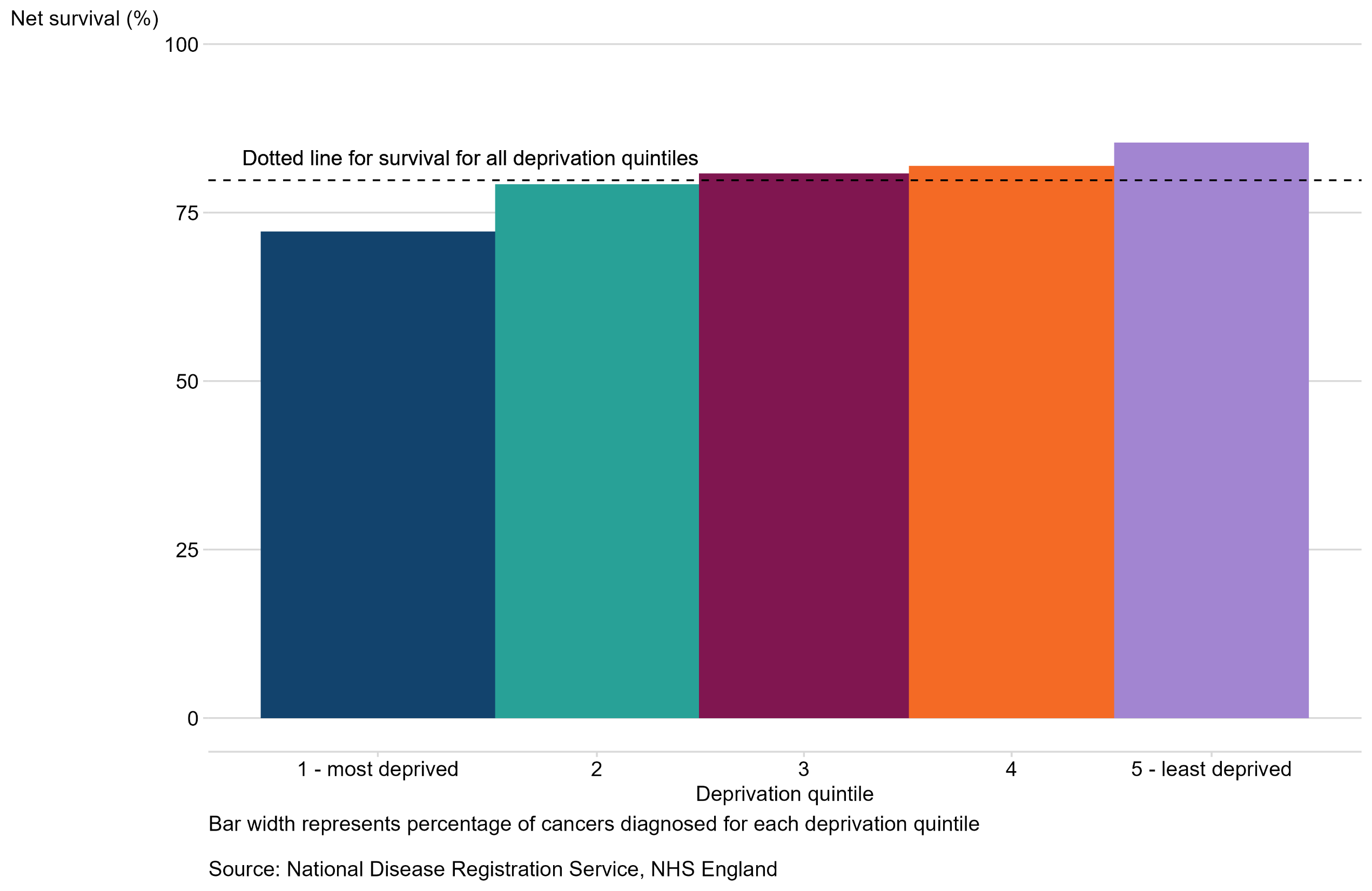
The largest difference in survival at one year after diagnosis between persons living in the least deprived areas compared to the most deprived areas was for cancer of the oropharynx (13.2 percentage points) (see Figure 5), Mature T-cell and NK-cell neoplasms (11.0 percentage points), and acute lymphoblastic leukaemia (9.2 percentage points).
The smallest difference in survival at one year after diagnosis between persons living in the least deprived areas compared to the most deprived areas was for BCC (0.4 percentage points), benign endocrine (0.6 percentage points), and thyroid cancer (0.6 percentage points). These cancers have high survival even for persons living in the most deprived quintile.
For the four most common cancers, excluding skin cancers, the difference in survival at one year after diagnosis between persons living in the least deprived areas compared to the most deprived areas was 7.8 percentage points for lung cancer, 7.3 percentage points for bowel cancer, 2.7 percentage points for breast cancer in females, and 1.3 percentage points for prostate cancer in males.
The largest difference in survival at 1-year after diagnosis for females and males living in the least deprived areas compared to the most deprived areas was 17.9 percentage points for ovary - miscellaneous and unspecified in females and 15.4 percentage points for cancer of the oropharynx in males.
Figure 5: 1-year age-standardised net survival for cancer of the oropharynx, persons, diagnosed in the period 2018 to 2022 and followed up to 2023, for all deprivation quintiles, England
Notes:
-
Survival estimates were age-standardised using a standard set of age-specific weights provided by the International Cancer Survival Standard (ICSS).
-
The dotted line represents survival for all deprivation quintiles combined.
Last edited: 15 April 2026 1:41 pm