Publication, Part of Cancer Survival in England
Cancer Survival in England, cancers diagnosed 2018 to 2022, followed up to 2023
National statistics, Accredited official statistics

Replaced the lifetables file with correct IMD labelling.
15 April 2026 13:41 PM
Geographic patterns of cancer survival - adults
Within this chapter, survival estimates are age-standardised and show 1-year and 5-year net survival for adults diagnosed between 2018 and 2022, with follow-up through to the end of 2023. Table 4 in the data download includes both net and overall survival estimates by geography.
Cancer Alliances
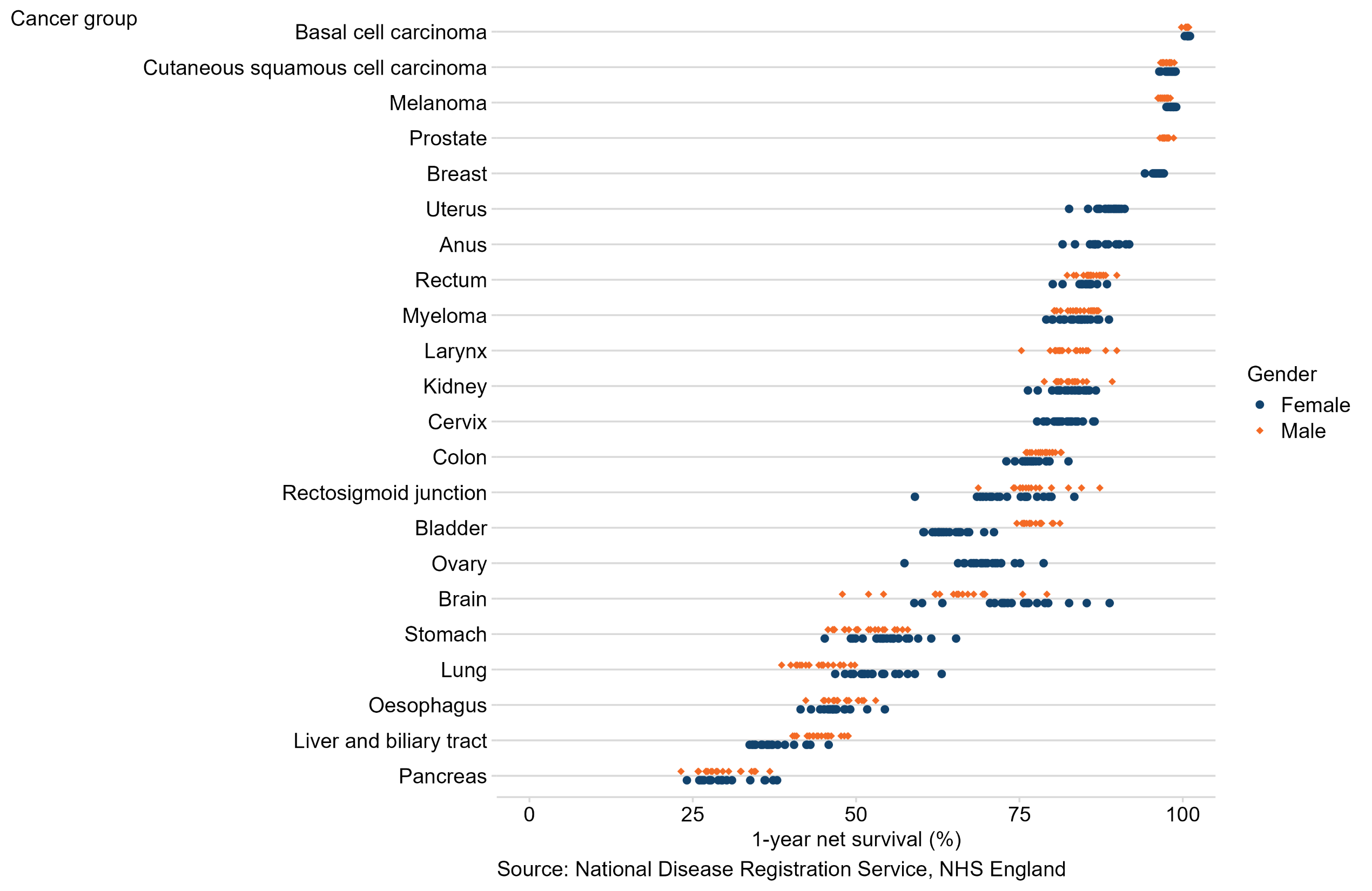
Estimates for 1-year and 5-year survival have been calculated for all 21 Cancer Alliances (CAs). Cancer groups are included in the plots below if 1-year age-standardised survival estimates are available for at least 75% of CAs for either males or females.
Figure 6: Age-standardised 1-year net survival (%) for adults diagnosed in the period 2018 to 2022 and followed up to 2023, and the site-specific variation in survival estimates for CAs
Notes:
-
Survival estimates were age-standardised using a standard set of age-specific weights provided by the International Cancer Survival Standard (ICSS).
-
Survival estimates presented are for: anus, breast, cervix, ovary, and uterus for females only; and larynx and prostate for males only.
Figure 6 shows that the cancer site with the greatest variation in 1-year survival by CA for both males and females is Brain cancer, ranging from 58.9% to 88.8% (a difference of 29.9 percentage points) in females and 47.9% to 79.2% (a difference of 31.3 percentage points) in males.
The cancer site with the least variation in 1-year survival by CA and with the highest 1-year survival for both males and females is basal cell carcinoma (BCC), ranging from 100.3% to 101.1% in females (a difference of 0.8 percentage points) compared with 99.8% to 100.9% in males (a difference of 1.1 percentage points). The difference between lowest survival in females in comparison to males was 0.5 percentage points. The difference between the highest survival in females compared with males was 0.2 percentage points.
The cancer site with the lowest 1-year survival was cancer of the pancreas, ranging from 24.1% to 37.9% in females compared with 23.2% to 36.8% in males. The difference between lowest survival in females in comparison to males was 0.9 percentage points. The difference between the highest survival in females compared with males was 1.1 percentage points.
Integrated Care Boards
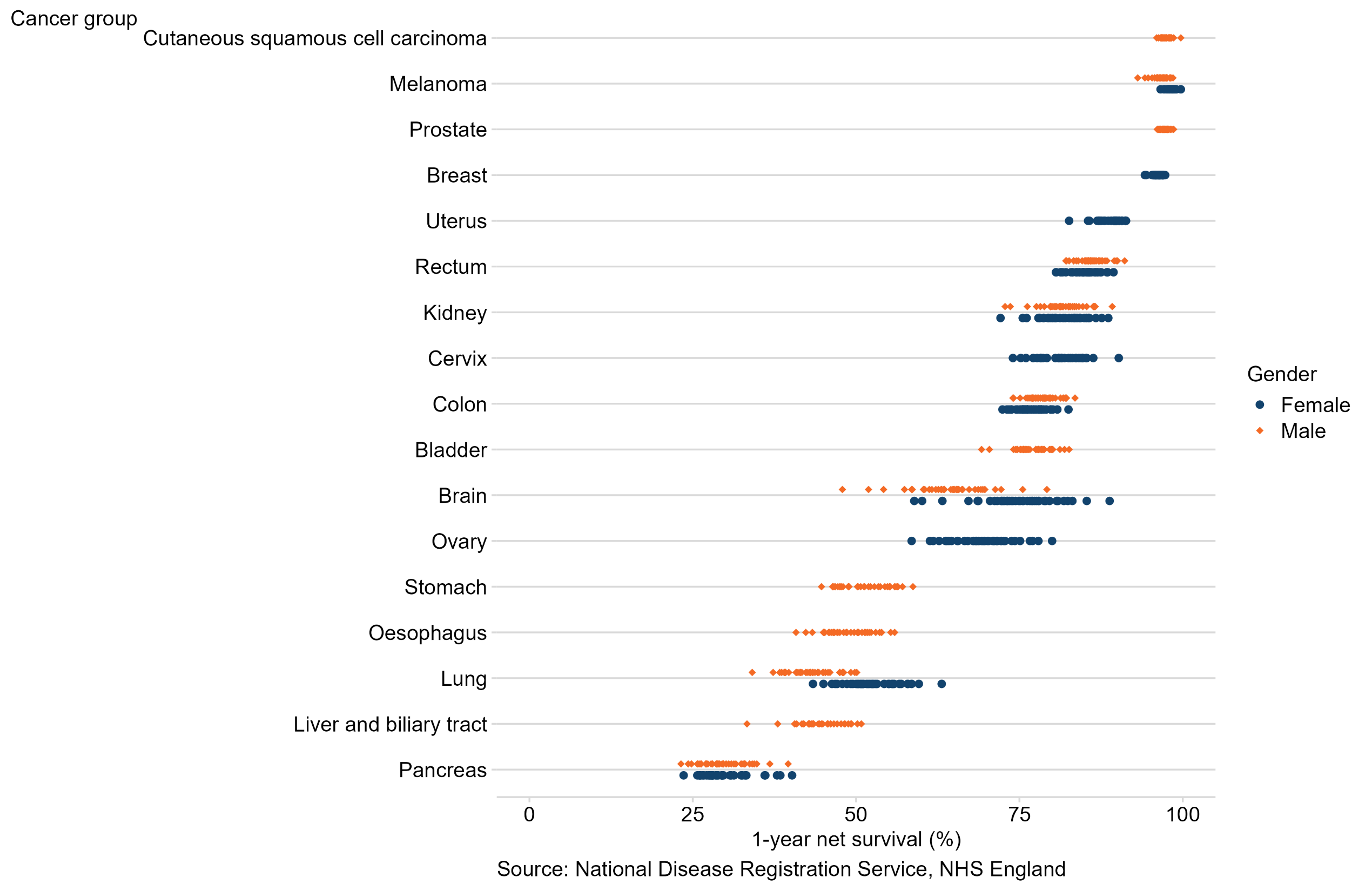
Estimates for 1-year and 5-year survival have been calculated for all 42 Integrated Care Boards (ICBs). Cancer groups are included in the plots below if 1-year age-standardised survival estimates are available for at least 75% of ICBs for either males or females.
ICBs are the smallest geographical areas in this publication and so fewer age-standardised estimates can be presented. Because of the smaller populations, a greater number of these estimates did not meet the validation criteria and have been suppressed.
Figure 7: Age-standardised 1-year net survival (%) for adults diagnosed in the period 2018 to 2022 and followed up to 2023, and the site-specific variation of survival estimates for ICBs
Notes:
-
This chart uses age-standardised survival estimates; individual ICBs were not included in this chart if reliable age-standardised estimates were not available.
-
Survival estimates were age-standardised using a standard set of age-specific weights provided by the International Cancer Survival Standard (ICSS).
-
Survival estimates presented are for: breast, cervix, ovary, and uterus for females only; bladder, cutaneous squamous cell carcinoma, liver and biliary track, oesophagus and prostate for males only.
Figure 7 shows that the cancer site with the greatest variation in 1-year survival by ICB for both males and females is Brain cancer, ranging from 58.9% to 88.8% (a difference of 29.9 percentage points) in females and 47.9% to 79.2% (a difference of 31.3 percentage points) in males.
The cancer site with the least variation in 1-year survival by ICB for females is breast cancer, ranging from 94.2% to 97.3% (a difference of 3.1 percentage points). For males, this is prostate cancer, ranging from 96.1% to 98.6% (a difference of 2.5 percentage points).
Government office regions
England has 9 Government office regions (East Midlands, East of England, London, North East, North West, South East, South West, West Midlands, and Yorkshire and The Humber).
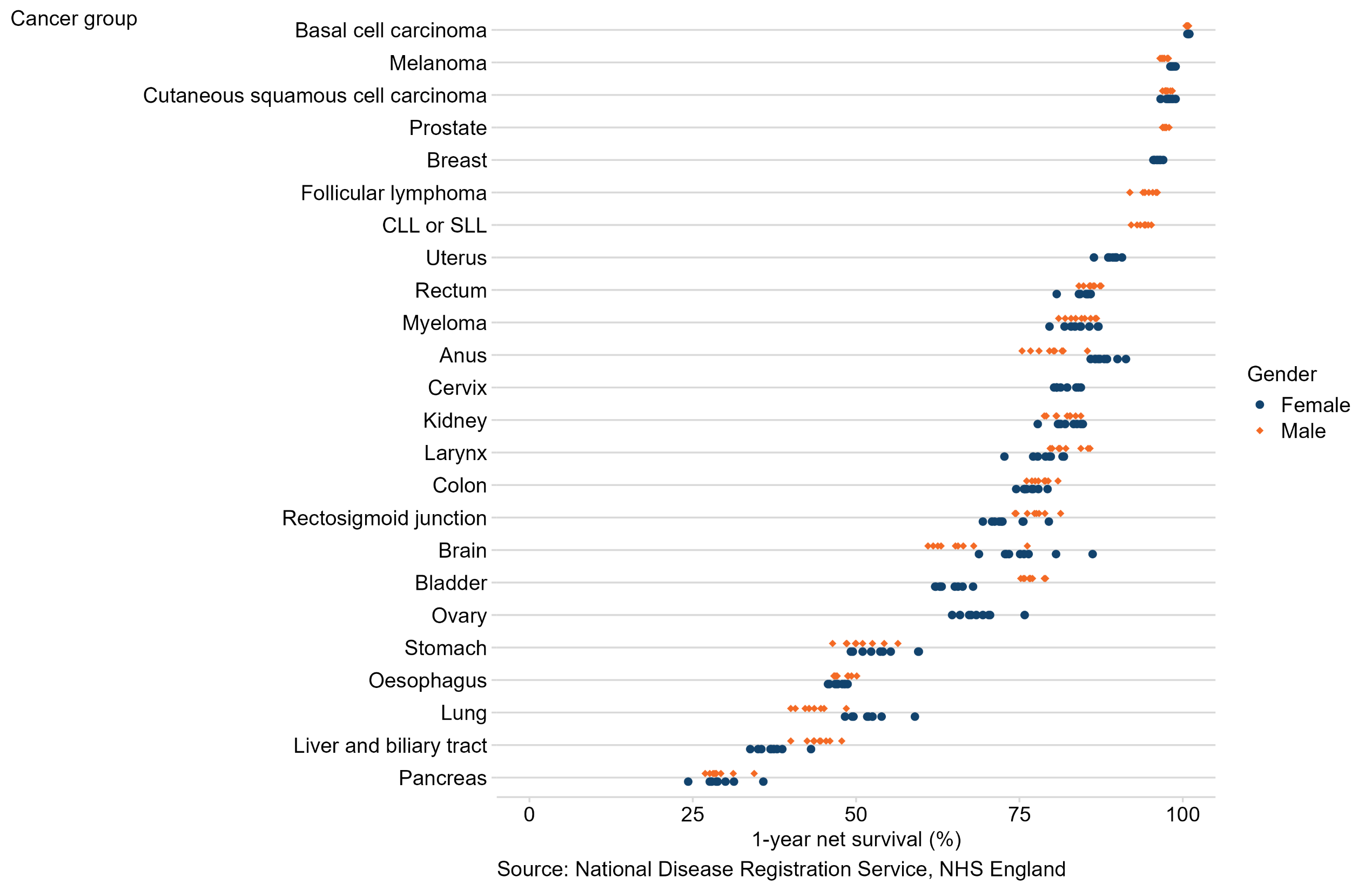
Cancer groups are included in the plots below if 1-year age-standardised survival estimates are available for at least 75% of Government office regions for either males or females.
Government office regions have a smaller variation in survival estimates relative to CAs and ICBs due to having larger populations.
Figure 8: Age-standardised 1-year net survival (%) for adults diagnosed in the period 2018 to 2022 and followed up to 2023, and the site-specific variation of survival estimates for Government office regions
Notes:
-
This chart uses age-standardised survival estimates; individual Government office regions were not included in this chart if reliable age-standardised estimates were not available.
-
Survival estimates were age-standardised using a standard set of age-specific weights provided by the International Cancer Survival Standard (ICSS).
-
Survival estimates presented are for: breast, cervix, ovary, and uterus for females only; and Chronic lymphocytic leukaemia (CLL) or small lymphocytic lymphoma (SLL), follicular lymphoma, prostate for males only.
Figure 8 shows that the cancer site with the greatest variation in 1-year survival by Government office region for both males and females is Brain cancer, ranging from 68.8% to 86.2% (a difference of 17.4 percentage points) in females and 61.0% to 76.2% (a difference of 15.2 percentage points) in males.
The cancer site with the least variation in 1-year survival by Government office region for both males and females is basal cell carcinoma (BCC), ranging from 100.7% to 101.0% in females (a difference of 0.3 percentage points) compared with 100.5% to 100.9% in males (a difference of 0.4 percentage points).
Last edited: 15 April 2026 1:41 pm