Publication, Part of Cancer Survival in England
Cancer Survival in England, cancers diagnosed 2016 to 2020, followed up to 2021
National statistics, Accredited official statistics

Geographic patterns of cancer survival
Cancer Alliances
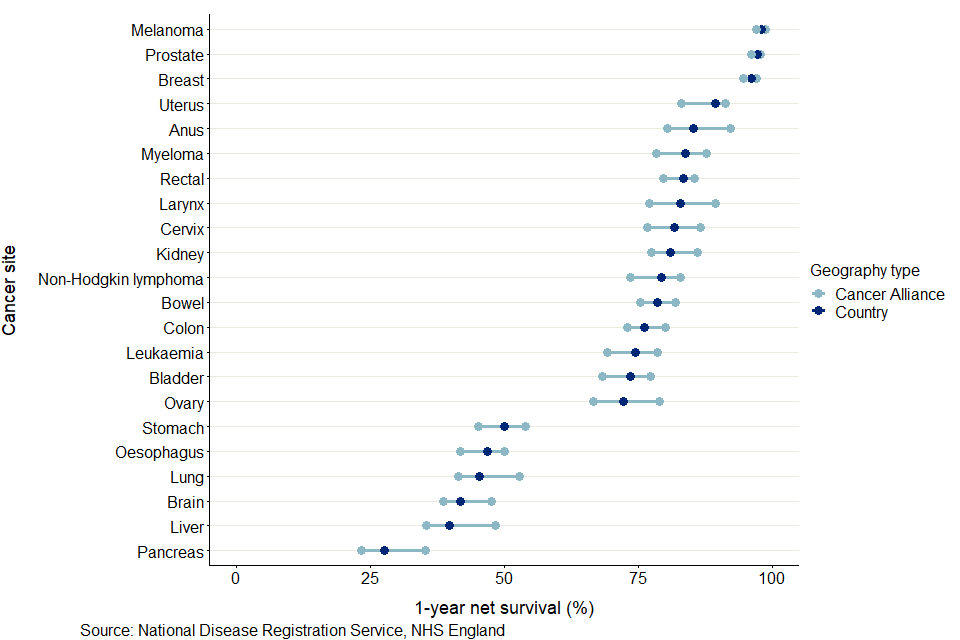
Estimates for 1-year and 5-year survival have been calculated for all 21 Cancer Alliances (CAs). Cancer sites are included if 1-year age-standardised survival estimates are available for at least 75% of CAs for either males or females. Estimates for persons are presented if estimates are included for both males and females.
Figure 6: Age-standardised 1-year net survival (%) for adults diagnosed in the period 2016 to 2020 and followed up to 2021, and the site-specific variation in survival estimates for CAs
Notes:
-
Survival estimates were age-standardised using a standard set of age-specific weights provided by the International Cancer Survival Standard (ICSS).
-
Survival estimates presented are for persons except for:
a) cervix, ovary, uterus and vulva for females only and prostate for males only;
b) larynx cancer is presented only for males because reliable estimates were not obtained for 75% of CAs for females;
c) breast cancer is presented only for females because reliable estimates were not obtained for 75% of CAs for males.
-
The International Classification of Diseases 10th Revision (ICD-10) was used to classify cancer sites.
As shown in Figure 6, cancer of the pancreas had the lowest 1-year survival in all CAs. Across all CAs, the site-specific variation in 1-year survival estimates affecting persons are narrowest for melanoma, with a range of 1.7 percentage points between the lowest (97.0% for North West and South West London CA) and the highest (98.7% for Northern CA). The largest range in 1-year survival estimates is for liver cancer in persons, with a range of 12.9 percentage points between the lowest (35.4% for Kent and Medway CA) and highest (48.3% for North Central London CA).
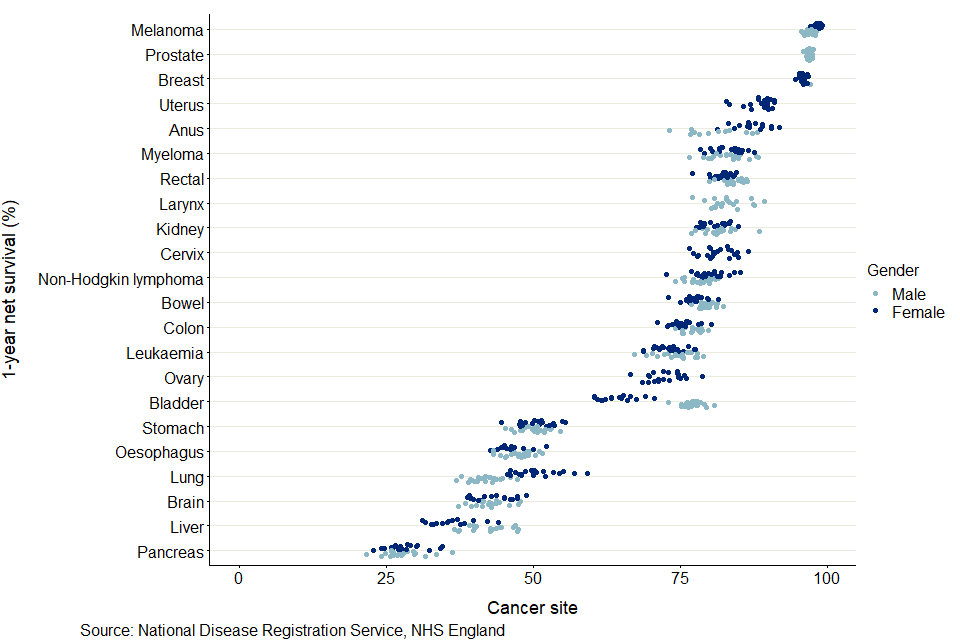
Figure 7: Age-standardised 1-year net survival (%) for adults diagnosed in the period 2016 to 2020 and followed up to 2021: 22 common cancers, by gender for CAs
Notes:
-
Survival estimates were age-standardised using a standard set of age-specific weights.
-
Survival estimates presented are for both males and females except for:
a) cervix, ovary, uterus and vulva for females only and prostate for males only;
b) larynx cancer is presented only for males because reliable estimates were not obtained for 75% of CAs for females;
c) breast cancer is presented only for females because reliable estimates were not obtained for 75% of CAs for males.
-
The International Classification of Diseases 10th Revision (ICD-10) was used to classify cancer sites.
Figure 7 illustrates that cancer survival for each CA in males is typically lower than survival in females, most noticeably in lung cancer. Only for bladder cancer was survival for each CA in females lower than in males, reflecting the national cancer survival estimates.
For 5-year survival, reliable age-standardised estimates could not be obtained for most cancer sites and most CAs. It was only possible to provide age-standardised estimates for all CAs in breast cancer (females).
For each CA, trends in 1-year non-standardised net survival for 13 cancer sites/groups (persons, except breast, cervix and uterus for females and prostate for males) were produced (total 273 trend estimates). 1-year non-standardised net survival has significantly improved for 145 cancer groups/CA combinations, with patients diagnosed between 2016 and 2020 having a higher 1-year survival than patients diagnosed between 2007 and 2011.
Over the same period, 1-year non-standardised net survival decreased significantly for 27 cancer groups/CA combinations and did not significantly change for 101 cancer groups/CA combinations. The increasing trends were evenly spread between the 21 CAs and most cancer sites/groups. Of the 27 decreasing trends, 14 were for bladder cancer, broadly reflecting the national findings on cancer survival.
Integrated Care Boards
NHS England established 42 statutory integrated care boards (ICBs) on 1 July 2022 in line with its duty in the Health and Care Act 2022. This was as part of the Act’s provisions for creating integrated care systems (ICSs).
ICSs are partnerships of NHS bodies and local authorities, working with other relevant local organisations, that come together to plan and deliver joined up health and care services to improve the lives of people in their area.
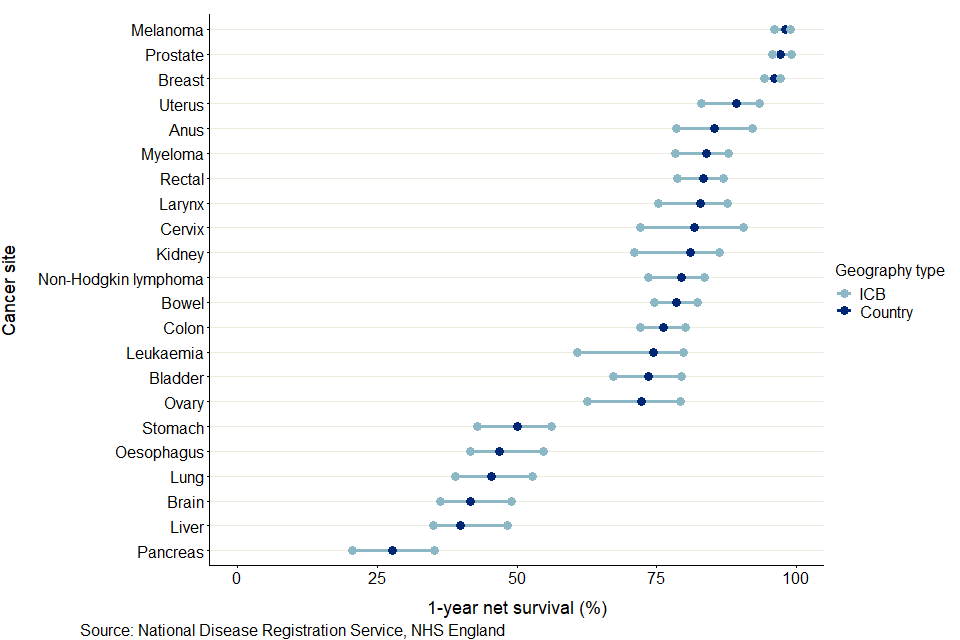
ICBs are the smallest geographical areas in this publication and so fewer age-standardised estimates can be presented. There is more volatility and uncertainty in their estimates because of the smaller populations.
Across cancer sites, the variation in 1-year survival estimates for ICBs varies from 2.9 percentage points for breast cancer (females) to 19.0 percentage points for leukaemia (persons).
Figure 8: Age-standardised 1-year net survival (%) for adults diagnosed in the period 2016 to 2020 and followed up to 2021, and the site-specific variation of survival estimates for ICBs
Notes:
-
This chart uses age-standardised survival estimates; individual ICBs were not included in this chart if reliable age-standardised estimates were not available.
-
Survival estimates were age-standardised using a standard set of age-specific weights.
-
Survival estimates presented are for persons except for:
a) cervix, ovary, uterus and vulva for females and prostate for males;
b) larynx which is presented only for males because reliable estimates were not obtained for 75% of CAs for females;
c) breast which is presented only for females because reliable estimates were not obtained for 75% of CAs for males.
-
The International Classification of Diseases 10th Revision (ICD-10) was used to classify cancer sites.
-
A combination of site and gender is presented for all geographies if age-standardised 1-year survival estimates can be produced for at least 75% of ICBs.
For each ICB, trends in 1-year non-standardised net survival for 13 cancer sites/groups (persons, except breast, cervix and uterus for females and prostate for males) were produced (total 546 trend estimates). 1-year non-standardised net survival has significantly improved for 217 cancer groups/ICB combinations, with patients diagnosed between 2016 and 2020 having higher 1-year survival than patients diagnosed between 2007 and 2011. Over the same period, 1-year non-standardised net survival decreased significantly for 36 cancer groups/ICB combinations and did not change for 293 cancer groups/ICB combinations. The increasing trends were evenly spread between the 42 ICBs and most cancer sites/groups. Of the 36 decreasing trends, 14 were for bladder cancer, broadly reflecting the national findings on cancer survival.
Estimates of 5-year survival for ICBs are provided in the data tables where they pass the statistical reliability tests. However, a full comparison of these estimates is not reported due to the suppression of many estimates.
NHS regions
England has 7 NHS regions (East of England, London, Midlands, North East and Yorkshire, North West, South East, and South West).
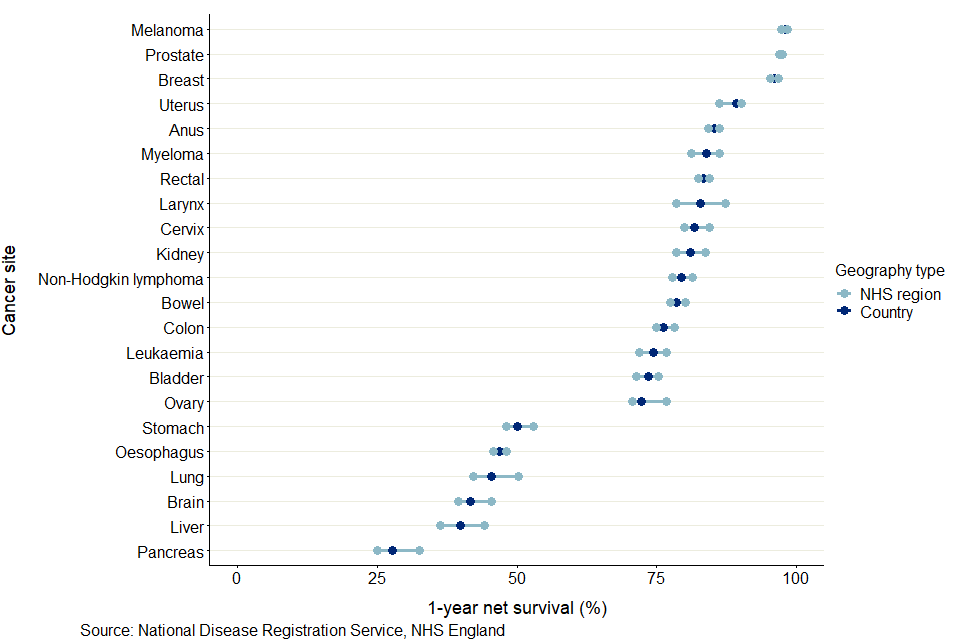
NHS regions have a smaller variation in survival estimates relative to CAs and ICBs due to having larger populations. The site specific 1-year survival varied from 0.7 percentage points for prostate cancer to 8.1 percentage points for lung cancer.
Figure 9: Age-standardised 1-year net survival (%) for adults diagnosed in the period 2016 to 2020 and followed up to 2021, and the site-specific variation of survival estimates for NHS regions
Notes:
-
This chart uses age-standardised survival estimates; individual NHS regions were not included in this chart if reliable age-standardised estimates were not available.
-
Survival estimates were age-standardised using a standard set of age-specific weights.
-
Survival estimates presented are for persons except for:
a) cervix, ovary, uterus and vulva for females and prostate for males;
b) larynx which is presented only for males because reliable estimates were not obtained for 75% of CAs for females;
c) breast which is presented only for females because reliable estimates were not obtained for 75% of CAs for males.
-
The International Classification of Diseases 10th Revision (ICD-10) was used to classify cancer sites.
For both 1-year and 5-year survival estimates, London tends to have the highest results (approximately 10 out of 22 sites). Whereas, for both 1-year and 5-year survival estimates, the Midlands tends to have the lowest results (approximately 8 out of 22 sites),
For each NHS region, trends in 1-year non-standardised net survival for 13 cancer sites/groups (persons, except breast, cervix and uterus for females and prostate for males) were produced (total 91 trend estimates). 1-year non-standardised net survival has improved for 47 cancer groups/NHS region combinations, with patients diagnosed between 2016 and 2020 having a higher 1-year survival than patients diagnosed between 2007 and 2011.
Over the same period, 1-year non-standardised net survival decreased significantly for 7 cancer groups/NHS region combinations and did not change for 37 cancer groups/NHS region combinations. The increasing trends were evenly spread between the 7 NHS regions and most cancer sites/groups. Of the 7 decreasing trends, 4 were for bladder cancer, broadly reflecting the national findings on cancer survival.
Last edited: 19 April 2023 12:39 pm