Publication, Part of Cancer Survival in England
Cancer Survival in England, cancers diagnosed 2016 to 2020, followed up to 2021
National statistics, Accredited official statistics

Cancer survival by deprivation
Quintiles of the Index of Multiple Deprivation (IMD) were used as an area-based measure of deprivation based on the postcode of residence at the time of diagnosis using the Public Health method of assigning deprivation quintiles.
For all cancers, the age-standardised net survival was higher for both males and females living in the least deprived areas when compared to the most deprived areas. For most cancer sites, the survival increased consistently for each deprivation quintile from most deprived to least deprived.
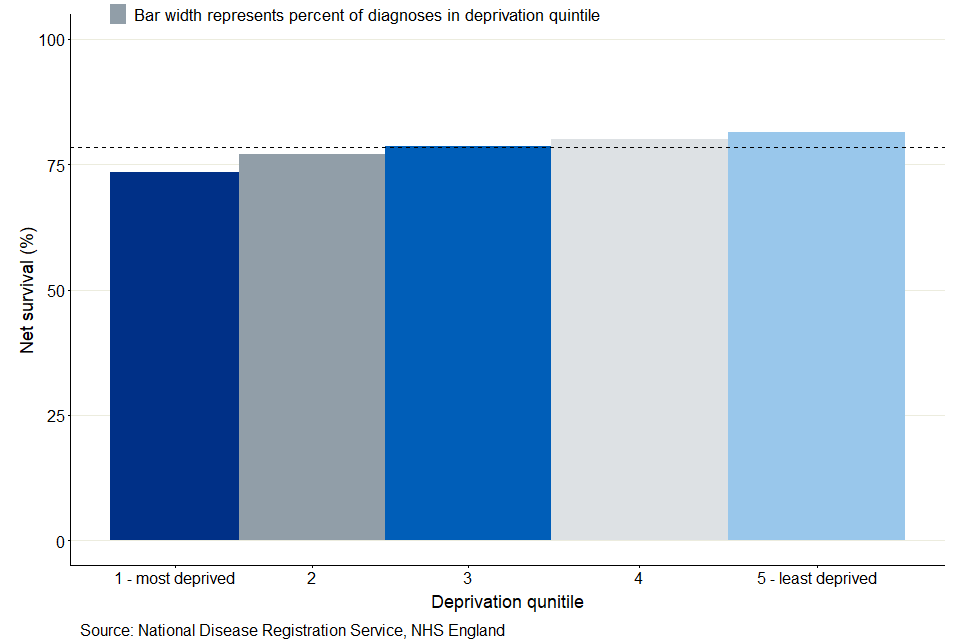
The difference in the 1-year age-standardised survival between persons living in the least deprived areas compared to the most deprived areas was 9.0 percentage points for oesophagus cancer, 8.9 percentage points for small intestine cancer and 8.6 percentage points for bladder cancer. These represented the cancers with the largest differences in 1-year survival between persons living in the least deprived areas compared to the most deprived areas.
The difference in 1-year survival between persons living in the least deprived areas compared to the most deprived areas was smallest for eye cancer (0.2 percentage points), thyroid cancer (1.0 percentage points) and melanoma (1.1 percentage points). These cancers have high survival even for persons living in the most deprived quintile.
For the four most common cancers, the difference in 1-year survival between persons living in the least deprived areas compared to the most deprived areas were 8.0 percentage points for bowel cancer, 7.8 percentage points for lung cancer, 2.7 percentage points for breast cancer (females only) and 1.7 percentage points for prostate cancer (males only).
The largest difference in 1-year survival between males and females living in the least deprived areas compared to the most deprived areas was 9.4 percentage points for both brain cancer and oesophagus cancer (Figure 5) in males and 13.8 percentage points for bladder cancer in females.
Figure 5: 1-year age-standardised net survival for oesophagus cancer, persons, diagnosed in the period 2016 to 2020 and followed up to 2021, for all deprivation quintiles, England
Last edited: 19 April 2023 12:39 pm