Publication, Part of Breast Screening Programme
Breast Screening Programme, England, 2024-25
National statistics, Official statistics, Accredited official statistics

Amendment to Section 7, Women at very high risk; Cancer detection rates, by risk category
The label "Equivalent risk, Not tested" in this table has been amended to "Untested gene / Equivalent risk", the 2024-25 rates now include both "BRCA untested" and "not tested", previously they only included women under the "not tested" category.
30 June 2026 16:29 PM
Main Report
Coverage is defined as the percentage of women in a population eligible1 for screening at a specific point in time who have had a test result recorded in the last three years.
Acceptable level is defined as attaining coverage levels of 70% or greater2.
Achievable level is defined as attaining coverage levels of 80% or greater2. All BSUs should be aiming for this standard.
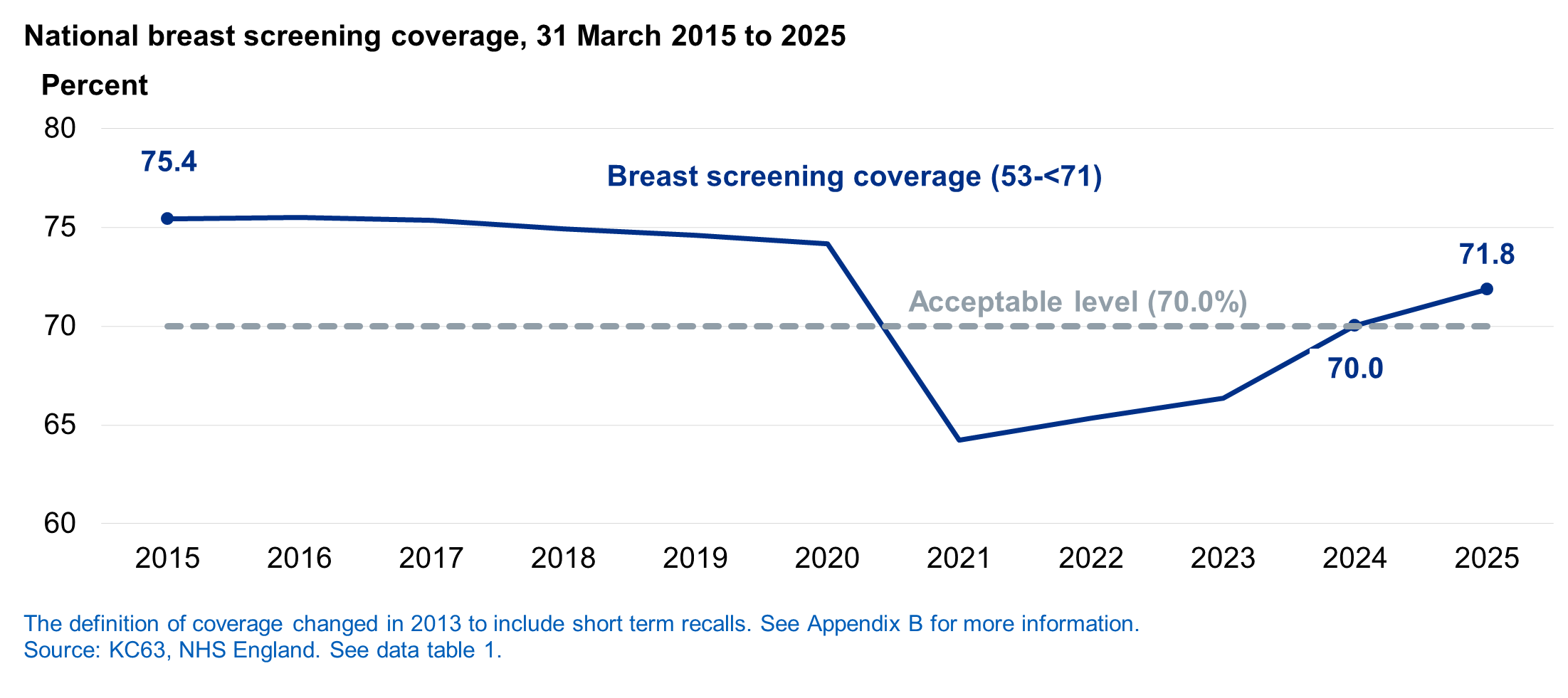
National coverage as at 31 March, 2015 to 2025
- In 2025, 6.67 million women were eligible for screening.
- Coverage was 71.8%, an increase of 1.8 percentage points from the previous year.
All breast screening services were impacted by disruption from the COVID-19 pandemic between 2020-21 and 2022-23 - see COVID impact summary for more details.
National and regional (ages 53 to <71)
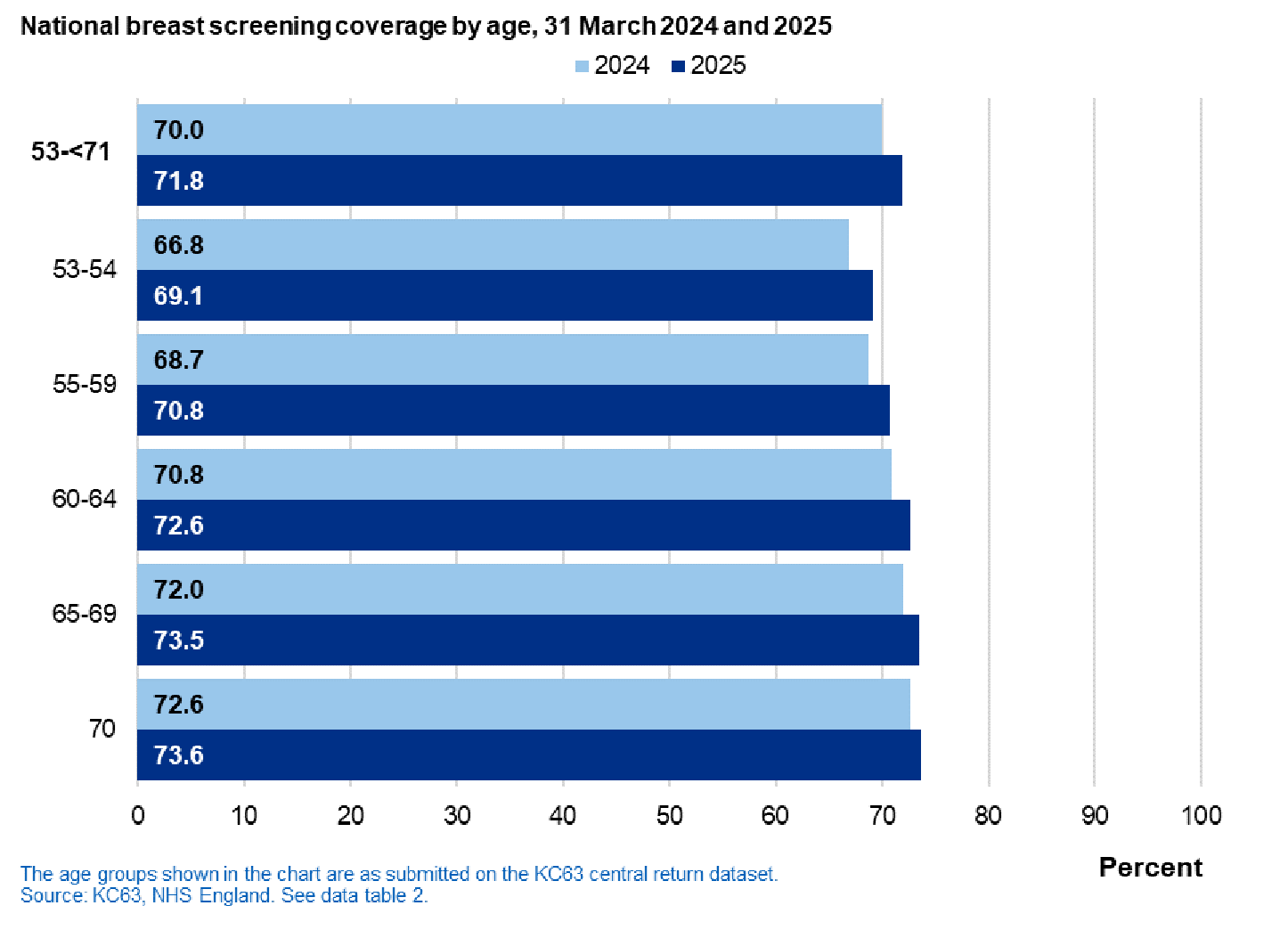
National coverage by age band, 31 March 2024 and 2025
- In 2025, coverage was highest amongst those in the 70-year age group and those aged 65-69 (73.6% and 73.5% respectively).
- Compared to 2024, coverage increased in 2025 for all age-groups within the 53 -< 71 age range.
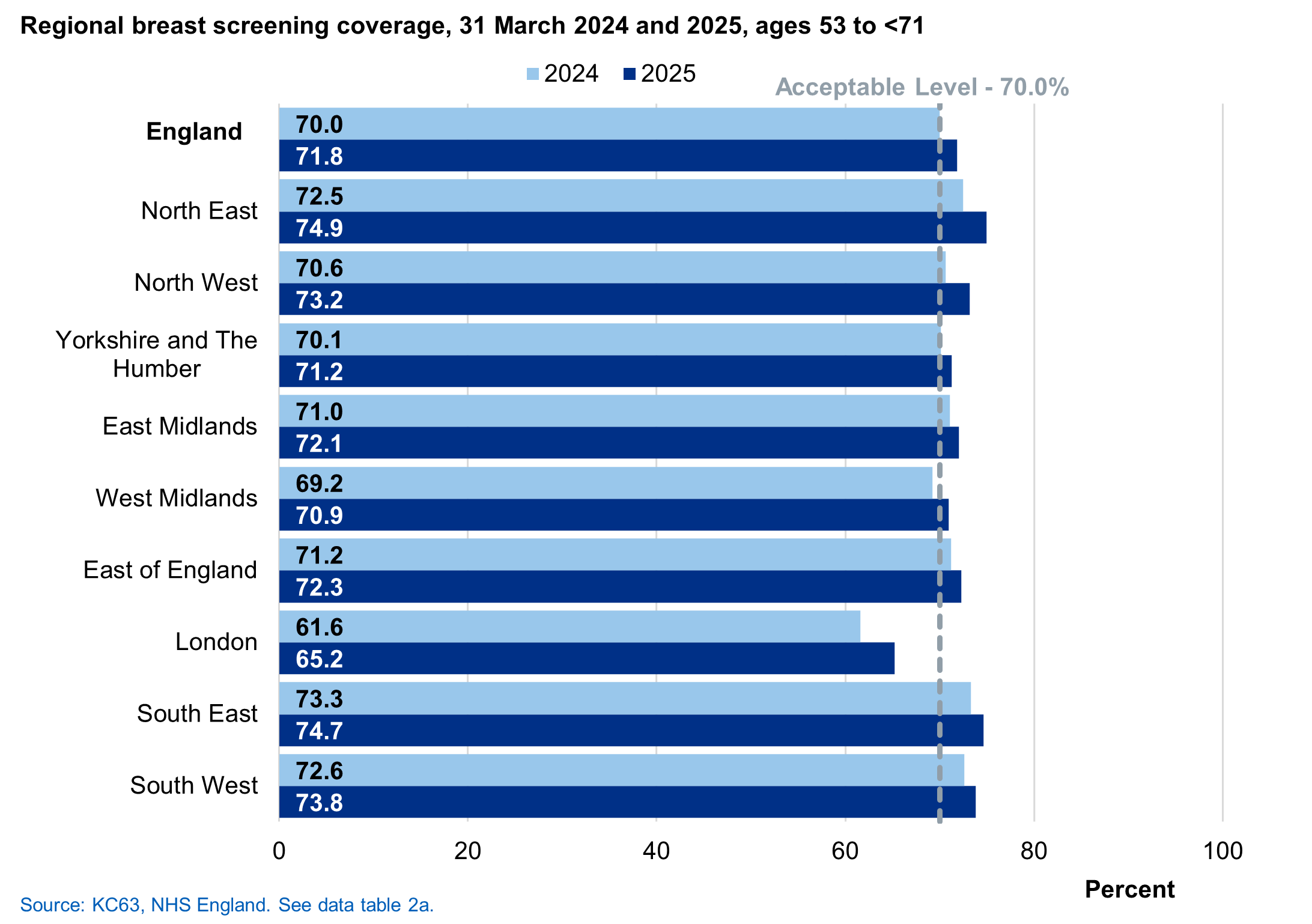
Regional coverage as at 31 March, 2024 and 2025
- In 2025, coverage increased in all regions. Coverage ranged from 65.2% in London to 74.9% in the North East.
Local authority (LA) (ages 53 to <71)
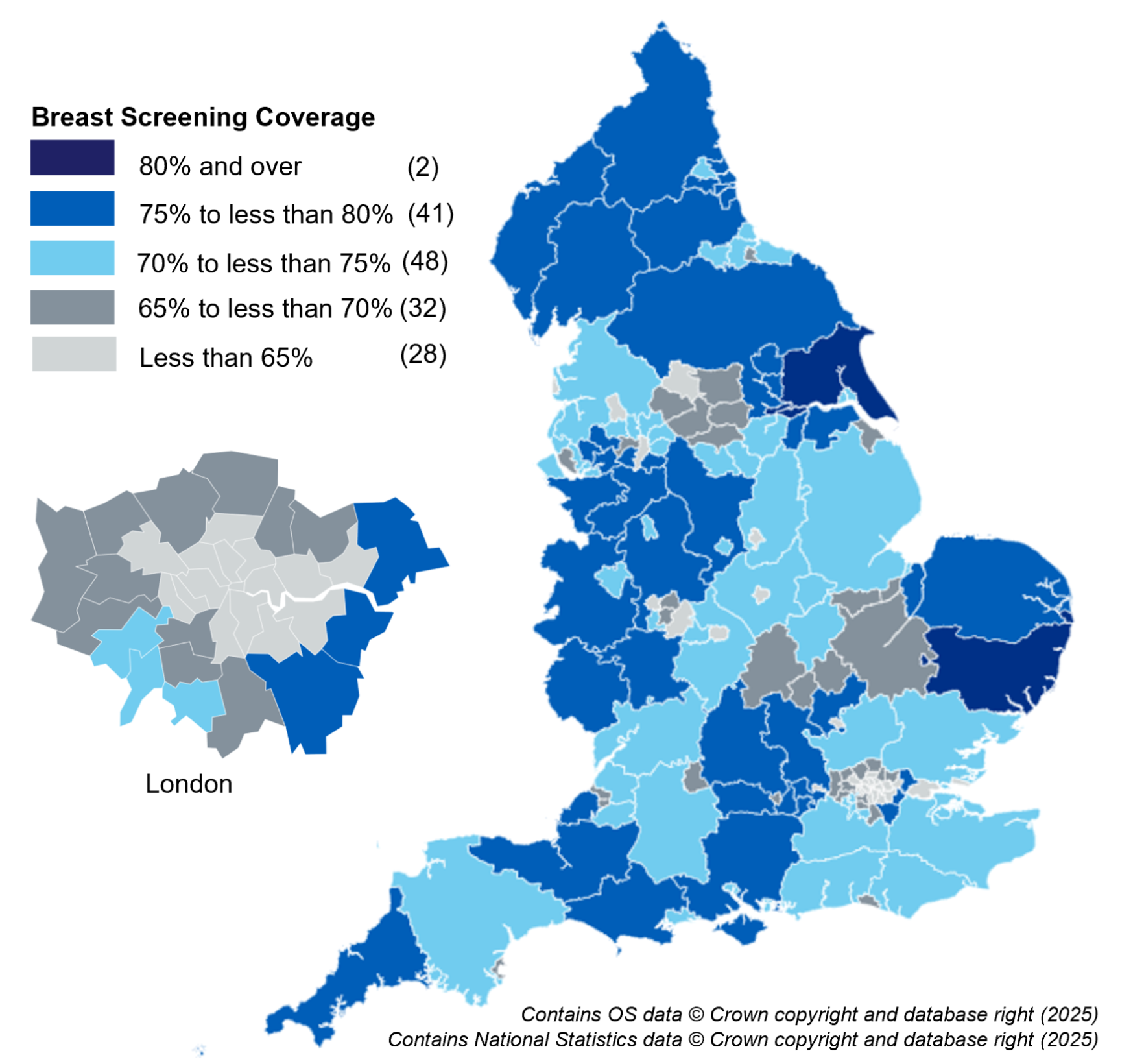
LA coverage as at 31 March 2025
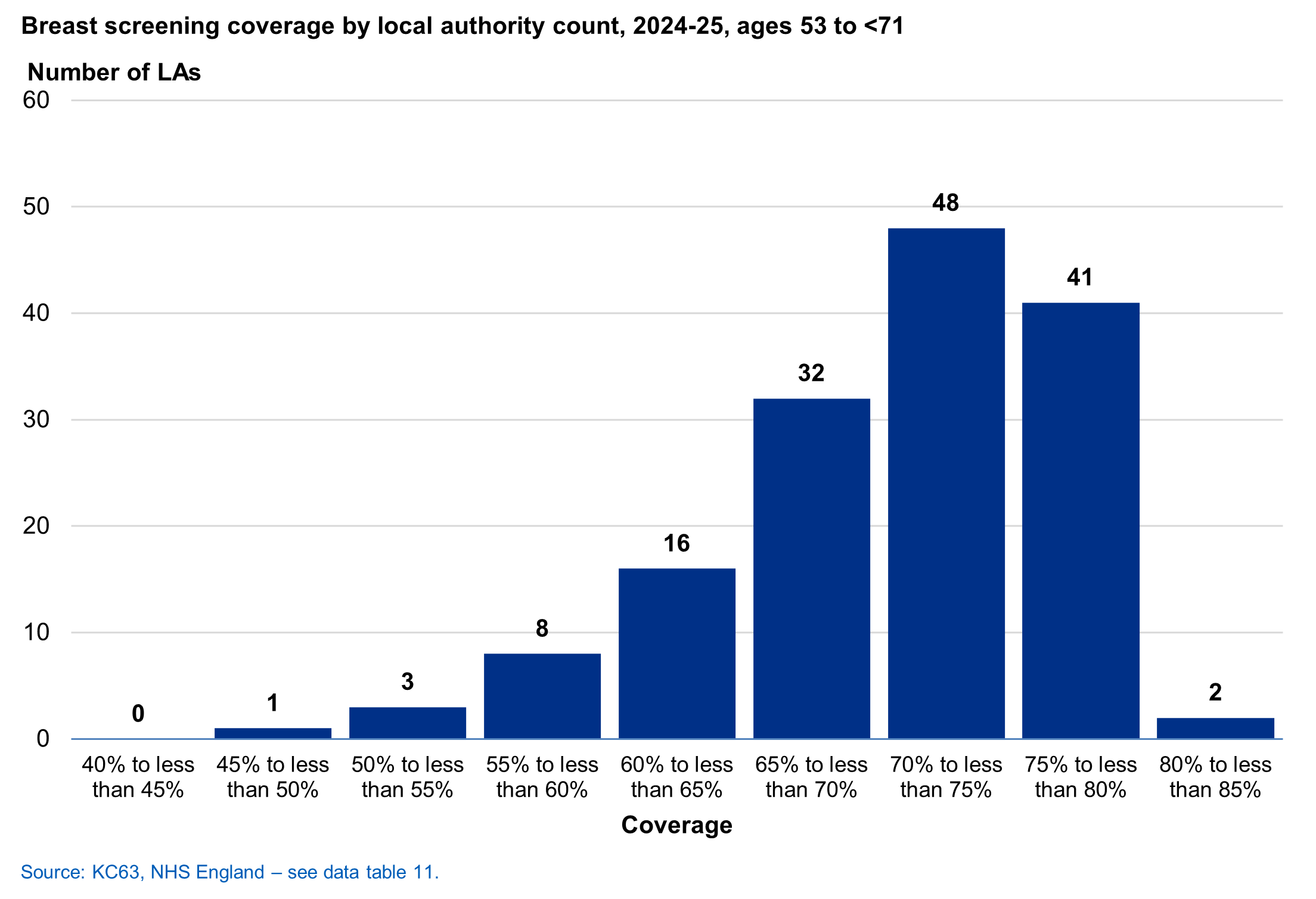
- 91 of 151 LAs reached the acceptable level of 70% coverage, an increase of 14 compared to 2024.
- 2 LAs reached the achievable threshold of 80%.
The Frequency chart below shows the number of LAs in each coverage category in 2024-25.
- The lowest coverage reported at LA level was 48.7% (Kensington and Chelsea), the highest was 81.6% (East Riding of Yorkshire).
- The full LA level data is available in table 11 of the data tables and the report dashboard.
Overall activity is measured for women aged 45 and over to include all screening activity; both those invited as part of the programme and those screened as a result of a self-referral.
- Since 2004, the programme screened women aged 50-<71 years.
- In 2009, the programme began to include a broader age range as part of the AgeX research trial, 47-49 years at the lower end and 71-73 at the upper end. Recruitment to the trial stopped in March 2020.
National activity, 2014-15 to 2024-25
- 2.15 million women aged 45 and over were screened within the programme in 2024-25, an increase of 10.3% from 2023-24.
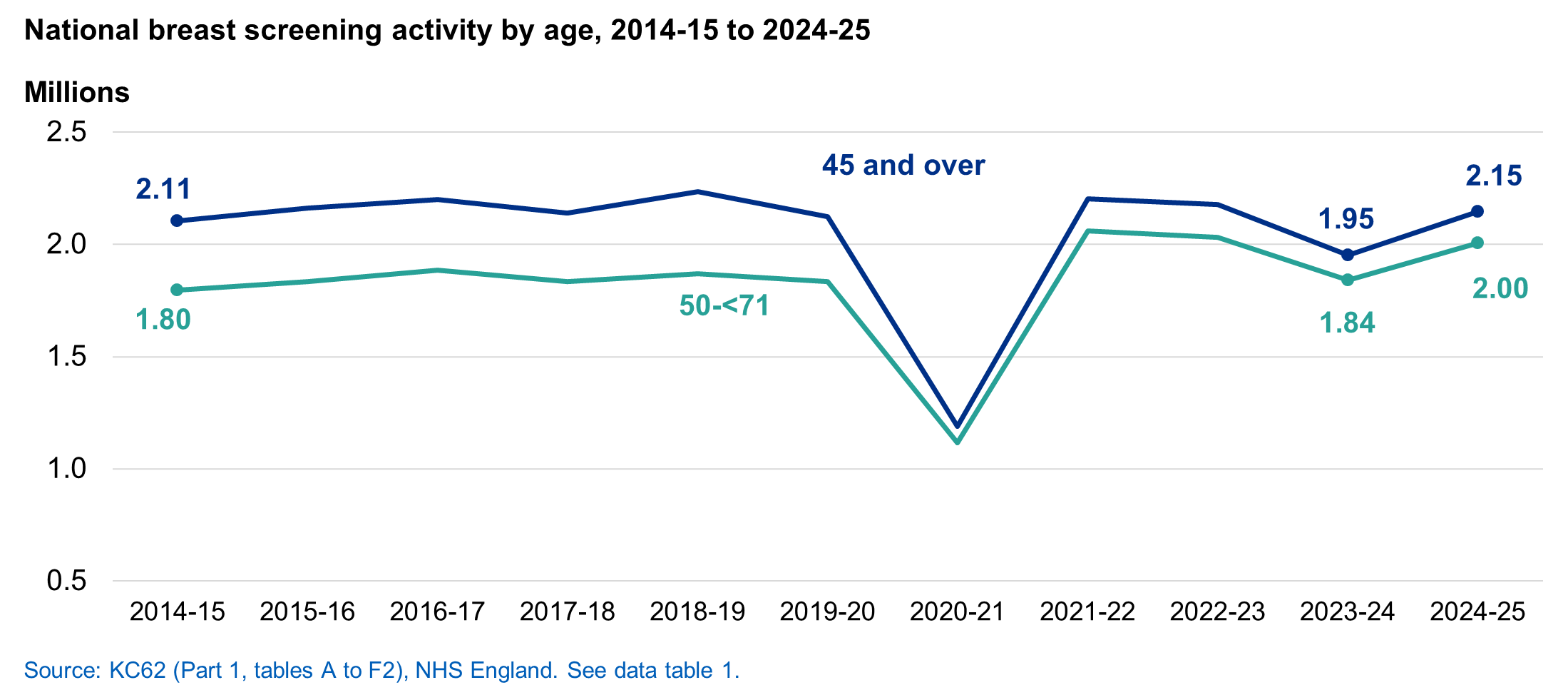
All breast screening services were impacted by disruption from the COVID-19 pandemic between 2020-21 and 2022-23 - see COVID impact summary for more details.
National Screening Activity (ages 45 and over)
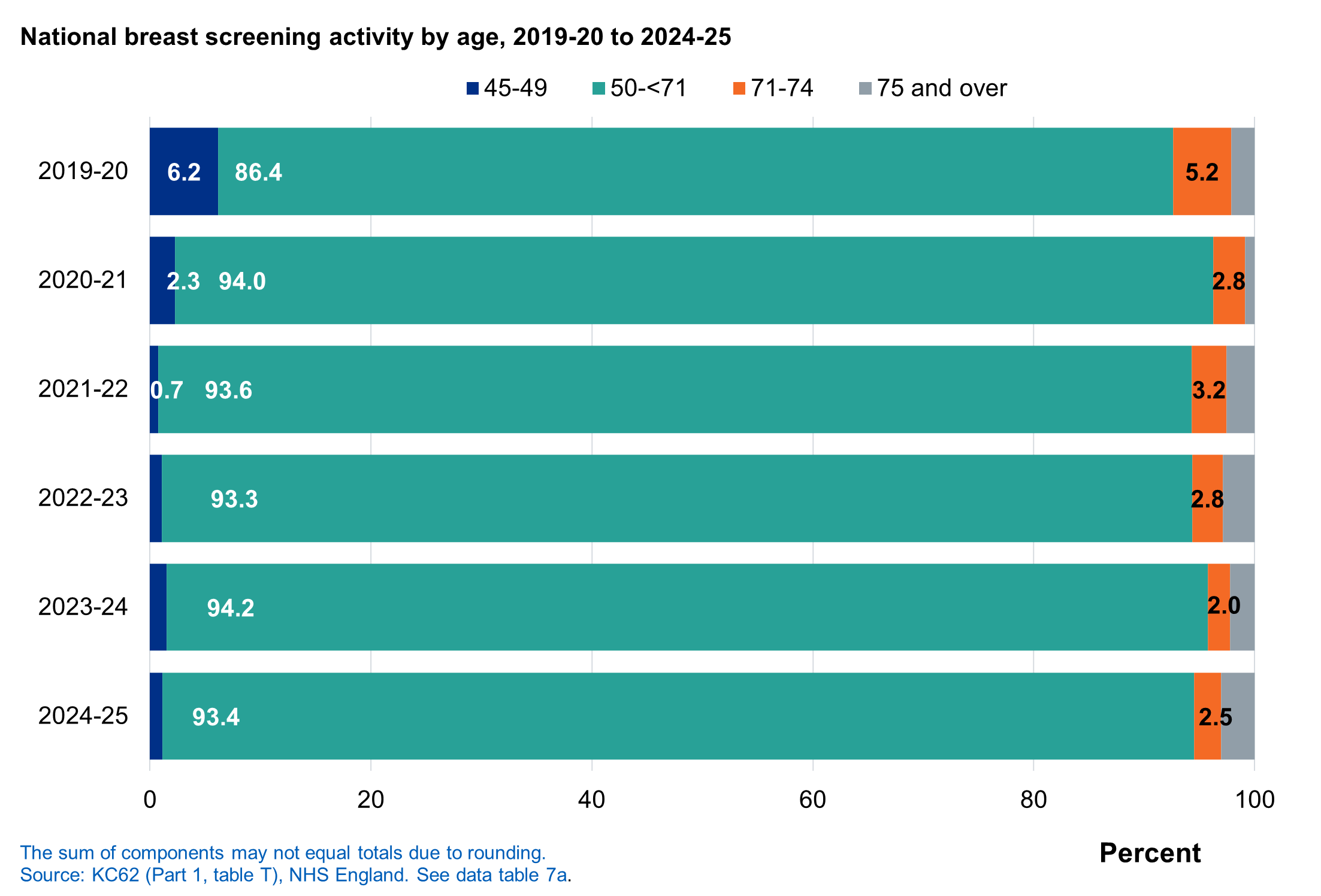
National activity, by age, 2019-20 to 2024-25
- In 2024-25, 93.4% of women screened were in the 50-<71 age category, 1.1% were in the 45-49 category, 2.5% were in 71-74 category and the remaining 3% were 75 and over.
-
The Age-X trial recruitment ceased in March 2020.
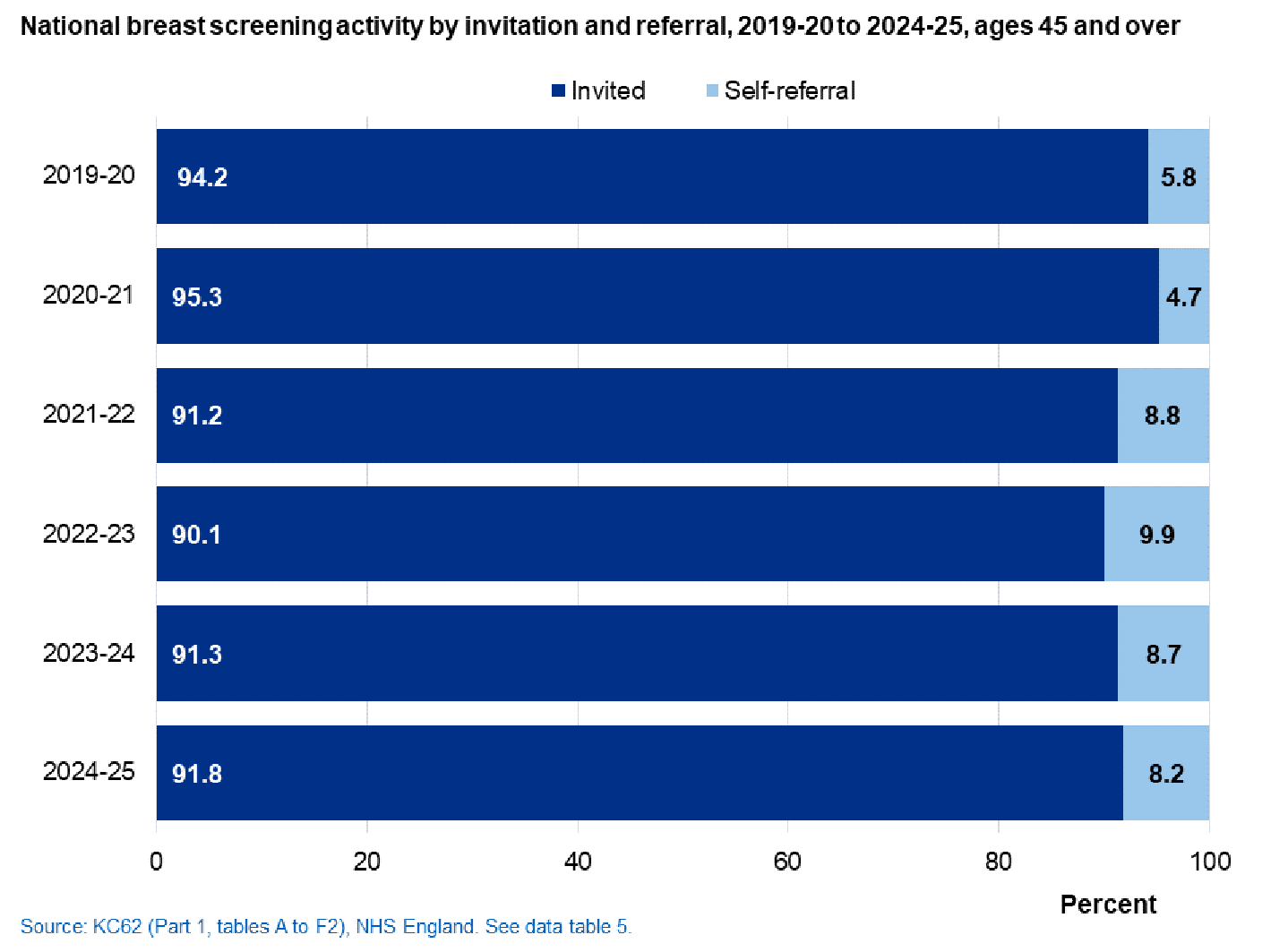
National activity, by invitation and referral, 2019-20 to 2024-25
- In 2024-25, 91.8% of women screened were invited as part of the programme; the remaining 8.2% were screened as a result of self-referral.
Self-referrals (ages 45 and over)
National activity for self-referral, by age, 2014-15 to 2024-25
The data collection definition is ‘self / GP referrals’, however, in all cases, it is expected that only self-referrals can be made directly to the local breast screening service. The report refers to 'self-referrals' rather than 'self / GP referrals'.
- In 2024-25, 175,351 women were screened as a result of a self-referral, an increase from 169,119 in 2023-24.
- 63.6% of self-referrals in 2024-25 were for women aged over 70 years.
- Between 2020-21 and 2022-23, there was an increase in the proportion of self-referrals in women of screening age (50<71 years). This has decreased in 2023-24 and decreased further in 2024-25.
- Women who self-refer are recorded in total screening activity, but are not included in invitation and uptake statistics due to their own request for screening. Consequently, the increase in self-referrals has a small negative impact on the rate of screening uptake nationally, as women aged 50<71 who self-refer and are screened are not included in national uptake statistics.
- Self-referrals are the most common point of entry to the screening programme for women aged 71 or over; these women are outside the target age group for invitation, but the programme does accept such referrals from this age group at three-yearly intervals. (See Appendix A).
- In 2020-21, there was a decrease in the number of self-referrals for all age groups. Contributory factors to this decrease include disruption from the COVID-19 pandemic, with services instructed to pause self-referrals for a number of months. See COVID impact summary for details.
Women are eligible to receive an invitation to be screened if they are in the screening age range (core 50 - <71), unless they are ceased due to having had bilateral mastectomies1 or individually opt out of screening3 or are ceased under a best interests decision.
The Age-X research trial, which invited women aged 47-49 and 71-73, ceased recruitment in March 2020.
National invites, 2023-24 and 2024-25
- In 2024-25, the number of women invited for screening was 2.80 million, an increase of 9.8% from 2023-24 (45-74 years).
- There were 10,662 invitations in the 71-74 age group in 2024-25, an increase of 10.4% from 2023-24.
The table below shows a breakdown of national invites by age for 2023-24 and 2024-25.
| Change from 2023-24 to 2024-25 |
|||||
| Age group | 2023-24 | 2024-25 | Number | % | |
| 45 and over | 2,548,823 | 2,795,460 | 246,637 | 9.7 | |
| 45-74 | 2,548,796 | 2,795,436 | 246,640 | 9.7 | |
| 45-49 | 43,658 | 34,258 | -9,400 | -21.5 | |
| 50-70 | 2,495,480 | 2,750,516 | 255,036 | 10.2 | |
| 71-74 | 9,658 | 10,662 | 1,004 | 10.4 | |
| Source: KC62 (Part 1, tables A to D) NHS England - see data table 4. | |||||
Invitations to screening
National, core programme (ages 50 to <71)
The programme categorises invitations into 5 groups, as summarised in the table (for further detail see Appendix C).
- In 2024-25, for women aged 50-<71 most invites (56.7%) were routine invitations to previous attenders where the last screen was within 5 years.
- The number of first invitations increased in 2024-25 by 6.9% from 2023-24.
- The majority of first invitations were to those in the 50-52 years age group, 328,338 in 2024-25 (up 7.4% from 305,716). See table 4 in data tables.
National invites, 2023-24 and 2024-25
The table below shows a breakdown of invitation type for 2023-24 and 2024-25 for those ages 50 to <71.
| 2023-24 | 2024-25 | ||||
| Type of invitation | Number (millions) |
% | Number (millions) |
% | |
| Total | 2.50 | 100.0 | 2.75 | 100.0 | |
| First invitation for routine screening | 0.35 | 14.1 | 0.38 | 13.7 | |
| Routine invitation to previous non-attenders | 0.35 | 14.0 | 0.38 | 13.7 | |
| Routine invitation to previous attenders (last screen within 5 years) |
1.42 | 56.8 | 1.56 | 56.7 | |
| Routine invitation to previous attenders (last screen more than 5 years) |
0.38 | 15.1 | 0.44 | 15.9 | |
| Short term recall | 0.00 | 0.0 | 0.00 | 0.0 | |
The sum of components may not equal totals due to rounding.
Source: KC62 (Part 1, tables A to D) NHS England – see data table 4.
Uptake is the proportion of eligible women who have a technically adequate screen ≤6 months of date of first offered appointment (see Appendix B).
Acceptable level is defined as attaining uptake levels of 70% or greater2.
Achievable level is defined as attaining uptake levels of 80% or greater2. All BSUs should be aiming for this standard.
One of the objectives of the screening programme is to maximise the number of eligible women who attend for screening. This is set out in the NHS Breast Screening Programme screening standards2. The performance levels provide a way to monitor progress.
Where ‘routine invitation’ is used this indicates that short term recall invitations4 are not included. Measurement of the national standard excludes short term recall invitations and self-referrals.
In September 2020, in response to COVID-19, open invitations were recommended rather than timed invitations to maximise utilisation of screening slots. This may have impacted uptake of invitations. See COVID impact summary for more details.
Uptake* of invitations
National and regional (ages 50 to <71)
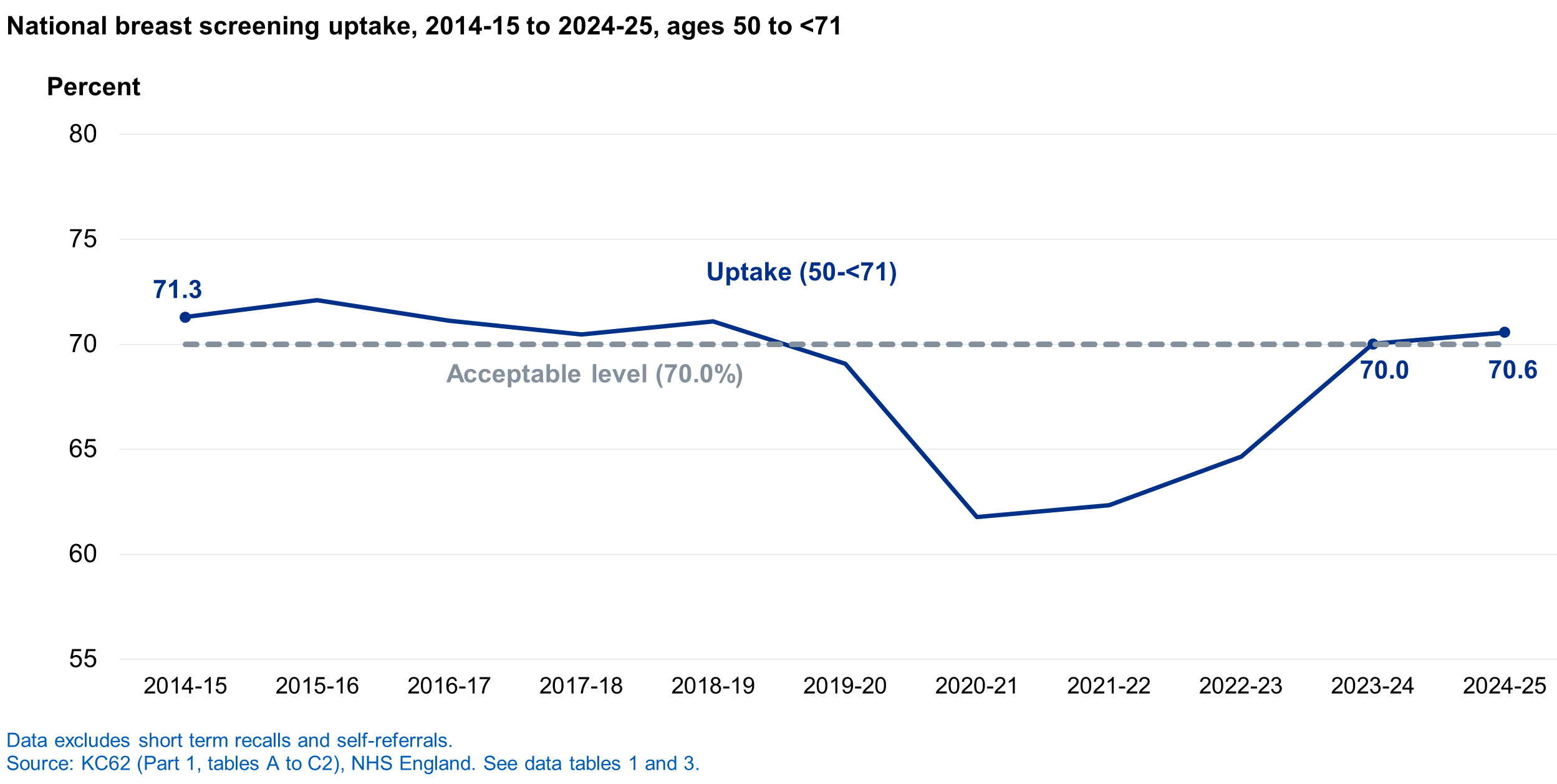
National uptake, 2014-15 to 2024-25
- In 2024-25, 1.94 million women who received an invitation** were screened by the programme up from 1.75 million in 2023-24.
- Uptake of invitations** increased to 70.6% in 2024-25, up from 70.0% in 2023-24.
Regional uptake, 2023-24 and 2024-25
- Uptake by women aged 50-<71 increased in all regions in 2024-25 except for Midlands where it reduced slightly and in South West where it stayed the same.
- Uptake ranged from 63.4% (London) to 73.3% (South East).
*All breast screening services were impacted by disruption from the COVID-19 pandemic between 2020-21 and 2022-23 - see COVID impact summary for more details.
** Invitation figure used to calculate uptake includes first and all routine invitations. This does not include short term recalls.
By invitation type
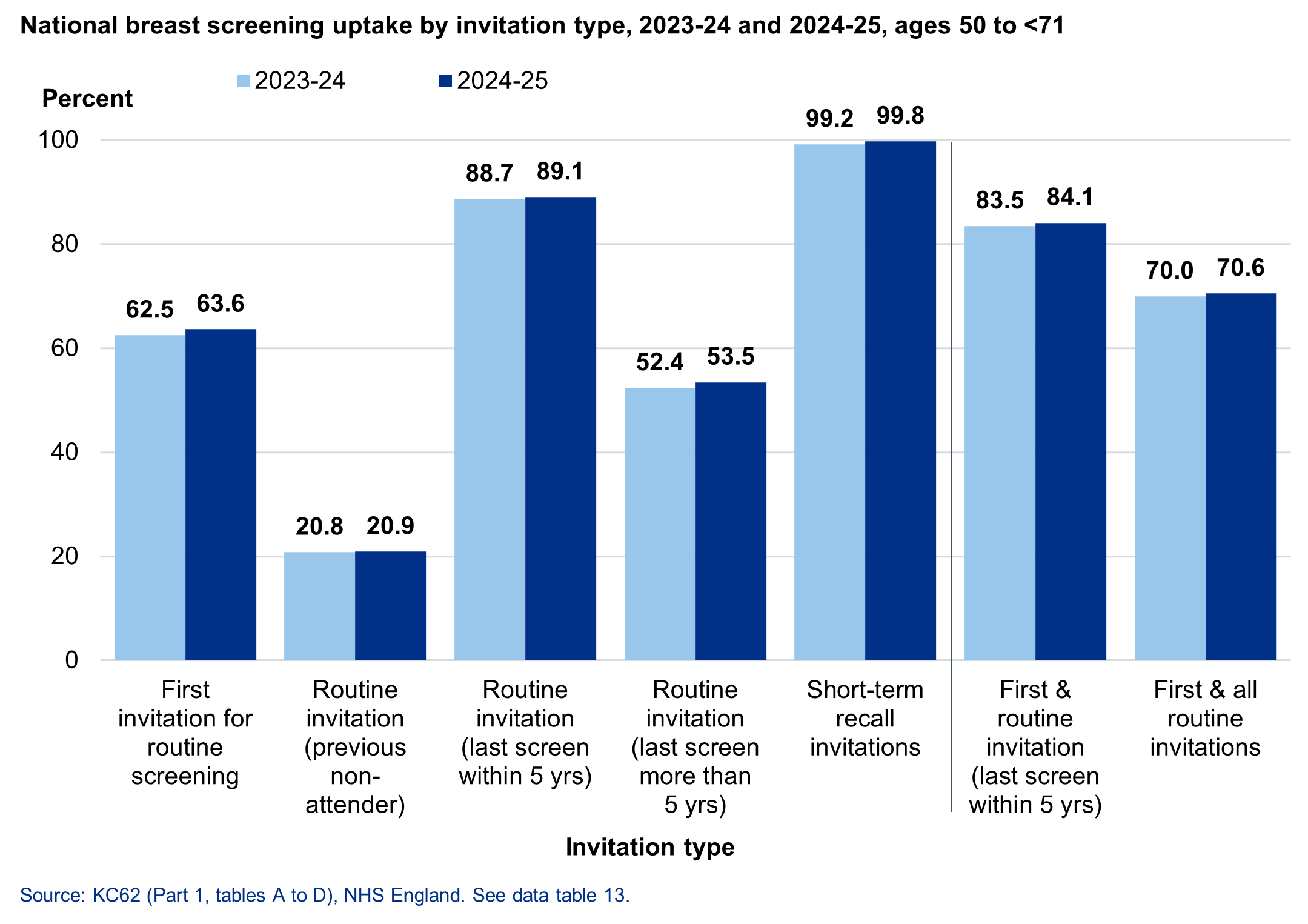
National uptake, 2023-24 and 2024-25, by invitation type, ages 50-<71
- 63.6% of women receiving their first invitation in 2024-25 were adequately screened.
- Uptake was lowest (20.9%) amongst women who received a routine invitation, having failed to respond to a previous invitation.
- Uptake was highest (99.8%) amongst those receiving short term recall invitations.
- Uptake has increased in every invitation type in 2024-25 when compared to 2023-24.
National uptake, 2014-15 and 2024-25, by invitation type
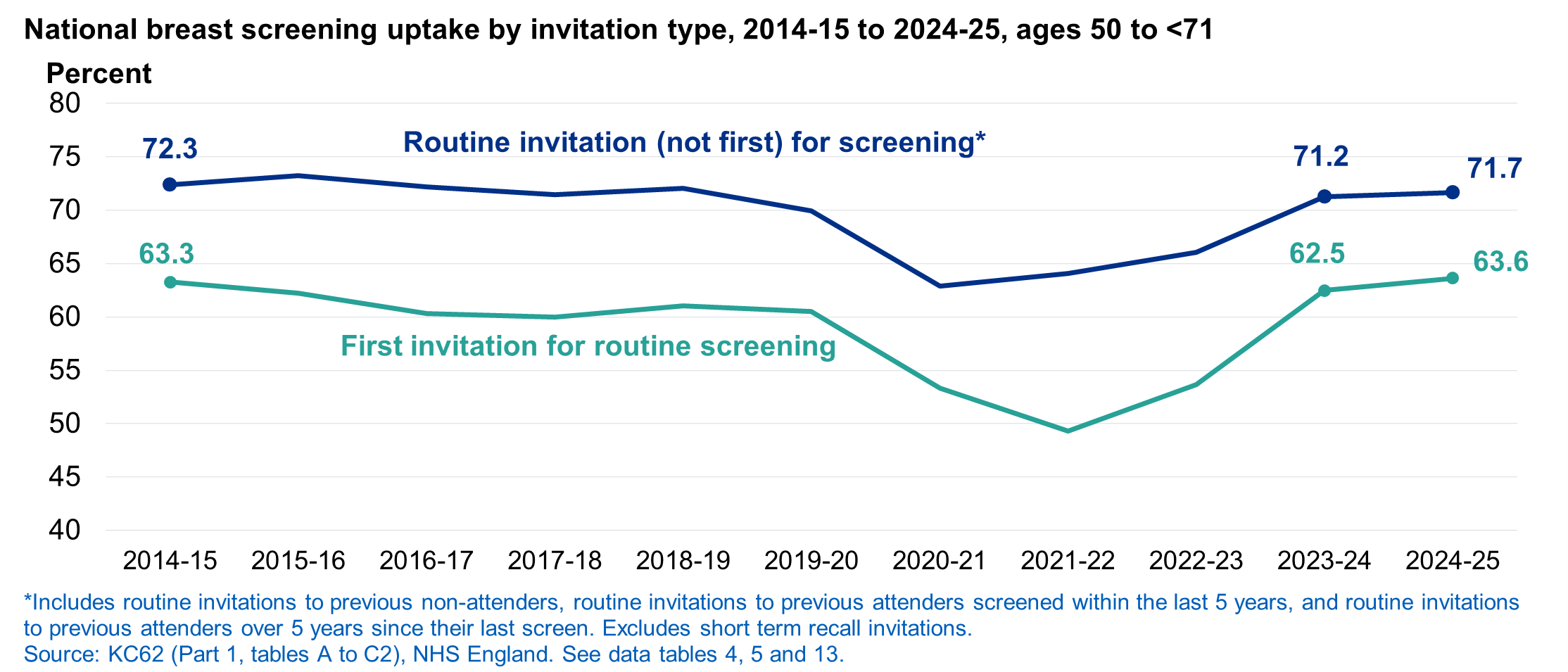
All breast screening services were impacted by disruption from the COVID-19 pandemic between 2020-21 and 2022-23 - see COVID impact summary for more details.
Breast screening service (ages 50 to <71)
National uptake, 2023-24 and 2024-25, by breast screening service
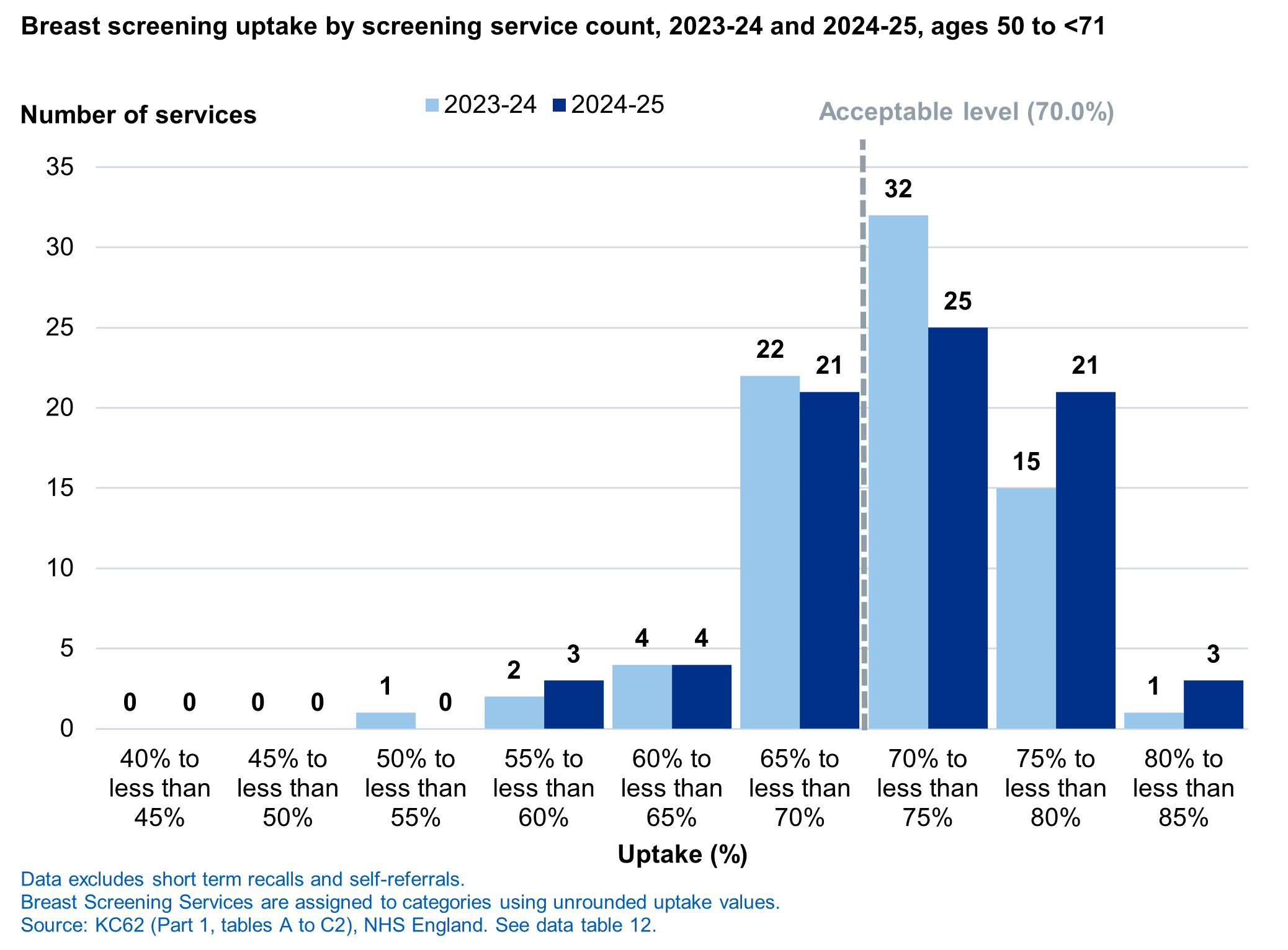
49 of 77 breast screening services reached the acceptable level of 70%, 1 breast screening service more than in 2023-24.
Uptake ranged from 55.8% to 81.0% at Breast Screening Service level.
National (ages 50 to <71)
National uptake, by age, 2024-25
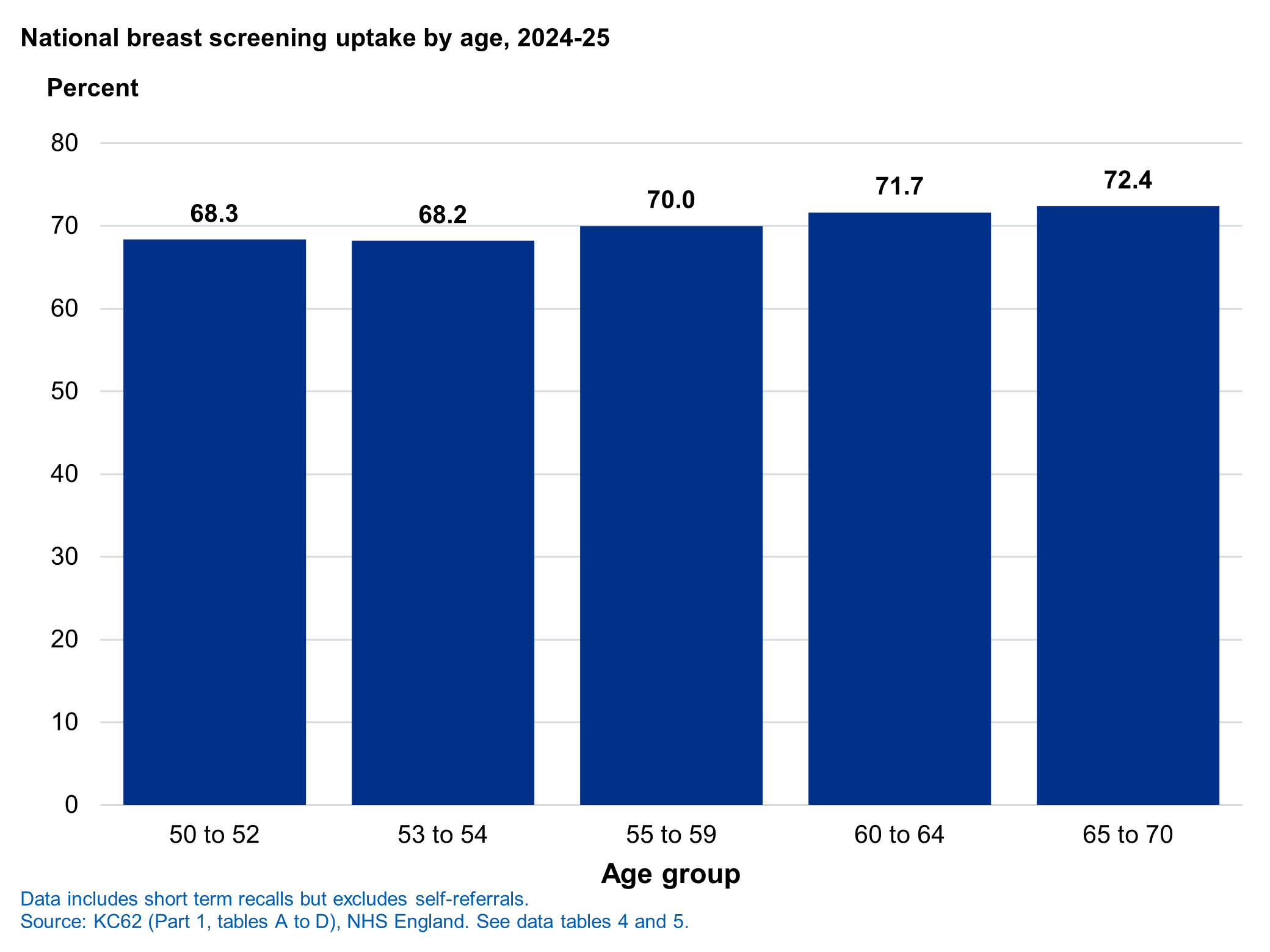
Uptake by women increased by age group, ranging from 68.2% (aged 53-54) to 72.4% (aged 65-70).
Women are referred to an assessment clinic for further tests if a potential abnormality is detected at initial screening (see Appendix A).
Referrals for assessment are reported by two distinct screening types as the percentage of referrals is expected to vary according to type:
Prevalent screening refers to first invitations for routine screening and invitations to previous non-attendees.
Incident screening refers to routine invitations to previous attendees screened.
The programme aims to minimise the adverse effects of screening, such as anxiety and unnecessary investigations, and therefore the number of women this affects through referral for assessment.
Outcome of screening
National, referrals for assessment (ages 45 and over)
- In 2024-25, 6.2% of women attending for the first time (prevalent screening) were referred for assessment.
- 2.7% of women who had been previously screened (incident screening) were referred for assessment.
| 2023-24 | 2024-25 | ||||||||
| Referred for assessment(a) | Referred for assessment(a) | ||||||||
| Type of invitation/referral | Number screened | Number referred |
% | Number screened | Number referred |
% | |||
| Total | 1,951,323 | 68,664 | 3.5 | 2,146,462 | 73,451 | 3.4 | |||
| Prevalent screens | 322,169 | 20,295 | 6.3 | 342,977 | 21,218 | 6.2 | |||
| 1st invitation for routine screening | 249,492 | 15,296 | 6.1 | 263,759 | 15,919 | 6.0 | |||
| Routine invitation to previous non-attenders | 72,677 | 4,999 | 6.9 | 79,218 | 5,299 | 6.7 | |||
| Incident screens | 1,459,516 | 40,055 | 2.7 | 1,627,617 | 44,583 | 2.7 | |||
| Routine invitation to previous attenders (within five years) |
1,261,527 | 32,069 | 2.5 | 1,392,938 | 35,764 | 2.6 | |||
| Routine invitation to previous attenders (more than five years) |
197,989 | 7,986 | 4.0 | 234,679 | 8,819 | 3.8 | |||
| Other Short term recall(b) |
519 | 500 | 96.3 | 517 | 496 | 95.9 | |||
| Self/GP referral (no previous screen) | 34,449 | 2,372 | 6.9 | 26,249 | 1,760 | 6.7 | |||
| Self/GP referral (within 5 years) | 91,410 | 3,222 | 3.5 | 111,074 | 3,478 | 3.1 | |||
| Self/GP referral (>5 years) | 43,260 | 2,220 | 5.1 | 38,028 | 1,916 | 5.0 | |||
(a) Including women referred for cytology, core biopsy or open biopsy. See glossary for more information.
(b) Women invited under short term recall are invited to an assessment clinic rather than to routine screening.
(c) The technical definition recorded in the dataset is 'self / GP referral', however, the activity recorded under this definition is expected to only self-referrals as GPs do not make referrals to the screening programme.
Source: KC62 (Part 1, tables A to F2) NHS England – see data table 6.
All breast screening services were impacted by disruption from the COVID-19 pandemic between 2020-21 and 2022-23 - see COVID impact summary for more details.
National, referrals for assessment by category (ages 45 and over), 2024-25
73,451 women were referred for assessment in 2024-25, up from 68,664 in 2023-24.
52.0% of women referred for assessment in 2024-25 underwent core biopsy and/or fine-needle aspiration cytology.
For further information see Appendix A.
1.1% of women referred for assessment were referred for open biopsy, down from 1.2% in 2023-24.
| Total referred for assessment(b) |
Referred for cytology and/or core biopsy(a) |
Referred for open biopsy |
||||
| Type of invitation/referral | Number | %(c) | Number | %(c) | ||
| Total | 73,451 | 38,196 | 52.0 | 831 | 1.1 | |
| Prevalent screens | 21,218 | 11,131 | 52.5 | 260 | 1.2 | |
| 1st invitation for routine screening | 15,919 | 8,210 | 51.6 | 191 | 1.2 | |
| Routine invitation to previous non-attenders | 5,299 | 2,921 | 55.1 | 69 | 1.3 | |
| Incident Screens | 44,583 | 22,913 | 51.4 | 504 | 1.1 | |
| Routine invitation to previous attenders (within five years) |
35,764 | 17,979 | 50.3 | 374 | 1.0 | |
| Routine invitation to previous attenders (more than five years) |
8,819 | 4,934 | 55.9 | 130 | 1.5 | |
| Other Short term recall |
496 | 85 | 17.1 | 4 | 0.8 | |
| Self/GP referral (no previous screen) | 1,760 | 912 | 51.8 | 19 | 1.1 | |
| Self/GP referral (within 5 years) | 3,478 | 1,979 | 56.9 | 31 | 0.9 | |
| Self/GP referral (>5 years) | 1,916 | 1,176 | 61.4 | 13 | 0.7 | |
(a) Including women referred for open biopsy after being referred for cytology and/or core biopsy.
(b) Including women referred for further imaging, or subsequently referred for cytology, core biopsy or open biopsy. See Appendix A for more information.
(c) The percentages for ‘Referred for cytology and/or core biopsy’ and ‘Referred for open biopsy’ are calculated using the total number of women referred for assessment as the denominator.
Source: KC62 (Parts 1 and 2, tables A to F2) NHS England – see data table 6.
National, short term recall outcomes (ages 45 and over), 2024-25
Amongst women who are referred for assessment following breast screening, a definitive diagnosis cannot be made in a very small number of cases. When this occurs women are recalled early for further assessment.
0.7% of women referred for assessment were recommended for short term recall.
| Assessment outcome - short term recall(a) |
|||
| Type of invitation / referral | Total referred for assessment(b) |
Number | %(c) |
| Total | 73,451 | 515 | 0.7 |
| Prevalent screens | 21,218 | 180 | 0.8 |
| 1st invitation for routine screening | 15,919 | 118 | 0.7 |
| Routine invitation to previous non-attenders | 5,299 | 62 | 1.2 |
| Incident screens | 44,583 | 275 | 0.6 |
| Routine invitation to previous attenders (within five years) |
35,764 | 218 | 0.6 |
| Routine invitation to previous attenders (more than five years) |
8,819 | 57 | 0.6 |
| Other Short term recall |
496 | 19 | 3.8 |
| Self/GP referral (no previous screen) | 1,760 | 9 | 0.5 |
| Self/GP referral (within 5 years) | 3,478 | 16 | 0.5 |
| Self/GP referral (>5 years) | 1,916 | 16 | 0.8 |
(a) Including all women whose final outcome was short term recall, whether after initial screen, assessment, cytology or biopsy (core or open).
(b) Including women subsequently referred for cytology, core biopsy or open biopsy. See Appendix A for more information.
(c) Note that the percentage of assessment outcomes that were ‘short term recalls’ is calculated using the total number of women referred for assessment as the denominator.
This differs from data tables 6, 7 and 7a where the denominator is the number of women screened.
Source: KC62 (Part 1, tables A to F2) NHS England – see data table 6.
Number of women with cancers detected
The number of women each year with cancer detected can be attributed to factors including changes to the number of women eligible for screening as a result of changes to the population.
Hence, as the population of women within the screening age range increases, the number of women eligible for screening will also increase. Therefore, the more women who are screened, the more potential cancers which will be detected. This is independent of the rate of detection
Rate of cancer detection
The cancer detection rate may be influenced by the following factors:
- The age distribution of women screened in any one year, as the incidence of breast cancer increases with age.
- The expansion of the screening programme to broader, largely older, age groups in the last ten years.
- Targeted awareness campaigns.
- The introduction of digital mammography in 2008 which was fully implemented by 2016.
National (ages 45 and over)
National detection, by age, 2023-24 and 2024-25
- In 2024-25, 19,291 women had cancers detected by the programme, a rate of 9.0 cases per 1,000 women screened (an increase from a rate of 8.5 in 2023-24).
- Amongst the core programme (50-<71 years), the detection rate was 8.6 per 1,000 in 2024-25 (an increase from a rate of 8.1 in 2023-24).
| 2023-24 | 2024-25 | ||||||
| Cancers detected | Cancers detected | ||||||
| Age group | Number screened | Women with cancer | Rate per 1,000 women screened | Number screened | Women with cancer | Rate per 1,000 women screened | |
| 45 and over | 1,951,323 | 16,677 | 8.5 | 2,146,462 | 19,291 | 9.0 | |
| 45 - 49 | 29,158 | 192 | 6.6 | 23,741 | 164 | 6.9 | |
| 50 - 70 | 1,838,932 | 14,970 | 8.1 | 2,004,644 | 17,213 | 8.6 | |
| 71 - 74 | 39,645 | 621 | 15.7 | 52,699 | 749 | 14.2 | |
| 75 and over | 43,588 | 894 | 20.5 | 65,378 | 1,165 | 17.8 | |
Source: KC62 (Parts 1 and 3, table T) NHS England - see data table 9a.
National detection, by age, 2014-15 to 2024-25
- The incidence of breast cancer detected through screening increases with age.
- In 2024-25, detection rates were lowest for women aged 45-49 (6.9 per 1,000) and highest for women aged 71 or over (16.2 per 1,000).
- All breast screening services were impacted by disruption from the COVID-19 pandemic between 2020-21 and 2022-23 - see COVID impact summary for more details.
National detection, by age (45 and over), 2024-25
- In prevalent screens, the rate of women aged 45 and over with cancer detected was 9.0 per 1,000 women screened. In incident screens, the rate was 8.4 per 1,000.
- The cancer detection rate was highest in short term recalls (38.7 per 1,000 women).
- It would be expected that the detection rate is highest for short term recalls as in these cases women have been referred for assessment following an abnormal mammogram but following further tests a definitive diagnosis could not be made. Short term recalls should be an exceptional outcome of assessment and will only occasionally occur.
| Rate per 1,000 women screened | ||||||||
| Type of invitation / referral | 45+ | 50-70 | 45-49 | 50-54 | 55-59 | 60-64 | 65-70 | 71+ |
| Total | 9.0 | 8.6 | 6.9 | 7.3 | 7.3 | 9.1 | 10.8 | 16.2 |
| Prevalent screens | 9.0 | 9.2 | 6.8 | 8.3 | 11.7 | 15.6 | 18.1 | 14.1* |
| 1st invitation for routine screening | 8.1 | 8.2 | 6.8 | 8.0 | 9.3 | 12.2 | 15.6 | 12.6* |
| Routine invitation to previous non-attenders | 12.2 | 12.2 | - | 9.8 | 12.2 | 16.8 | 19.3 | 23.8* |
| Incident screens | 8.4 | 8.4 | 30.3* | 5.7 | 6.8 | 8.8 | 10.6 | 9.5 |
| Routine invitation to previous attenders (within five years) |
7.9 | 7.9 | 41.7* | 5.7 | 6.5 | 8.2 | 9.9 | 9.1 |
| Routine invitation to previous attenders (more than five years) |
11.4 | 11.4 | - | 6.6 | 8.9 | 11.7 | 14.8 | 11.6* |
| Other Short term recall |
38.7* | 33.8* | - | 6.5* | 44.6* | - | 87.0* | 90.9* |
| Self/GP referral (no previous screen) | 12.5 | 10.8 | 20.0* | 9.4 | 11.1 | 13.8 | 17.6* | 27.7 |
| Self/GP referral (within 5 years) | 12.8 | 9.6 | - | 5.9 | 8.1 | 10.6 | 12.9 | 13.8 |
| Self/GP referral (>5 years) | 21.0 | 14.1 | - | 11.4* | 12.7 | 13.9 | 16.8 | 24.6 |
- = Zero.
* Rate based on fewer than 2,000 women screened.
Source: KC62, Parts 1 and 3 (tables A to F2, T) NHS England - see data tables 8 and 9a.
National (ages 45 and over)
The overarching aim of breast screening is to reduce mortality by finding breast cancer at an early stage when the changes in the breast are often too small to detect by hand.
Cancers are reported in two main categories, non-invasive and invasive. Invasive cancers are then reported by two further subcategories.
Non-invasive or micro-invasive cancer is one which demonstrates no or only very slight (<1mm) invasion into adjacent tissues.
Invasive cancer is one which has spread beyond the layer of tissue in which it has developed and is growing into surrounding, healthy tissues.
- Small invasive cancers (size of less than 15mm)
- Invasive cancers (size of 15mm or greater)
National detection, by cancer type or size, 2014-15 to 2024-25
In 2024-25, detection rates were highest for small invasive cancers (3.4 per 1,000 women) and lowest for non-invasive or micro-invasive cancers (1.8 per 1,000 women).
The breakdowns in the chart above exclude the subcategories ‘Invasive status not known’ (2 in 2024-25) and ‘Invasive – size not known’ (828 in 2024-25). See data tables 9a and 10 for full data.
All breast screening services were impacted by disruption from the COVID-19 pandemic between 2020-21 and 2022-23 - see COVID impact summary for more details.
National (ages 45 and over)
National detection, by type / size of cancer, 2023-24 and 2024-25
| 2023-24 | 2024-25 | ||||
| Type / size of cancer | Total with cancer | % | Total with cancer | % | |
| Total | 16,677 | 100.0 | 19,291 | 100.0 | |
| Invasive status not known | 4 | 0.0 | 2 | 0.0 | |
| Non-invasive or micro-invasive | 3,482 | 20.9 | 3,958 | 20.5 | |
| Total invasive | 13,191 | 79.1 | 15,331 | 79.5 | |
| Invasive – small (<15mm) | 6,161 | 36.9 | 7,357 | 38.1 | |
| Invasive (>=15mm) | 6,265 | 37.6 | 7,146 | 37.0 | |
| Size not known | 765 | 4.6 | 828 | 4.3 | |
Source: KC62 (Part 3, table T) NHS England - see data table 10.
NB: The sum of components may not equal totals due to rounding.
All breast screening services were impacted by disruption from the COVID-19 pandemic between 2020-21 and 2022-23 - see COVID impact summary for more details.
- In 2024-25, 20.5% of women aged 45 and over with cancer detected had non-invasive or micro-invasive cancers.
- 79.5% had invasive cancers of any size.
- Small invasive cancers accounted for 48.0% of all invasive cancers, and 38.1% of all cancers.
National (ages 50-<71), 2024-25
- At the prevalent screen, 27.7% of all cancers detected were non-invasive cancers and 30.9% were small invasive cancers.
- At the incident screen, 19.6% of all cancers detected were non-invasive cancers and 40.2% were small invasive cancers.
| Total with cancer |
Non-invasive or micro-invasive cancer |
Invasive cancer | ||||
| Total invasive(a) |
Small invasive (<15mm) |
Invasive (>=15mm) |
||||
| Type of invitation/referral | % of total with cancer |
% of total with cancer |
% of total with cancer |
% of total with cancer |
||
| Total | 17,213 | 21.0 | 79.0 | 38.2 | 36.7 | |
| Prevalent screens | 2,932 | 27.7 | 72.3 | 30.9 | 36.5 | |
| 1st invitation for routine screening | 1,969 | 29.8 | 70.2 | 31.4 | 34.6 | |
| Routine invitation to previous non-attenders | 963 | 23.4 | 76.6 | 29.8 | 40.5 | |
| Incident screens | 13,567 | 19.6 | 80.4 | 40.2 | 36.4 | |
| Routine invitation to previous attenders (within five years) |
10,902 | 19.9 | 80.1 | 41.1 | 35.5 | |
| Routine invitation to previous attenders (more than five years) |
2,665 | 18.2 | 81.8 | 36.5 | 40.2 | |
| Other Short term recall |
16 | 37.5 | 62.5 | 31.3 | 31.3 | |
| Self/GP referral (no previous screen) | 254 | 20.9 | 79.1 | 28.0 | 46.9 | |
| Self/GP referral (within 5 years) | 258 | 21.7 | 78.3 | 34.1 | 37.6 | |
| Self/GP referral (>5 years) | 186 | 17.7 | 82.3 | 28.0 | 48.9 | |
Source: KC62 (Part 3, tables A to F2, T) NHS England - see data tables 8, 10 and 10a.
(a) Includes some invasive cancers of unknown size.
National (ages 50-<71), 2024-25
- In 2024-25, small cancers (less than 15mm in diameter) accounted for 48.4% of those with invasive cancer.
- In prevalent screens this figure is 42.7%.
- In incident screens this figure is 50.0%.
| Total invasive |
Small invasive (<15mm) |
Invasive (>=15mm) |
Invasive (size unknown) |
|
| Type of invitation/referral | % of total invasive |
% of total invasive |
% of total invasive |
|
| Total | 13,596 | 48.4 | 46.5 | 5.1 |
| Prevalent screens | 2,120 | 42.7 | 50.5 | 6.8 |
| 1st invitation for routine screening | 1,382 | 44.7 | 49.3 | 6.0 |
| Routine invitation to previous non-attenders | 738 | 38.9 | 52.8 | 8.3 |
| Incident screens | 10,910 | 50.0 | 45.3 | 4.7 |
| Routine invitation to previous attenders (within five years) |
8,730 | 51.3 | 44.3 | 4.3 |
| Routine invitation to previous attenders (more than five years) |
2,180 | 44.7 | 49.1 | 6.2 |
| Other Short term recall |
10 | 50.0 | 50.0 | 0.0 |
| Self/GP referral (no previous screen) | 201 | 35.3 | 59.2 | 5.5 |
| Self/GP referral (within 5 years) | 202 | 43.6 | 48.0 | 8.4 |
| Self/GP referral (>5 years) | 153 | 34.0 | 59.5 | 6.5 |
Source: KC62 (Part 3, Tables A to F2, T) NHS England - see Data Tables 8, 10 and 10a.
Cancer detection rates in other UK countries
Women at higher risk are those who have been assessed by a specialist in genetics or oncology as being at greater risk of developing breast cancer than women in the general population6. Women at very high risk6 are eligible for screening in the NHS BSP and are screened as part of the programme.
Women at very high risk of developing breast cancer are offered breast screening at an earlier age and at different frequencies to women in the general population6.
In addition to a mammogram, these women may also be screened using a magnetic resonance imaging (MRI) scanner; a large tube surrounded by a strong magnetic field.
Since 2017-18, high-risk data in this section has been collected using a new and more comprehensive collection system.
2020-21 was the first year that the new breakdowns were available for use in the annual report.
By risk category
England, 2024-25
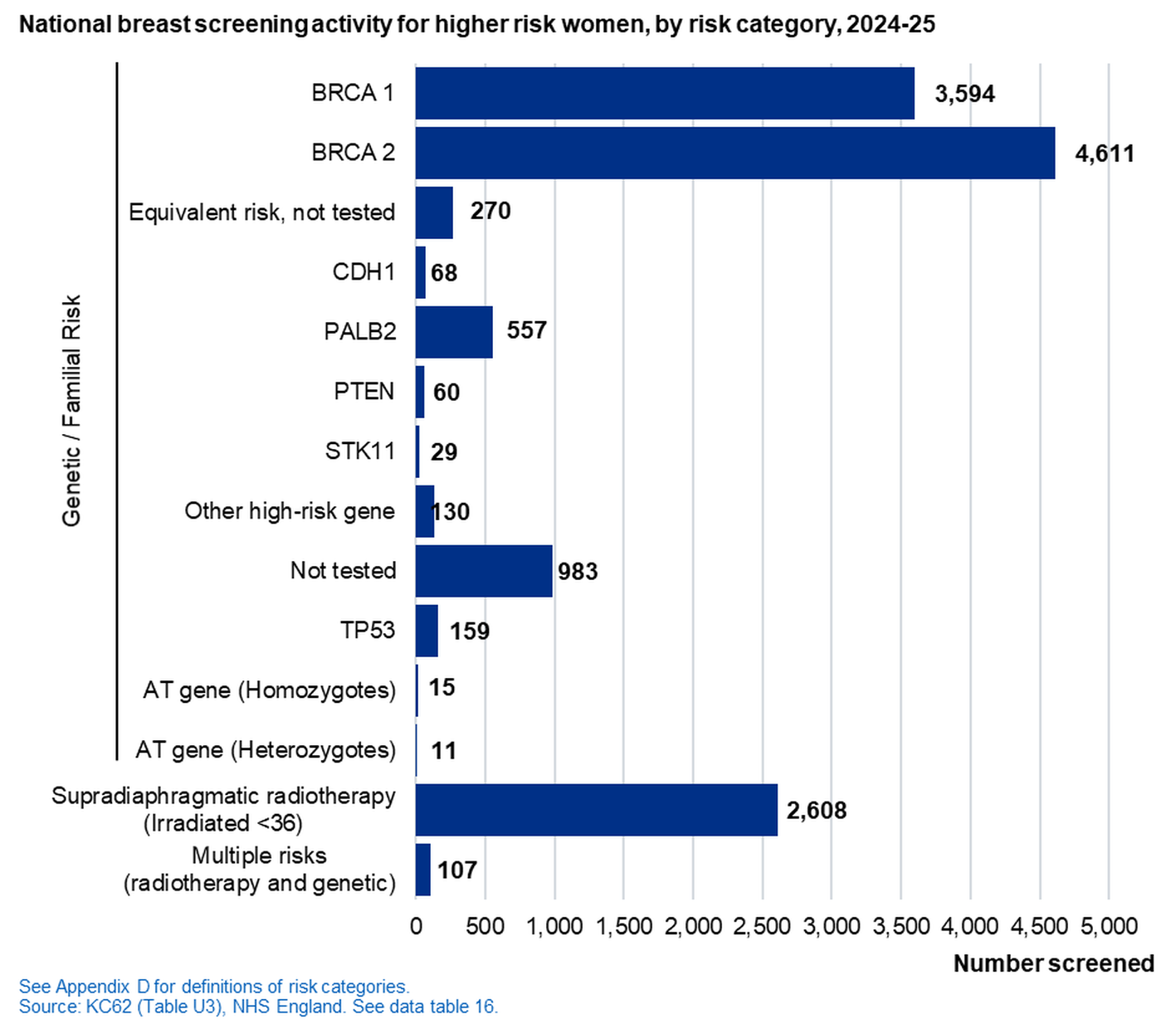
A total of 13,202 women at very high risk of developing breast cancer were screened in 2024-25. This is a 13.2% increase from 2023-24 (11,660 women at high risk screened).
Of those screened, the majority were in the BRCA 1 and BRCA 2 risk categories. Women in the BRCA 1 and BRCA 2 risk categories make up 78.2% of high risk women in genetic/familial risk categories and 62.1% of all women in high risk categories.

Cancer detection rates, by risk category
Cancer detection rates for the largest risk categories are presented in the table below.
| Rate per 1,000 women screened | ||||
| 2023-24 | 2024-25 | |||
| High risk category | Total Cancers(1) | Invasive Cancers(2) | Total Cancers(1) | Invasive Cancers(2) |
| All risk categories | 19.5 | 15.5 | 18.7 | 14.4 |
| Genetic / Familial Risk BRCA 1 |
20.5 | 16.6 | 22.3 | 17.5 |
| BRCA 2 | 22.4 | 18.7 | 20.0 | 15.0 |
| Untested gene / Equivalent risk | 13.1 | 8.4 | 8.8 | 8.0 |
| Radiotherapy (Irradiated <36) |
19.9 | 14.4 | 15.0 | 11.1 |
Source: KC62 (Table U3) NHS England - see data table 16.
(1)For comparison: in the routine screening programme, the national rate for cancers detected per 1,000 women screened in 2024-25, for women aged 45 and over is 9.0.
(2)For comparison: in the routine screening programme, the national rate for invasive cancers detected per 1,000 women screened in 2024-25, for women aged 45 and over is 7.1.
BRCA1 = Breast cancer gene 1, BRCA 2 = Breast cancer gene 2
By region
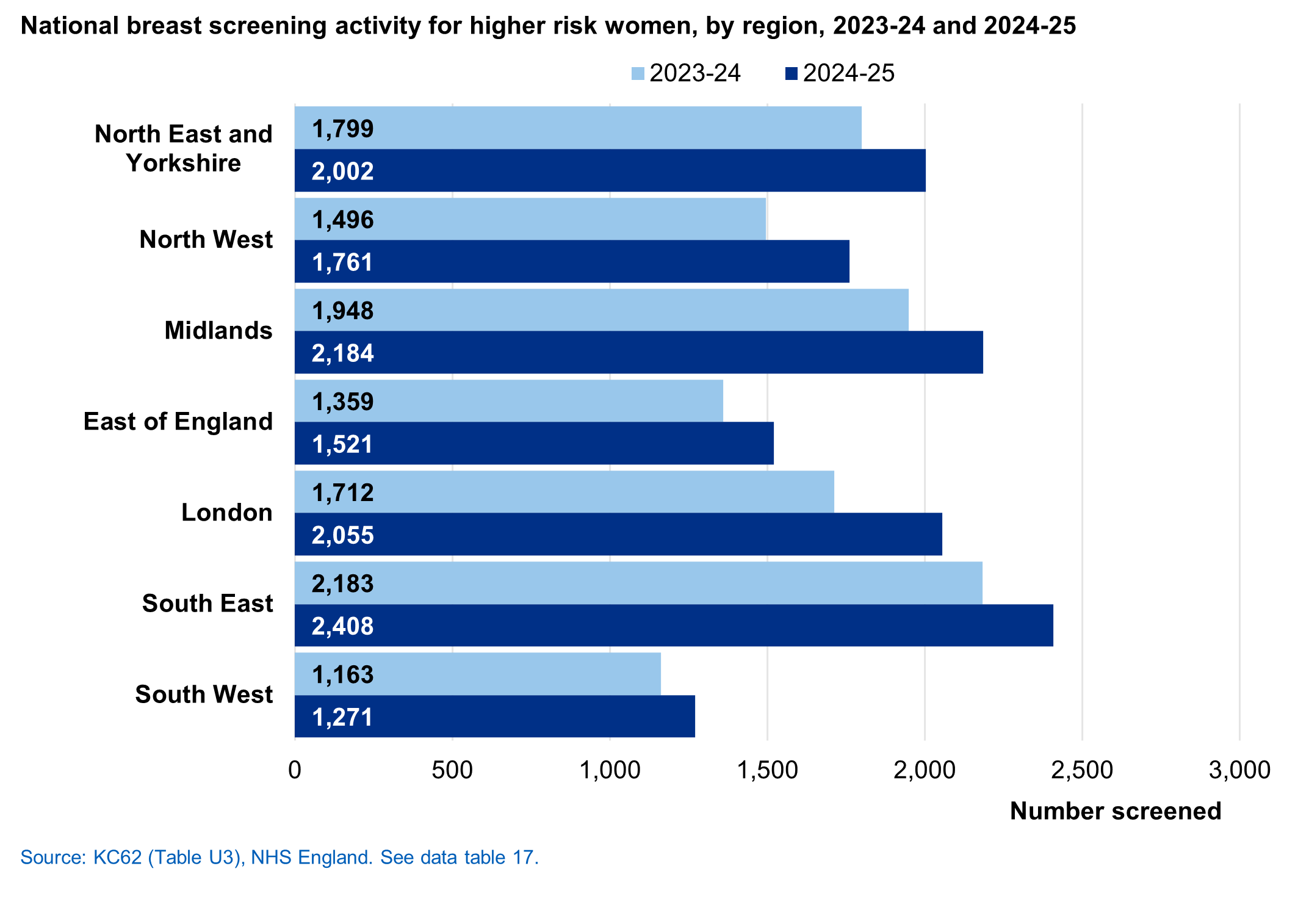
England, 2024-25
The South East region had the greatest number of women screened who were at higher risk of developing breast cancer.
Glossary
Assessment ‘Further diagnostic tests’ that do not include ‘repeat examinations’2
Benign Not cancer. Not malignant. A benign tumour does not invade surrounding tissue or spread to other parts of the body7 .
Bilateral mastectomy Surgical removal of both breasts.
Biopsy A medical procedure that involves taking a small sample of tissue so that it can be examined under a microscope7.
Breast Screening Service In 2024-25 there were 77 breast screening services in England which deliver local screening programmes. These were referred to as Breast Screening Units (BSUs) in previous publications.
Coverage The percentage of women in the population who are eligible for screening at a particular point in time (31 March 2025 in this report), who have had a test with a recorded result at least once within the screening round, i.e. in the previous three years. Currently coverage is best assessed using the 53-70 age group.
Cytology The medical and scientific study of cells. A branch of pathology, the medical specialty that deals with making diagnoses of diseases and conditions through the examination of tissue samples from the body7.
Eligibility Women are eligible for screening when in the screening age range, unless they are ceased due to the following: women who have had bilateral mastectomies. In order for an invitation to be sent, an individual must be registered at a GP practice. Note: Women who are excluded due to a best interests decision or who request to opt-out from screening will no longer receive invitations for screening but are included in the eligible population.
Fine-needle aspiration cytology Where samples of breast cells or fluid are drawn off through a very fine needle.
Incident Screening Screening of women who have been previously screened within the NHS Breast Screening Programme. In this statistical bulletin, incident screening figures relate only to routine invitations to previous attenders last screened within five years.
Invasive cancer Cancer which has spread beyond the layer of tissue in which it developed and is growing into surrounding, healthy tissues.
Magnetic resonance imaging (MRI) A type of scan that uses strong magnetic fields and radio waves to produce detailed images of the inside of the body8
Mammogram X-rays of each breast. Mammography can detect small changes in breast tissue which may indicate cancers which are too small to be felt either by the woman herself or by a doctor5.
Mastectomy Surgical removal of the whole breast.
Non- or micro-invasive cancer A cancer which demonstrates no or only very slight invasion into adjacent tissues by malignant cells of a carcinoma in situ.
Open biopsy A minor operation to take one or more samples of tissue under general anaesthetic. Also known as excision or surgical biopsy.
Prevalent screening Screening of women never previously screened within the NHS Breast Screening Programme. In this statistical bulletin, prevalent screening figures relate to first invitations for routine screening and routine invitations to previous non-attendees.
Repeat examinations Repeat examinations include both those images repeated with the same view while the woman is still present in the unit, and those occasions when a woman is required to attend a second time to have a film repeated (same view) because of a technical inadequacy9.
Short term recall A second invitation to attend an assessment clinic at less than the routine (three year) screening interval9 .
Technically adequate screen A technically adequate screen is defined as one which gives sufficient detail to allow a decision to be made to refer for assessment or to return to a routine recall status.
Uptake The percentage of eligible women invited for screening in the year, who were screened adequately within six months of invitation10.
1. See glossary for definition of eligibility.
2. Programme screening standards valid for data collected from 1 April 2021 https://www.gov.uk/government/publications/breast-screening-consolidated-programme-standards
3. https://www.gov.uk/government/publications/opting-out-of-breast-screening
4. Short term recall is a second invitation to attend an assessment clinic at less than the routine (three year) screening interval
5. NHS Cancer Screening Programmes: https://www.nhs.uk/tests-and-treatments/breast-screening-mammogram/
6. See https://www.gov.uk/government/publications/nhs-breast-screening-high-risk-women and https://www.gov.uk/government/publications/breast-screening-higher-risk-women-surveillance-protocols and Eligibility criteria and screening protocols for women at very high risk of breast cancer - GOV.UK
7. National Cancer Institute: https://www.cancer.gov/publications/dictionaries/cancer-terms
8. NHS Choices - https://www.nhs.uk/tests-and-treatments/mri-scan/
9. ‘Guidance for breast screening mammographers ’, NHS Breast Screening Programme https://www.gov.uk/government/publications/breast-screening-quality-assurance-for-mammography-and-radiography
10. ‘Clinical guidance for breast cancer screening assessment ’, December 2025, NHS Breast Screening Programme https://www.gov.uk/government/publications/breast-screening-clinical-guidelines-for-screening-management
Last edited: 30 June 2026 4:35 pm