Cloud Based Telephony in General Practice: Supporting Information
Guidance on using the Cloud Based Telephony in General Practice data, with details of what is included in the figures and what the data can and cannot tell you.
Cloud Based Telephony
This publication is classed as official statistics in development.
Official statistics in development are a series of statistics that are in the testing phase and not yet fully developed for several reasons, notably:
- This is a new collection, and not all suppliers of Cloud Based Telephony are sending data.
- Since the data collection is new, we are still evaluating the overall data quality, completeness, and coverage.
Users should be aware of the status and constraints of this data. The known limitations are explained in the data quality section below.
NHS England regularly ask for feedback from users of its publications, and we are particularly keen to receive comments and feedback on our experimental statistics, to help with further development.
Introduction
NHS England is collecting telephony data from all CBT system suppliers, including those on NHS England's Better Purchasing Framework (BPF). The monthly data collection collates metrics from GP practice systems to:
- support a better understanding of operational pressures in general practice
- support commissioning of local services
- inform service improvements
- understand the impact of service improvements on patient access, and
- facilitate better winter planning and demand management during periods of surge activity.
This information is published to understand more about the scale of patient demand for general practice services, in particular the number of calls into GP practices and how these are handled.
There are many suppliers of Cloud Based Telephony Systems for GP practices. More information about system suppliers is available in the Data Quality section. We are working with suppliers to enable the provision of data, and as data becomes available it will be included.
It is important to note that the data items collected, and overall system functionality varies by supplier and by practice.
Publication coverage
What this data can tell you
The publication will present a high-level time series from October 2024 onwards, showing monthly counts of:
- Practices
- open practices
- practices that have agreed to participate in the collection and whether any information has been suppressed
- practices for which their telephony supplier has provided data
Data provided by the digital telephony system suppliers enables the following information to be derived:
- Calls into the practice
- total Inbound calls
- total calls leaving the system via the Interactive Voice Recognition (IVR)* where the patient has been directed to a service without reaching the receptionist
- total calls being answered, the wait time for those calls to be answered and the duration of the call
- total calls missed (ended whilst queuing to speak to a member of staff), and the time the patient waited on the call before hanging up
- calls resulting in a call back request and subsequent call backs made
- count and average of call outcome by weekday and time of call
*Abandoned in the Interactive Voice Response (IVR) stage of the call prior to joining the queue to be answered, in response to an automated message or diversion.
It is important to note that no patient identifiable or patient-clinical information is collected or available in this release.
What this data cannot tell you
This data cannot tell you:
- the reason for the call, for example whether the call was to request an appointment, enquire about registering as a new patient
- who made the call, for example whether this was a patient, someone providing a service to the GP practice such as maintenance or business support or a call unrelated to the services provided
- information recorded on any conversations that happen during the call or actions resulting from these conversations, for example an appointment being booked with a clinician, the patient being given some test results or signposting the patient to a different service
- who answered the call, for example whether the call answered by a receptionist, a clinician or another member of practice staff
- the number of unique numbers calling into the GP surgery - this data collects only the number of calls into the GP practice, so this could include the same person ringing more than once resulting in different outcomes
Cloud based Telephony System Supplier(s)
Practice coverage
Data will be available only for practices that have agreed to participate in the collection and given their consent for their system supplier to submit data on their behalf. Practices that are yet to sign up are encouraged to do so to meet their contractual obligations and improve the national understanding of patient demand as well as system availability and usage.
Practices with the following criteria have been excluded from the publication:
- inactive and closed practices
- practices with an appointment rate of less than 1 call per registered patient per year
This will exclude practices with a zero-list size.
Cloud Based Telephony system suppliers are providing the data directly. Where a supplier is not yet able to provide this information, but the practice has agreed to participate the data will be included once the system supplier can provide the data.
This data is provided by Cloud-Based Telephony Suppliers by account which are then mapped to the GP Practices that the account services. Most accounts have a single practice assigned to it but in some instances, there can be up to 10 practices using one phone system. In the cases where there is more than one practice to account, we cannot disaggregate the calls and assign them correctly to each practice and so the Practice Code has been set to unassigned, these have been grouped together and included in the publication as an “unassigned” category.
Data has been included as it becomes available and so there has been a phased approach to onboarding suppliers, please take note of this as the increase in calls is largely due to the increase in coverage over time. The coverage appears in the main summary table across all months.
This spreadsheet provides information on GP Practices in scope for this data collection and details which practices have agreed to participate, whether the supplier has submitted data, and if the Practice Code has been set to “unassigned” (due to the account having more than one practice).
Supplier Coverage
Since October 2024, NHS England has been onboarding call data from the following suppliers:
- Abzorb Systems Ltd
- Babblevoice
- Check Communication
- Ctalk Limited (Health24)
- Firstcom Europe*
- Gamma (resellers)
- ITS Digital
- MPS Networks Ltd
- MidMedway*
- Redcentric
- Firstcom Europe*
- Tailor Made Technologies*
- X-on Health
* These suppliers have not been able to submit data and are still developing their reports and submissions but are engaged with the collection and will be providing data in the future.
Data quality
This is a new dataset and data quality is likely to be variable. We are working with suppliers to ensure the data is provided consistently across suppliers and completed to a high standard and to improve the overall coverage of the data.
The data is collected from system suppliers and the system’s primary focus is to deal with calls. We have provided guidance to help determine the call flows we would like to record as part of this collection. More information on the data specification can be found on our website: Cloud-Based Telephony Data Collection.
The Cloud Based Telephony systems are very dynamic and flexible meaning that the systems offered to practices can be configured by the provider and also practices can configure them to suit their needs. Given this some caution should be borne when comparing practice data.
There are some known data quality issues with the data and we have listed these below. Any decisions or comparisons between practices should bear this in mind. The data has been included in the publication so that it is visible and data quality can improve over time. These are official statistics in development and therefore caution should be taken when comparing data. This list may not be exhaustive and if you have any feedback on the data please email us at [email protected]
- Time of call, some calls in the data appear in the wrong time buckets, this is a small number of calls.
- All Inbound Calls (CBT001) should be accounted for in the calls outcomes. Those ended in the IVR (CBT002), Answered Calls (CBT003/CBT007), Missed Calls (CBT004) and Callbacks Requested (CBT005). There are a large number of practices where this is not the case and these are not equal. This can occur as when a call falls out of the usual call flow marker and cannot be assigned to a defined outcome or is assigned to more than one outcome in the call system due to the complexity of the call flows set up by the system and practice.
- Some of the suppliers have not been able to include direct dial calls into the practice (due to the way the systems are set up and how practices choose to use them).
- Approximately 600 practices have 0 callbacks requested, this may be because the practice has chosen not to use the callback functionality.
Other Useful Information
There are 7 separate metrics provided in the data collection by system suppliers. More information on the data specification can be found on our website: Cloud-Based Telephony Data Collection.
Inbound Calls (CBT001) – this is the total number of external inbound calls to the GP Practice, and this is provided by day and time bucket of call.
Calls ended in the IVR stage (CBT002) - these are calls where the patient/caller has ended the call during the call routing stage – for example when a patient listens to a message and presses a button to be diverted to another organisation, or when the patient decides to end the call after listening to an information message. This is provided by day and time bucket of call.
Answered calls (CBT003) - these are calls answered by a person within the GP practice. These are provided by day and time bucket of the call and the wait time the caller was waiting for the call to be answered from joining the queue or when the line started ringing.
Missed Calls (CBT004) – these are calls where the caller has expected to speak to a person either after going through the IVR and waiting in the queue or calling the GP surgery directly. These are provided by day and time bucket of the call and the wait time the caller was waiting before the call was ended (this includes voicemails). This wait time is measured from joining the queue or when the line started ringing.
Callback requested (CBT005) – these are calls where the caller has asked for a callback whilst waiting in the queue. These are virtual queue callbacks, and the system automatically calls the caller back when they have reached the front of the call queue.
Callback made (CBT006) – these are the automatic callbacks made from those where the caller requested a virtual queue call back.
Answered calls (CBT007) - these are calls answered by a person within the GP practice. These are provided by day and time bucket of the call and the duration of the call. This is provided as a separate metric to CBT003, and CBT007 and CBT003 should be equal to each other. However, there are instances where this is not the case. The specification was clarified in June 2025 and following this has improved with the majority of Suppliers providing matching totals for these metrics.
Call Outcomes
The 7 metrics collected, include four distinct call outcomes as a result of a call made to general practice (please note that the sum of the four outcomes may not equal the total inbound calls for some practices for more information please see the data quality section):
Calls dealt with by general practice:
- Answered calls: Calls answered by a practice staff member
- Calls ending during the IVR: Calls that end during the Interactive Voice Response (IVR) stage of the call - this may be as a result of being signposted to another service, the patient checking/verifying an existing appointment or being directed to another contact route, e.g. online consultation
- Calls resulting in a callback request: The caller is given the option to receive a callback from the practice when they reach the front of the queue, or at a specified time selected by the caller
Calls not dealt with by general practice:
- Missed calls: Calls which reach the call queue, but go unanswered by the practice, including voicemails. Voicemails have been included in missed calls as leaving a message may not fully resolve the patient’s enquiry or need and further contact with the GP Practice would be needed. For some practices voicemails will include a designated prescription ordering service which mean the patients leave a message to order and the enquiry has been dealt with.
There are further breakdowns of the answered and missed call outcomes collected:
Answered Calls (CBT003) is provided broken down by the waiting time to answer the call, this means we can provide the number of calls answered within given waiting time buckets.
Answered Calls (CBT007) is provided broken down by duration of the call, this provides the number of calls and how long the call lasted with practice staff, broken down by duration buckets.
Missed Calls (CBT004) is provided broken down by the waiting time to the call being ended without being answered. This means we can provide the number of calls missed within given waiting time buckets.
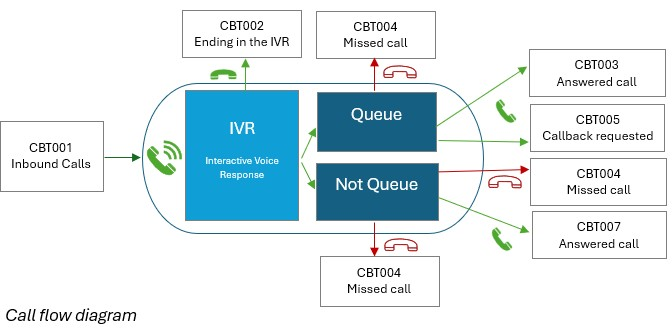
The call flow below illustrates the calls coming in to the General Practice.
inbound calls come into the practice and these can be dealt with via the Interactive Voice Recognition (IVR) stage. Calls not dealt with in the IVR stage may then join a queue or ring directly through to a member of staff. Calls ending before being answered whether they joined the queue or not are classed as missed calls. Calls in the queue maybe offered an option for a call back - these calls will automatically be called back when the caller would have reached the end of the virtual queue, and those answered are classed as answered calls.
Last edited: 6 May 2026 3:39 pm