Urgent care self-service
A digital triage tool (also known as Streaming and Redirection) that helps urgent and emergency care settings safely prioritise, redirect and schedule patients based on clinical need.
About this service
The urgent care self-service (also known as Streaming and Redirection) is a clinically driven digital triage tool designed to improve safety and efficiency across urgent and emergency care. It provides a digital front door for patients to check in and complete a short, guided triage, enabling faster prioritisation and smoother patient journeys.
Who this service is for
You can use this service if you are:
- type 1 emergency department
- urgent treatment centre
- minor injury unit
Benefits
- Reduce crowding and improve safety in urgent care waiting rooms
- Enable patients to be prioritised quickly based on clinical need
- Improve patient experience through shorter waits and clear information
- Support staff by reducing manual triage workload
- Increase system efficiency by redirecting patients to appropriate services
- Improve 4-hour performance and flow across urgent and emergency care pathways
Features
- Patient self check-in and triage on arrival.
- Digital prioritisation based on presenting symptoms.
- Digital redirection to services such as Pharmacy First or an urgent treatment centre (UTC).
- Digital referrals to hospital systems via Booking and Referral Standard (BaRS)
- Automatic capture of demographics and NHS number.
- Consistent, clinically validated assessment model.
- Usable on tablets and kiosk devices in waiting areas.
How to access this service
This service can be accessed at the front door of Emergency Departments and Urgent Treatment Centres using the urgent care self-service.
How this service works
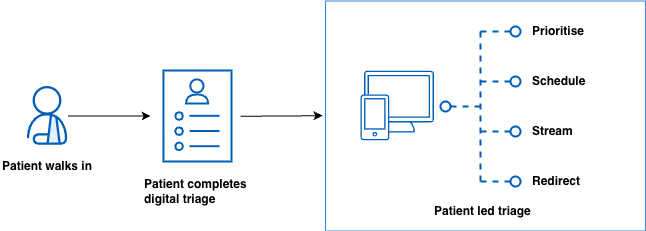
- Patient arrives at the urgent care setting.
- Patient completes a digital triage on a tablet or kiosk.
- The system prioritises, redirects, schedules or streamlines care, depending on clinical need.
- Clinicians receive triage outcomes instantly and can take action.
Patients may be:
- seen in the department
- redirected (for example, to a UTC or Pharmacy First)
- given an appointment and asked to return
- streamed to services such as same day emergency care (SDEC) or early pregnancy assessment
This supports faster, safer decision-making and a more efficient flow of patients.
What information is available
The service provides access to:
- completed patient triage assessments
- clinical prioritisation outcomes
- digital referral information
- appointment details
- patient demographics and NHS number (linked automatically)
Examples of use
Redirecting patients to alternative services
For example, directing a patient with a minor condition to Pharmacy First or a UTC instead of emergency departments
Streaming to specialist services
Patients can be streamed directly to same day emergency care or early pregnancy assessment services.
Scheduling appointments
Patients can complete a triage and return later for a booked appointment, reducing waiting room crowding.
Managing peak demand
High‑volume UTCs have used the tool to reduce waiting room numbers and maintain safety.
We’ve reduced the wait time in triage and reduced the wait to be seen.
We’re getting the right clinician, to the right type of patient, in the right time.
National usage policy
Use of this service is optional, but it is recommended for urgent and emergency care settings seeking to improve safety, flow and patient experience.
Roadmap
This service is live and in a maintenance phase. There are no planned enhancements at this time. Any future changes will be communicated here.
- Emergency Care Data Set (ECDS) inclusion in assessment.
- Decoupling product from telephony system.
- Enhanced Directory of Service (DoS) functionality.
- Improve onboarding process for new sites.
- Redesign triage outcome summary.
Status, service level and current usage
Contact us
| Enquiry | Contact |
|---|---|
| Live service incident |
National Service Desk Email: [email protected] Report via our customer portal Telephone: 0300 303 5035 |
| General enquires | Email: [email protected] |
Last edited: 9 July 2026 3:02 pm