OPEN DASHBOARD (Please note this opens in a new window)
Introduction
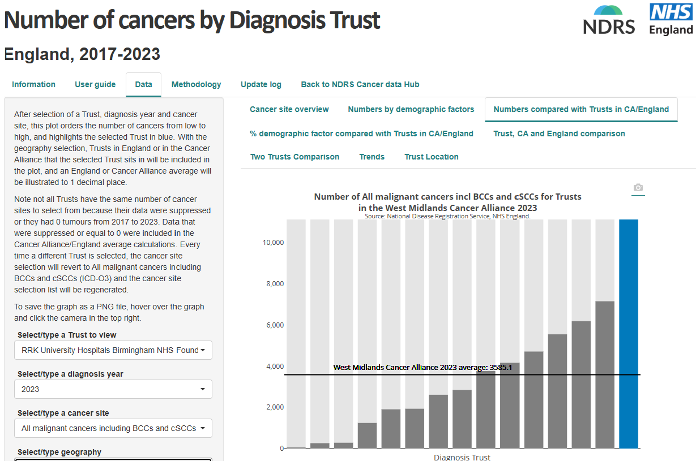
This publication reports the number of cancers by NHS Diagnosis Trust, single year of diagnosis (2017-2023) and cancer site group, with further breakdowns by:
- Age group: 0-24, 25-49, 50-59, 60-69, 70-79, 80+
- Index of Multiple Deprivation (IMD) 2019 quintile: 1- most deprived, 2, 3, 4, 5 - least deprived
- Gender: male, female
- Broad ethnic group: White, Asian, Black, Mixed, Other, Unknown
Acknowledgements
This work uses data that has been provided by patients and collected by the NHS as part of their care and support. The data are collated, maintained and quality assured by the National Disease Registration Service (NDRS), which is part of NHS England. The initial publication was developed as part of the Macmillan Cancer Support and NDRS Partnership Work Plan.
Purpose
NDRS already reports the number of cancers by Diagnosis Trust via the Cancerstats2 Data tools and platforms (opens in a new window). However, numbers released here are patient identifiable and access is restricted to stakeholders with an N3 / HSCN secure network connection. This publication can be a resource to other stakeholders for example, charities who have an interest in obtaining these data to help provide support in areas or locations more in need of specific services.
Methodology
This publication uses data from the NDRS Cancer Analysis System (CAS) July 2025 snapshot.
Tumour inclusion
This publication uses similar inclusion rules to those applied in the NDRS Cancer Registration Statistics England publication. All tumours included in the counts meet the following criteria:
- Resident in England at time of diagnosis, except for Table_2b which includes counts for all England and non-England residents combined
- Finalised cancer registration
- Aged 0 to 200 at the time of diagnosis
- Assigned a Diagnosis Trust (see Diagnosis Trust allocation)
- Cancers diagnosed between 2017 and 2023, except for Table_2b which includes diagnoses from 2017 to 2022. For Table_2b, 2023 data has not been included as 2023 non-England registrations were not finalised by the time the July 2025 snapshot was taken.
- Gender was male or female
- Tumours have been excluded where a sex-specific diagnosis code does not match the person-stated gender. This may exclude tumours diagnosed in transgender and non-binary patients. These include:
- Males for: cervix, ovary, uterus and vagina
- Females for: prostate and testes
A patient may have more than one tumour diagnosed between 2017 and 2023. Numbers in this publication reflect the number of tumours.
Cancer site definitions
This release uses the NDRS standard cancer group definitions to define cancer sites.
All malignant cancers excluding non-melanoma skin cancer (NMSC) includes ICD-10 C00-C97 excluding C44. All malignant cancer including BCCs (Basal Cell Carcinoma) and cSCCs (cutaneous Squamous Cell Carcinoma) (ICD-O3), this is defined as all cancers with behaviour code 3, 5, 6, or 9, and BCCs and cSCCs counted using the first BCC and cSCC per patient per annum (PPPA) method. Cancer sites defined using morphology codes only (sarcoma and neuroendocrine) overlap with other sites e.g. a neuroendocrine neoplasm can have an ICD-10 topography code C18 which is included in the cancer site bowel. Some cancer sites include ICD-10 D codes. Please assess the cancer site definitions if counts from more than one cancer site are combined. If combining counts from various cancer sites, do not expect the total count to agree with All malignant cancers for the above reasons. Not all ICD-10 C codes included in the two All malignant cancer definitions are used in other cancer site definitions.
Diagnosis Trust allocation
Patients undergo a series of events over their cancer care pathway from referral to diagnosis to treatment and sometimes death. NDRS hold information on these events and use this information to allocate a Trust at the time of diagnosis. From 2018, as part of a diagnosis event, one of the required data items collected via the Cancer Outcomes and Services Dataset (COSD) is Organisation site identifier of diagnosis (CR6230), this allows hospitals to complete the organisation site where the patient’s diagnosis took place. As a required data item collected from 2018 onwards, Organisation site identifier of diagnosis is not complete for all tumours. An algorithm is used to evaluate events across the patient pathway and selects the most appropriate event, based on type of event and date difference from diagnosis, to assign a Trust at diagnosis. Some tumours are not allocated a Diagnosis Trust, this occurs for 3% of cases and are not reported in this output. The Diagnosis Trust of all BCCs and cSCCs imputed by the PPPA method is assumed to be the Diagnosis Trust of the first BCC / cSCC diagnosed in a patient. This assumption provides the best overall estimate currently available of Trust level workload but will be incorrect if a patient with multiple tumours is treated in different Trusts for their tumours.
Cancer Alliance definition
Cancer Alliance is allocated according to the Trust and not the patient’s postcode of residence at diagnosis.
Suppression and Trust/Cancer site selection
In the spreadsheet/csv, numbers for each Trust and cancer site combination were suppressed and displayed as .k if the average across the 7 years is less than 10, and the total for 2023 is less than 15. Suppressed data along with Trust/cancer sites with 0 tumours between 2017 and 2023 are not included as choices to select in the dashboard.
Summing the same site across all Trusts and differences with the Cancer Registration Statistics Publication
Please note to take caution if attempts are made to sum across all Trusts to obtain a national total for a specific site. Totals are not likely to be similar to the NDRS Cancer Registration Statistics England publication due to:
- the suppression rules applied to this publication
- not all tumours are assigned a Diagnosis Trust
Chinese ethnic category
The ethnic category Chinese was combined with the broad ethnic category Asian for this publication.
Additional notes
Please note Trusts sometimes merge or change names. This publication used the most up to date Trust information as of September 2025. Numbers are for all acute Trusts in England, excluding small specialist centres such as children’s hospitals. At Macmillan's request, we have also included numbers for the following Trusts:
- Liverpool Women’s NHS Foundation Trust (REP)
- The Robert Jones and Agnes Hunt Orthopaedic Hospital NHS Foundation Trust (RL1)
- Birmingham Women’s and Children’s NHS Foundation Trust (RQ3)
- The Royal Orthopaedic Hospital NHS Foundation Trust (RRJ)
The allocation of children, teenagers and young adults with cancer to a Diagnosis Trust can be particularly complex due to the involvement in the diagnostic process of local hospitals, principal treatment centres (PTC) and, for some histologies, regional or supra-regional centres. It is worth noting that for those aged 0-24 years, only one Trust per tumour is counted which may either be the PTC or where the patient was initially diagnosed.
Release schedule
This is an annual publication released a few months after national statistics cancer registration counts are published.
Data download options
To access the data used in this publication, please refer to the 'User guide' tab within the dashboard.
Feedback and support
The dashboard is produced by the National Disease Registration Service (NDRS). Please send any queries and feedback to ndrsenquiries@nhs.net
Please do not include sensitive or patient identifiable information.
Last edited: 27 May 2026 9:32 am
