Pathology FHIR specification
FHIR R4 profiles to support the exchange of pathology and laboratory medicine test reports.
FHIR
Fast Healthcare Interoperability Resources (FHIR) is a standards framework that is used for healthcare data exchange. In this context, it is used to define the structure of pathology and laboratory medicine test reports.
In the pathology laboratory to GP practice data flow, test reports are currently represented using the data structure defined in the PMIP EDIFACT (NHS003) specification. As described in the DAPB4101 Pathology and Laboratory Medicine Reporting Information Standard, PMIP EDIFACT (NHS003) will be replaced by a specification based on FHIR. Each pathology report will be represented by a FHIR UK Core R4 ‘bundle’ and will include SNOMED PBCL and PaLM reportables to represent laboratory test result codes.
Download a diagram that illustrates the structure of an example HbA1c and serum lipid level laboratory test report
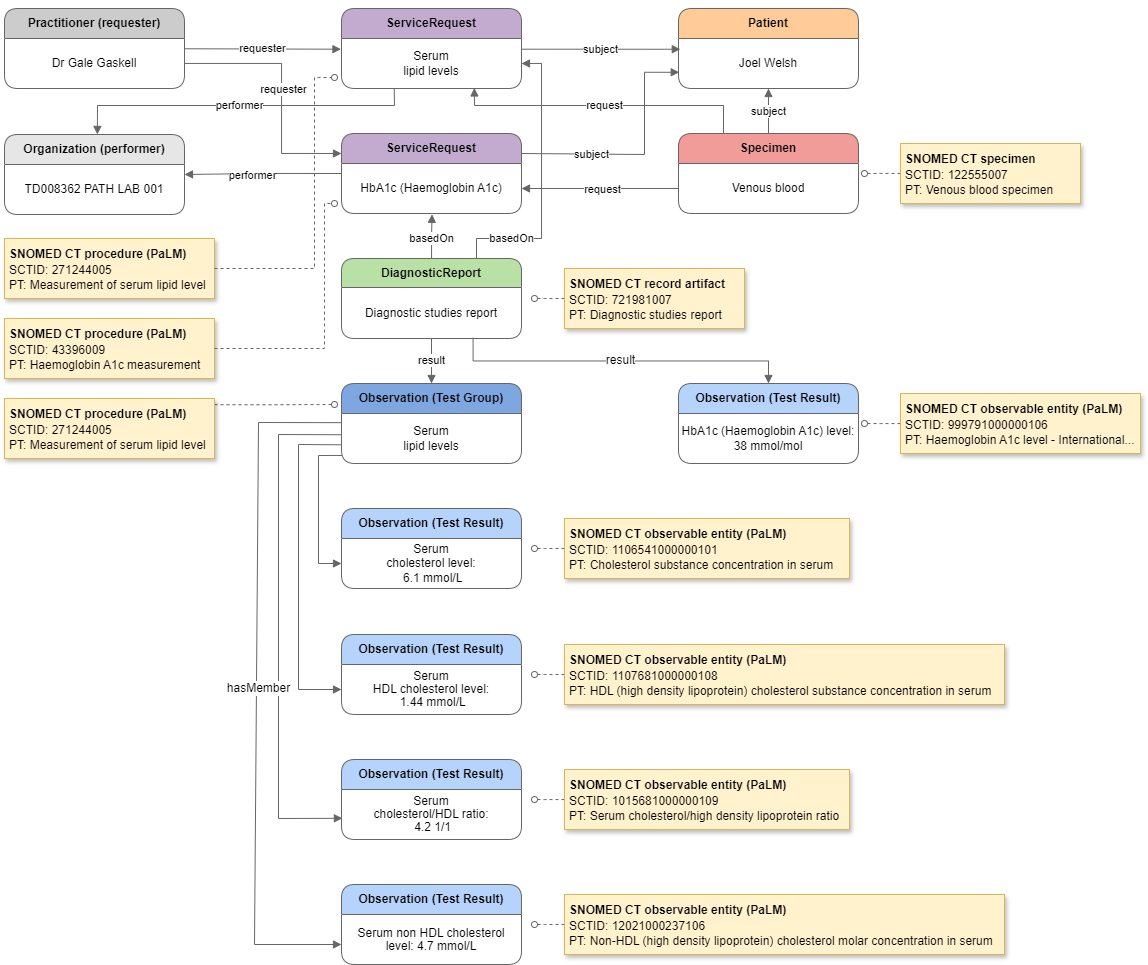
NHS England has created pathology-specific FHIR UK Core R4 profiles and an accompanying implementation guide:
The Pathology FHIR implementation guide provides the detailed guidance system suppliers will need to implement the pathology-related FHIR profiles. Regularly updated, this FHIR implementation guide is referenced in DAPB4101’s implementation guidance as the source of truth for implementors.
Architecture
NHS England's Message Exchange for Social Care and Health (MESH) service is currently used to transport PMIP EDIFACT pathology reports from laboratory systems to GP systems.
In addition to MESH, FHIR supports other methods of exchanging data, including the use of RESTful APIs. These will be used to transport DAPB4101 pathology reports.
NHS England is developing new architecture designed to replace MESH that will enable the interoperable flow of diagnostic data across the estate.
To support DAPB4101, the proposed solution involves the laboratory information management system (LIMS) creating a pathology report (in HL7v2 and other formats). The LIMS will send the report to middleware.
- Middleware will transform the report into a DAPB4101 FHIR/SNOMED report, then send the report to the Pathology API, an interface for systems flowing pathology data.
- The Pathology API will send the report to the Patient Data Manager (PDM), a product that enables the storage, retrieval, and management of healthcare data.
- The PDM will verify the report for errors against the Pathology FHIR Specification and write to storage if valid.
- If valid, the Pathology API will publish a notification (event) to the Multicast Notification Service (MNS), a product that allows healthcare systems to publish and subscribe to healthcare-related events.
- The MNS will deliver the event to the GP system, alerting it to collect the report.
- The GP system will get the report from the PDM.
- The GP system will publish an acknowledgement of receipt to the PDM containing details of the transaction.
- The PDM will publish an acknowledgement of receipt (event) to the MNS.
- The MNS will deliver this acknowledgement to middleware and the Pathology API.
- Middleware will retrieve details of the acknowledgment transaction either from the Pathology API or the PDM (to be determined).
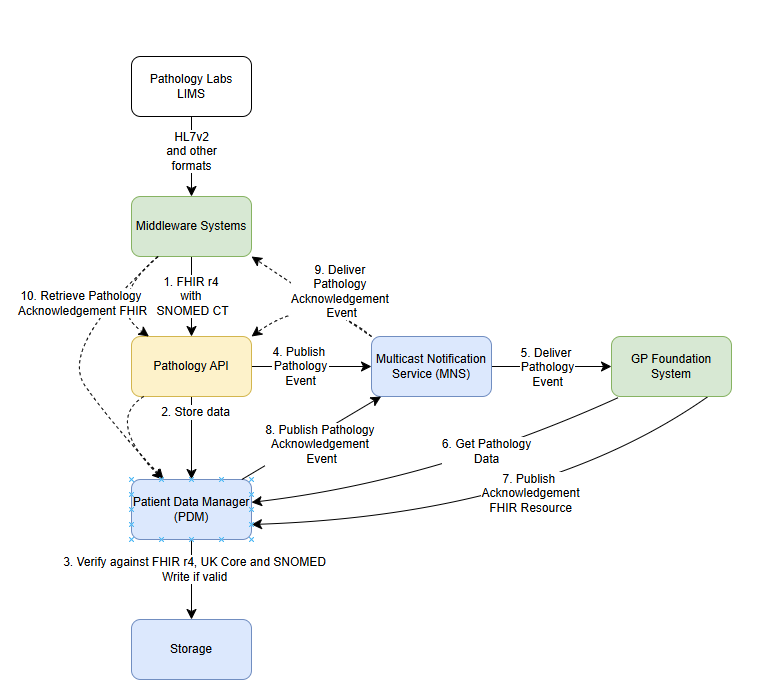
Key:
White: External systems, out of scope
Green: External systems, in scope
Yellow: New NHS England system
Blue: Existing NHS England systems
Last edited: 10 June 2026 2:40 pm