Data product fundamentals
The Emergency Care Data Set (ECDS) is the national data set for urgent and emergency care.
Watch our video below to learn about the Emergency Care Data Set (ECDS), including what the data is, how it’s collected, its metadata, and practical tips for using it.
Closed captions and transcript are available in the video settings.
The Emergency Care Data Set (ECDS) is the national data set for urgent and emergency care. It allows for:
- the capture of information about the complexity and acuity of attending patients
- granular diagnostic data to ensure an enhanced understanding of need, activity and outcomes
- consistent monitoring of data across local and national initiatives
- support for injury surveillance to identify patterns that enable targeted interventions and improved public health
- understanding causes of rising demand and the value added by emergency departments
See our Data set catalogue and Emergency Care data set data product pages for more information.
Scope of the data product
| Scope | Detail |
|---|---|
| Level of data | Patient level data (as opposed to aggregate) |
| Clinical coding used | SNOMED_CT coding across the data product, only valid codes are made available |
| Availability | Incomplete data available from August 2017. Official complete data from April 2020 |
| Historical data | For earlier years of emergency care refer to Hospital Episode Statistics (HES) Accident and Emergency data |
| Frequency of collection | ECDS data is submitted and collected daily |
| Data collection method | Commissioning Data Set (CDS) submissions from healthcare providers to Secondary Uses Service (SUS+) using XML validation |
| Time lag | Provisional monthly cycle and finalised annual cycle |
| Legally restricted data | Any records with a legally restricted diagnosis or procedure have all patient identifiable data removed |
Scope of the data within the data product
| Data group | Detail |
|---|---|
| National (England) | Provider organisation, sites, derived geographic fields |
| Patient demographics | age, gender, geographic, ethnicity, pseudonymised person ID |
| Clinical | diagnosis, investigation, chief complaint, injury |
| Activity characteristics | Emergency department, arrival mode, planned/unplanned, consultation mechanism (face to face, phone, video), acuity |
| Patient timings | arrival, investigation, seen, treatment, discharged, admitted and related durations |
Data collection method and processing
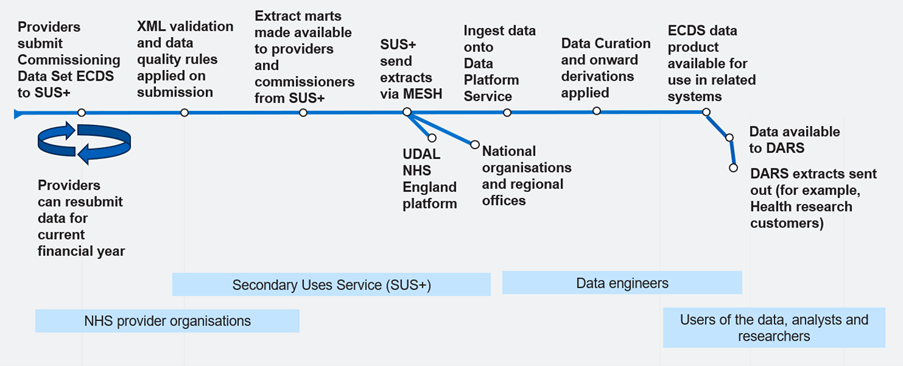
Time lag and availability
Daily management operational views are available internally.
Data outputs have been designed to align with succeeded historical HES Accident and Emergency (A&E) products which have a provisional monthly and finalised annual cycle.
| Availability | Detail |
|---|---|
| Monthly |
Provisional data, publications and dates Provisional Accident and Emergency Quality Indicators for England |
| Annual |
Final fixed data, publications and dates |
Analytical Technical Output Specification (ATOS)
The Emergency Care Data Set Analytical Technical Output Specification:
- contains information of all data items (definition, availability, format, submitted/derived)
- has the ability to filter on data items that are DARS specific (not all data items are available for DARS)
- contains details of all cleaning rules and derivations applied
- has known data quality issues
- has details of which data items are currently available (tranche 1), and which are pending to be released as they are assured (tranches 2 and 3)
Enhanced Technical Output Specification (ETOS)
The Emergency Care Data Set Enhanced Technical Output Specification:
- contains all the valid SNOMED_CT codes and descriptions for every data item that is in a snomed_ct format
- contains data items (and field names) that will vary, as this is the ECDS commissioning data set data dictionary on submission prior to any data curation
Versions and changes to the data product
ECDS from 2017 has minimal derivations or curation when it replaced HES A&E. It has since gone through a series of uplifts affecting content at field level rather than an overhaul of the data set itself.
There have been 4 versions of ECDS to date. Refer to ATOS for detail as to period fields available from/to.
Offering of new fields that are only submitted through ECDS Version 4, and additional derivations. Refer to ATOS.
Expert insights and concepts
Emergency care concepts to support users of the Emergency Care Data Set data product
Implications of CDS version changes. Refer to ATOS.
Implications of SNOMED_CT changes. Keep up to date with changes so you know to update your reports. Refer to ETOS.
Diagnosis MAX – more than 50K diagnosis codes. Plan to make core codes (1000 codes) available as an option for users.
ECDS collected by SNOMED-CT, resulting in granular variation how it can be reported. Users need to check for themselves if this type of activity is as expected.
Documentation and guidance material
Emergency Care Data Set (ECDS) Product
The national data set for urgent and emergency care.
Emergency Care Data Set Analytical Technical Output Specification (ATOS)
A data dictionary for users of the ECDS Data Product.
Emergency care concepts to support users of the Emergency Care Data Set (ECDS) data product
Information and concepts to help users understand how to work with the ECDS data product data.
A library of our implementation, tools and guidance documents about the Emergency Care Data Set (ECDS).
New and improved data product within the Data Platform Service
The differences and benefits between legacy ECDS SQL RDS data product (ECDS RDS) and the new ECDS data product in DPS (ECDS DPS) and its future support and development.
Data quality dashboard for ECDS
NHS Futures log in required.
Data sets are readily available to request through the Data Access Request Service (DARS).
Enquiries and feedback
Contact us at: [email protected]
Last edited: 17 December 2025 5:07 pm