NDRS Newsletter │21 September 2023

NDRS News

Each month we share the latest news from the National Disease Registration Service (NDRS) including recent publications, data releases and upcoming events. 


The National Disease Registration Service is part of NHS England and collects data from the NHS about cancer, rare diseases and congenital anomalies in England.


NDRS includes the National Cancer Registration and Analysis Service (NCRAS) and the National Congenital Anomaly and Rare Diseases Registration Service (NCARDRS). NDRS uses data provided by patients and collected by the NHS as part of their care and support. NDRS uses this data to detect changes in the health of the population and to help the NHS improve the diagnosis and treatment of these diseases.


Please share this newsletter with networks and colleagues

Others can sign up to our newsletter here.

Visit our website
Contact us
Updates from NDRS

Retirement of NCIN and Chemodataset websites next month.

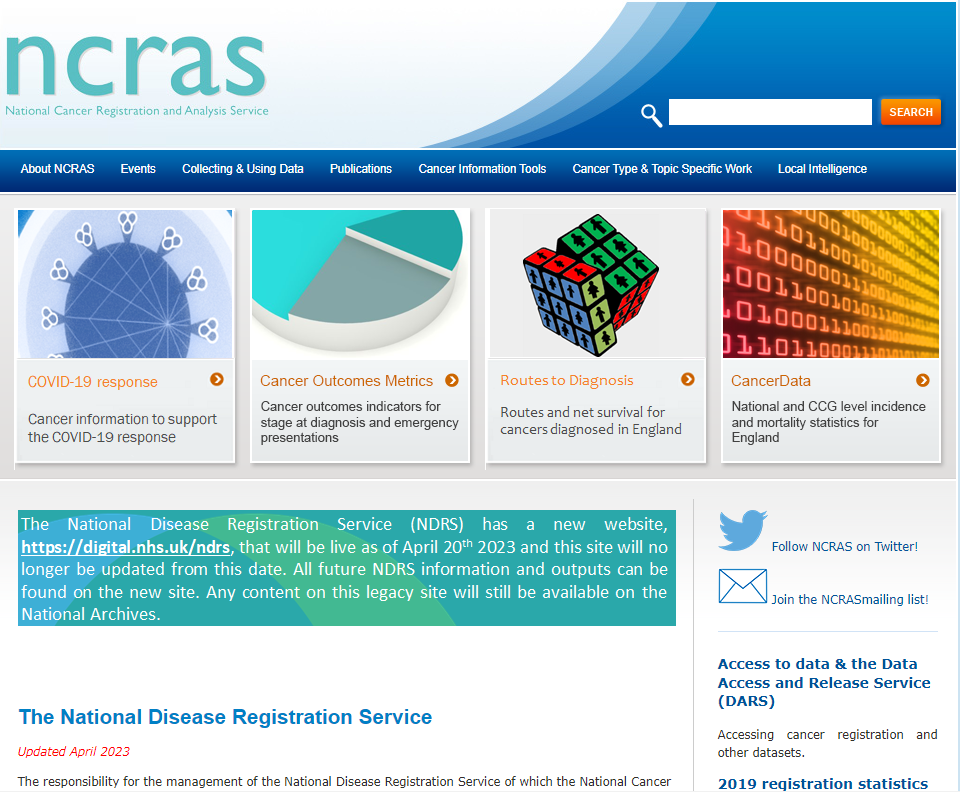
Screenshot of the legacy ncin.org.uk site

At the end of October we will be retiring the NCIN and Chemodataset websites.

We have migrated a lot of the content from these sites to the new NDRS website and in the process have ensured that it meets accessibility standards and is still relevant.


There will be some content that we will not be migrating, either because it cannot be presented in an accessible format or because it has been superseded by a more recent version. All content from the retired sites has been captured in the National Archives and can be accessed at any time. We will be adding signposts to the archived sites in the next few weeks.


If you have any questions about the retirement of these sites or the new site, or would like to provide any feedback please drop us an email at [email protected]

Data releases and publications

VICORI publication

The VICORI partnership has published a study in Clinical Oncology entitled Geographical Variation in Underlying Social Deprivation, Cardiovascular and Other Comorbidities in Patients with Potentially Curable Cancers in England: Results from a National Registry Dataset Analysis. In the study of over 600,000 patients with early-stage potentially curable malignancy in England, social deprivation, cardiovascular disease and other comorbidities show significant regional variations, which may partly contribute to differences observed in treatments and outcomes

Find out more

Virtual Cardio-Oncology Research Initiative (VICORI) logo

SACT Time to First Treatment Dashboard

We have published the SACT Time to First Treatment (TTFT) dashboard on the NDRS website. This report considers the time taken for patients to be treated with SACT drugs that have been approved for routine commissioning use in the NHS following NICE approval. The NDRS dashboard displays a summary measure for England. The accompanying CancerStats2 release (requires a secure HSCN connection to access) also includes results at trust and cancer alliance level. Providing routine information on the equity of access of new SACT drugs is important to gain a greater understanding of the care delivered throughout the NHS. It is hoped that these dashboards will improve cancer outcomes for patients, through identifying variation in uptake to support the understanding, and then improvement, in equitable access of new SACT drugs across the country. 

Find out more

Icon showing a drug

Simulacrum update

Health Data Insight CIC and the National Disease Registration Service (NDRS) are pleased to announce the release of Simulacrum v2, a collection of synthetic datasets generated from patient records held within the NDRS Cancer Analysis System (CAS). The Simulacrum has similar data structure and statistical properties to the real data, but contains no real patient information. Simulacrum v2 adds the radiotherapy dataset (RTDS) and genomics dataset to the previous collection of cancer registration data and systemic anti-cancer therapy dataset (SACT), and so can support a wider range of research by enabling users to explore data structures and simple properties, without risk to patient privacy.

Find out more

Simulacrum logo

Paper published: treatment costs

The CRUK-NDRS partnership published the paper Estimating surgery, radiotherapy and systemic anti-cancer therapy treatment costs for cancer patients by stage at diagnosis in the European Journal of Health Economics. This analysis involved linking patient treatment data to NHS costings data to calculate the initial treatment costs for breast, lung, prostate, colon and rectal cancers diagnosed between 2016 and 2018 and found that breast, colon and rectal cancers treated with resection, radiotherapy or Systemic Anti-Cancer Therapy (SACT) had increasing costs with later stage at diagnosis; costs for lung and prostate cancers were lower at stages 1 and 4 compared to stages 2 and 3, although it is important to interpret these findings in the context of additional wider costs of cancer diagnosis and treatment.

Find out more

An Icon showing treatment costs

Update to number of cancers by diagnosis Trust

The Number of cancers by Diagnosis Trust spreadsheet and app was published on Thursday 14th September. This is an update to the publication in November 2022 (spreadsheet only) and includes the number of cancers by NHS Diagnosis Trust, cancer site and diagnosis year (2017-2020) with further breakdowns by the demographic factors: age-group, gender, major ethnic group and deprivation. This is the first time these data have been presented in an interactive R Shiny app, and the first time we have been able to include additional cancer sites of skin and mesothelioma

Find out more

An icon showing diagnosis

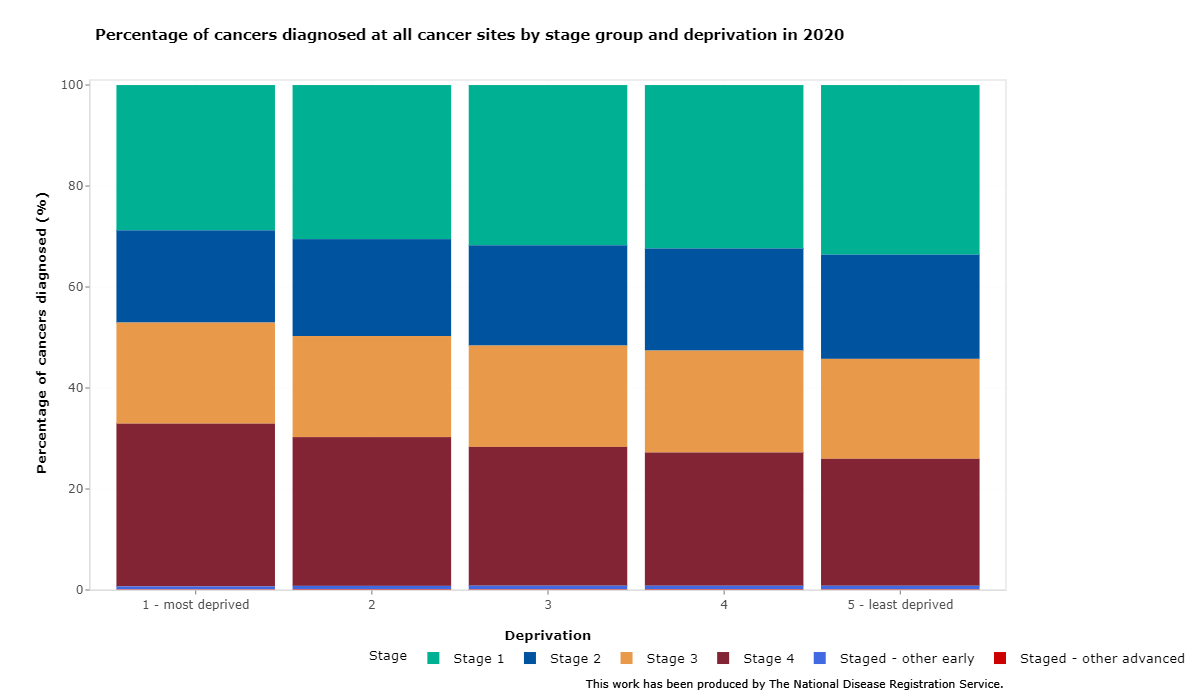
Stage app published on CancerData

A new staging app has been published on CancerData. This accompanies the publication Case-mix adjusted percentage of cancers diagnosed at stages 1 and 2 in England, 2020 released on 15 December 2022. That publication presented the 1- and 3-year unadjusted and case-mix adjusted ‘percentage of all cancers diagnosed at stages 1 and 2’ indicator nationally and at sub-Integrated Care Board location (sub-ICBL) level.

Find out more

A graph from the CancerData app showing Percentage of cancers diagnosed at all cancer sites by stage group and deprivation in 2020.

Non-Primary Cancers including recurrences by Trusts published

The Non Primary Cancers including recurrences by Trusts (previously known as Recurrences by Trust) output was published on Thursday 27 July. This includes numbers of Non Primary Cancers including recurrences by Trust and broad cancer site in England for the years 2014-2020. This shows that despite 2020 being a difficult year due to the coronavirus pandemic, Trusts did still submit Cancer Outcome and Services Data set (COSD) and Cancer Waiting Time (CWT) data on Non Primary Cancer Pathways.

Find out more

An icon showing data

Events

An image of a person using a laptop

SACT webinar


The SACT data set team hosted a webinar on Thursday to provide an overview of the two 30-day mortality post-SACT outputs. The presentation included guidance on how to access and review the Case-mix Adjusted Rates (CMAR) report and the Rapid Data Review (RDR), the release schedules, and examples of how NHS trusts have reported they have used the data to support their internal mortality reviews. Over 80 people attended on the day to listen to the team with questions asked regarding the data sources, release schedule, and deprivation data. The next webinar will be in October and will focus on the SACT data reports on Cancerstats2.

And finally

NDRS Clinical Lead features in BBC show

Dr Zoë Venables,

Clinical Associate Professor & Dermatology Consultant - Norfolk and Norwich University Hospital & University of East Anglia 

Dermatology Clinical Lead - National Cancer Registration and Analysis Service 


One of NDRS’ clinical leads, Dr Zoe Venables, Clinical Associate Professor & Dermatology Consultant, featured in BBC Radio 4 programme More Or Less discussing the publication on the lifetime risk of skin cancers, one of the projects arising from our partnership with the British Association of Dermatologists (BAD). The article demonstrated that one in five people will develop non-melanoma skin cancers (NMSC) in their lifetime in England. Tune in to BBC Sounds to hear Zoe expertly explain skin cancer incidence and mortality in both melanoma and non-melanoma skin cancer and go to the NDRS website for more about our partnership with BAD. 

Thank you for reading. If you have any questions or queries please get in touch. We would welcome your feedback on this newsletter too, and if you wish to unsubscribe please follow the link below.
Contact us