Each month we share the latest news from the National Disease Registration Service (NDRS) including recent publications, data releases and upcoming events.
Please share this newsletter with networks and colleagues
Others can sign up to our newsletter here.
|
|
BARD project wins the 'Outstanding Benefit to Society through Research" award |
Holding the "Outstanding Benefit to Society through Research’ award from left Dr Joanna Williams, Professor John Radford, Dr Sacha Howell and Mrs Elsita Payne |
BARD is one of the NDRS partnerships, working in collaboration with Manchester University and The Christie NHS Foundation Trust. NDRS data is used to identify women at increased risk of developing breast cancer and make sure they are offered enhanced breast cancer screening. BARD has changed national policy and clinical practice and is the means by which women across England are now automatically offered screening at the right time improving patient access, outcomes, and experience.
A huge congratulations to Professor John Radford, Dr Sacha Howell, Professor Richard Cowan, Dr Joanna Williams and Elsita Payne and the rest of the BARD team. This is wonderful example of the value of NDRS data and expertise.
|
|
Bladder cancer awareness month |
An icon showing the urinary system |
May is bladder cancer awareness month. At NDRS we wanted to use this opportunity to tell you about the Get Data Out (GDO) programme which publishes in-depth, anonymous data about cancer to support research
The GDO programme publishes detailed statistics on Bladder, Urethra, Renal Pelvis and Ureter. Statistics are presented on small groups of patients, defined both by characteristics of the patients (such as their age and sex) and by features of their tumours (such as the stage or location). The GDO groups present information on incidence, treatment, routes to diagnosis and survival for all these groups. For bladder cancer, groups are defined by the behaviour of the tumour, whether the tumour is urothelial or not, whether the tumour is muscle invasive or not, and for early stage tumours the grade of the tumour. This was developed by working with clinicians and charities. The full information and tree diagram can be found on our website.
|
|
Lynch Syndrome UK patient conference |
|
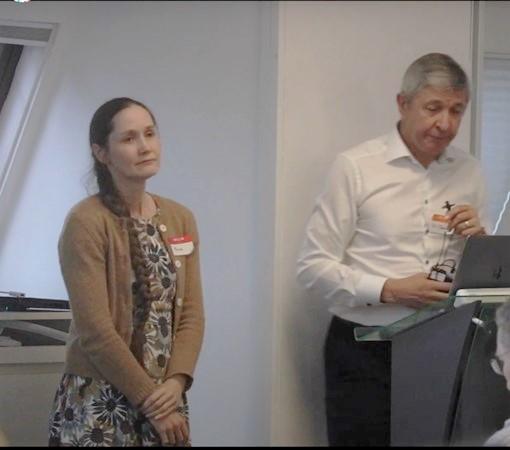
Fiona McRonald and Sir John Burn delivering a presentation at the Lynch Syndrome UK patient conference March 2022 |
|
The Lynch Syndrome UK patient conference was held on Saturday 29 April. NDRS was represented by Fiona McRonald, who gave an overview of how and why we use patient data, and the work we’re doing to improve diagnosis and screening for Lynch syndrome – then introduced our collaborators Helen White and Cassie Huntley. Helen has lived experience of Lynch syndrome, and recently completed her MRes dissertation using NDRS data; she showed that, in people with Lynch syndrome, bowel cancer was almost 4 times more likely to be diagnosed at Stage 1 (as opposed to stages 2, 3 or 4) in those who have pre-cancer germline genetic testing compared to those who have post-cancer germline genetic testing. Cassie is part of the CanGene-CanVar collaboration; she spoke about the work we’re doing in NDRS to create a national registry of people with Lynch syndrome, and share the data with the Bowel Cancer Screening Programme, who are in the process of taking over colonic surveillance of people with Lynch syndrome. Several other presenters in the meeting showed data or analysis that had been provided by NDRS, and a straw poll of the patients attending the meeting demonstrated that all were in favour of the work that we do.
|
|
International collaborations |
|
First UK - Thailand Genomics Steering Committee |
Earlier this month, Sarah Stevens (NDRS Associate Director) and Steven Hardy (NDRS Head of Genomics and Rare Disease) participated in the first UK-Thailand Genomics Steering Committee meeting which brought together key stakeholders from both nations following the recent signing of a memorandum of understanding between UK and Thailand. The aim of this landmark partnership is to boost genomics expertise and explore mutual benefits for improving patient outcomes. Sarah and Steven presented on our approach to national disease registration and the importance of genomic data across cancer, congenital anomalies and rare diseases.
|
|
|
Plenary presentation at the North American National Cancer Registrars Association annual educational conference |
Dr Steven Hardy, NDRS Head of Genomics and Rare Disease, was invited to deliver a plenary presentation at the North American National Cancer Registrars Association annual educational conference in San Diego, USA. Steven gave an overview of our approach to cancer registration in England with a particular focus on genomics and recent innovations in the use of cancer registration data to support early diagnosis, as well as sharing our strategic vision for the future. The conference was attended by over 2000 delegates and Steven’s presentation was extremely well received by attendees. We are looking forward to continuing to develop our relationship with our US counterparts and sharing learning both ways across the pond |
|
Dr Steven Hardy, Head of Genomics and Rare Disease
|
|
Data releases and publications |
|
A paper on the impact of the second COVID-19 wave on people with rare autoimmune rheumatic disease was published in Rheumatology by the RECORDER collaboration. The paper showed that, taking age and sex into account, death following COVID-19 was 2.7x more common in people with rare autoimmune rheumatic disease compared to the general population. However, there was no evidence of an increase in deaths from other causes. |
|
Registration of Complex Rare Diseases - Exemplars in Rheumatology (RECORDER logo |
|
Routes to Diagnosis dashboard upadated |
We updated our Routes to Diagnosis dashboard the CancerData website, bringing together the old outputs in to one. This contains previously published 2006-2018 data in an interactive display, with cuts of incidence data by a selection of cancer sites, time periods and demographics as well as cuts of data by stage and sub-Route with more granular detail on emergency presentations. The tool allows users to download all the data used in it and has links to historical publications.
|
|
|
Treatment dashboard updated |
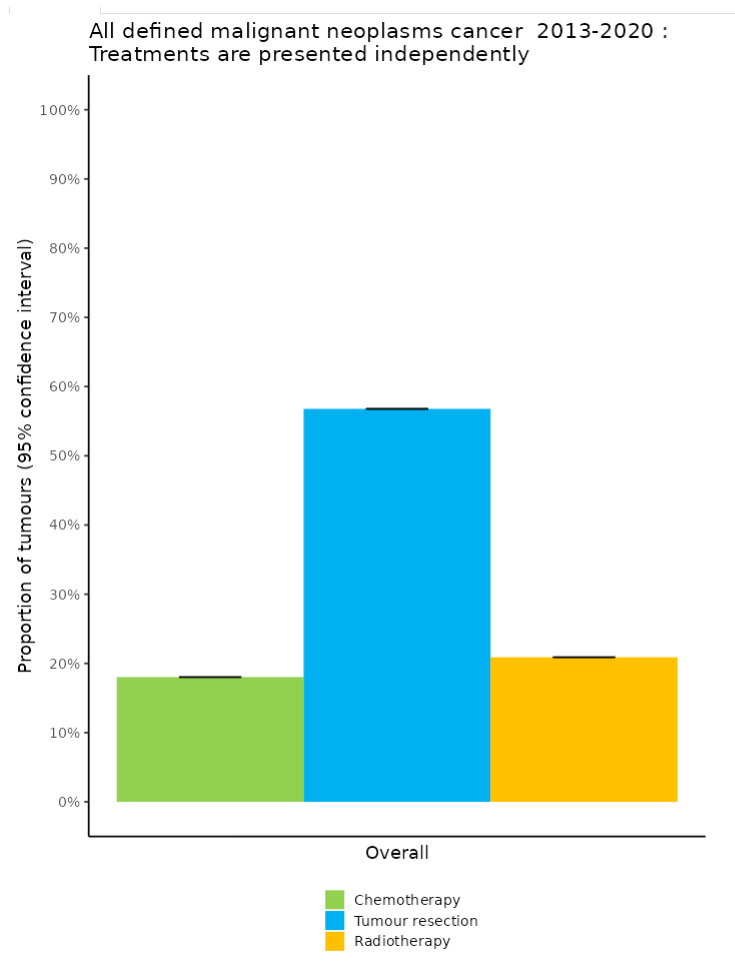
The treatment dashboard, presenting the percentage of tumours receiving chemotherapy, radiotherapy and/or a surgical tumour resection in England, has been updated to include 2020 cancer diagnoses. The tool shows the variation in treatment rates by tumour and patient characteristics, including cancer site, year of diagnosis, stage at diagnosis, age, gender, socio-economic deprivation, ethnicity, and comorbidity at diagnosis, and Cancer Alliance. Please find the methodology detailed in the Standard Operating Procedure (SOP).
|
|
A bar graph from the treatment dashboard showing all defined malignant neoplasms cancer 2013 -2020: treatments are presented independently |
|
Publication on sebaceous carcinoma |
In this national study of sebaceous carcinoma with genetic testing data and cancer diagnoses, it was found that one third of sebaceous carcinoma cases tested had MMR deficiency, and that cancer risk among these patients is high. These findings provide the necessary data to recommend that all patients with sebaceous carcinoma tumours should be offered MMR screening.
|
|
|
National study finds that the care and management of heart failure differs in people who have cancer compared to those without cancer |
A new study using cancer registry data and cardiovascular audit data across England has found differences in the care and management of heart failure for people who have cancer compared to people who don't have cancer.
The study found that people with cancer who were admitted with heart failure were less likely to be seen by a cardiologist and were also less likely to be prescribed guidance-recommended medication used to treat heart failure (ACE inhibitors/angiotensin receptor blockers) than those without cancer. This particularly applied to patients with cancers carrying a poorer prognosis. After being discharged from hospital following admission with heart failure, people with cancer also had much poorer survival, living on average a year shorter than those admitted with acute heart failure without prior cancer (median survival: 1.6 years vs 2.6 years). Most of these individuals (68%) did not die from cancer-related causes.
This work was carried out as a part of the Virtual Cardio-Oncology Research Initiative (VICORI), a joint partnership between University of Leicester, the National Cancer Registration and Analysis Service (NCRAS) [NHS England], and national cardiovascular audits held by the National institute for Cardiovascular Outcome Research (NICOR). |
|
Virtual Cardio-Oncology Research Initiative (VICORI) logo |
|
Upcoming Spring webinars series |
|
Our next series of lunchtime webinars, began on 29 March. The webinar series consists of 6 sessions covering a range of NDRS activities, including a closer look at some of the datasets, our work on congenital anomalies and rare diseases and highlighting recent partnership projects. All sessions will be recorded and available on the NDRS website so you can watch at another time, with the SACT and Health Inequalities recordings available now.
Please click on each link below for more information and to register for free.
Wednesday 24 May 1-2pm
|
|
Thank you for reading. If you have any questions or queries please get in touch. We would welcome your feedback on this newsletter too, and if you wish to unsubscribe please follow the link below. |
|
|
|
|
|
|
|