NDRS Newsletter │21 July 2023

NDRS News
Each month we share the latest news from the National Disease Registration Service (NDRS) including recent publications, data releases and upcoming events. 
 
The National Disease Registration Service is part of NHS England and collects data from the NHS about cancer, rare diseases and congenital anomalies in England.

NDRS includes the National Cancer Registration and Analysis Service (NCRAS) and the National Congenital Anomaly and Rare Diseases Registration Service (NCARDRS). NDRS uses data provided by patients and collected by the NHS as part of their care and support. NDRS uses this data to detect changes in the health of the population and to help the NHS improve the diagnosis and treatment of these diseases.

Please share this newsletter with networks and colleagues
Others can sign up to our newsletter here.
Visit our website
Contact us
Updates from NDRS

Notice of retirement of old NDRS related websites

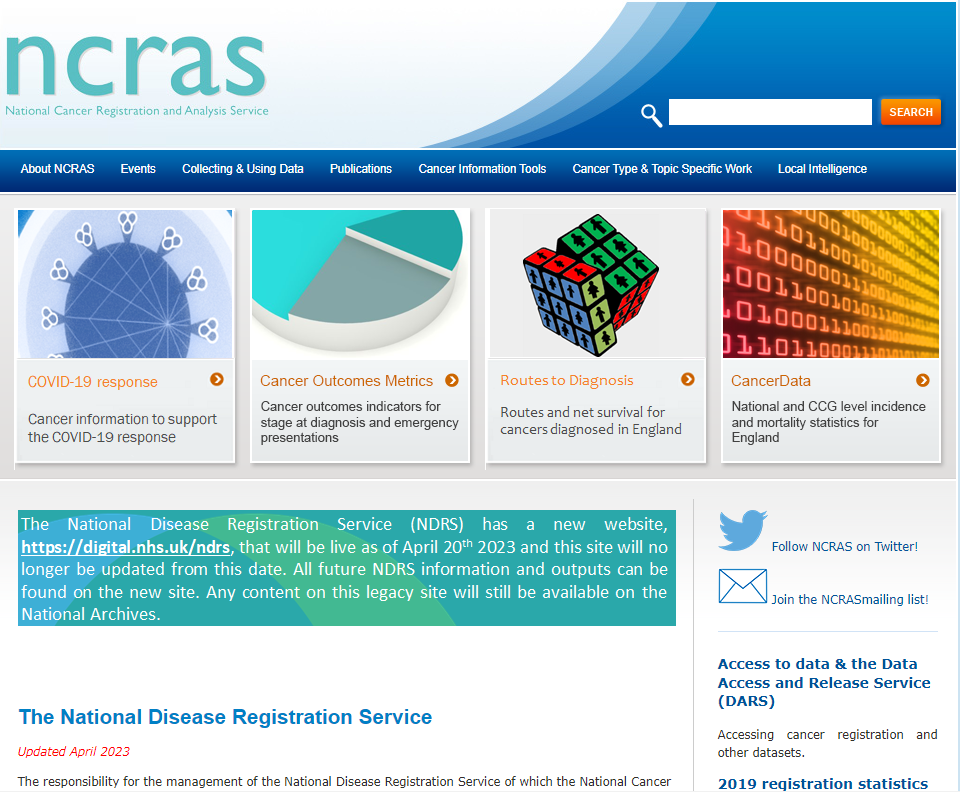
Screenshot of the legacy ncin.org.uk site

By now you will have hopefully seen our new website which brings all the content from other sites related to NDRS work into one place.

This is an ongoing project and the next phase will start to explore how we can improve the navigation and accessibility of our public data platforms.

As the new site is now live we will be retiring the legacy sites from Autumn this year.

The legacy sites are:


www.ncin.org.uk

www.ndrs.nhs.uk

www.chemodataset.nhs.uk


There is a small amount of content on the legacy sites that cannot be found on the new site. That is because it has either been superseded by new information or resources, or because it does not meet accessibility requirements. This content will not be lost. All of the legacy websites have been added to the National Archives and can be accessed at any time by following the links below. These will also be signposted to from the new site.


Archived NCIN website

Archived chemodataset website


If you have any questions regarding the retirement of the old sites please drop us an email at [email protected]

New NDRS Bitesize series

An icon showing a presentation on a laptop

We are delighted to launch the first three videos in our new NDRS Bitesize series. The series aims to provide a short introduction to a data set, data output, platform or other information tool or resource and is presented by our subject matter experts in that field. We will be adding to the series so if there is a particular topic you would like to know more about please drop us an email at [email protected]

We really hope you find these useful and value any feedback you would like to share.

Data releases and publications

Systemic Anti-Cancer Therapy (SACT) data set review – your opportunity to contribute

The SACT data set collects information on the use of systemic anti-cancer therapies across all NHS England trusts and is managed by NDRS.


NDRS is conducting a review of the SACT v3 data set and currently reaching out to stakeholders to collect their comments and suggestions for future changes. This will play a crucial role in shaping the future version of the SACT data set and will help to identify improvements that we should consider.


If you would like to provide feedback on the data set and share your thoughts, please do so using this Microsoft form. The form will close on Friday 11 August so please submit your feedback by this date. Details of current data set items and descriptions is available via the NHS data dictionary.


Once the feedback form closes on Friday 11 August, NDRS will review the comments we have received and will identify changes and improvements to be made with the planned launch of the new data set scheduled in April 2025. 

Provide feedback

An image showing feedback

National Cancer Diagnosis Audits (NCDA) paper published

Dr Ruth Swann, Senior Analyst with NDRS, featured on the British Journal of General Practice podcast, discussing findings from a paper on the National Cancer Diagnosis Audit paper in England. This paper showed significant improvement in the diagnostic pathway within primary care for cancer patients diagnosed in 2018 compared to 2014, which spans the publication of the updated NICE guidelines for the referral of suspected cancer in 2015. In particular, fewer patients had multiple consultations before referral, and more patients were referred and diagnosed quicker. The proportion of urgent referrals for suspected cancer increased and emergency referrals decreased. The paper was co-authored by Sean McPhail, Lorna Wills, and Yoryos Lyratzopoulos.

Find out more

Dr Ruth Swann, Senior Cancer Information Analyst

The national bowel cancer screening programme for Lynch syndrome officially launched 

Lynch syndrome is a genetic condition which causes a predisposition to developing cancer, particularly bowel and endometrial cancers. It is recommended that all Lynch patients undergo 2-yearly colonoscopies to support prevention and early detection of bowel cancer; however, access to surveillance has been extremely variable. In December 2021, a programme was established to support identification and enrolment of Lynch patients into the national bowel cancer screening programme for the first time. NDRS is an integral part of the clinical pathway, acting as the source of ascertainment for enrolling Lynch patients into the screening programme. We have established dataflows with all Regional Clinical Genetics Services and have set up a daily exchange with the national bowel cancer screening programme to enrol patients into the surveillance pathway at the point of diagnosis.

Find out more

Icon showing bowel cancer

Publication on Circulation Cardiovascular Quality and Outcomes

The Virtual Cardio-Oncology Research Initiative (VICORI) team have recently published a paper entitled Impact of a prior cancer diagnosis on quality of care and survival following acute myocardial infarction: retrospective population-based cohort study in England.


The authors studied a cohort of over half a million adults (n=512,388) in England who had acute myocardial infarction (heart attack) according to their previous history of cancer. Nearly two-thirds of the cohort were men. They found that people with cancer were less likely to be prescribed recommended medication to lower blood pressure (ACE inhibitors/angiotensin receptor blockers) compared to those without cancer. In additional, those with a recent diagnosis of cancer, later stage disease, and lung cancer were less likely to receive guideline-recommended clinical care.


This work was carried out as a part of the Virtual Cardio-Oncology Research Initiative (VICORI), a joint partnership between University of Leicester and the National Cancer Registration and Analysis Service (NCRAS) [NHS England])


An associated editorial entitled Mind the Gap: Differences in Acute Myocardial Infarction Care Due to a Cancer Diagnosis in England was also published in the same journal and discusses the clinical findings from the work, describing VICORI as a robust, integrated resource to study cardio-oncology.

Find out more

The Virtual Cardio-Oncology Research Initiative (VICORI) logo

Cohort Profile: The Radiotherapy Dataset for England

Cohort Profile: The Radiotherapy Dataset for England The RTDS Data Profile paper was published by the BMJ Open. The data profile paper outlines the data collected and its structure in addition to how the dataset has been used previously in research and reporting. The profile paper also highlights the strengths and limitations of the dataset and states how interested individuals can gain access to the data held.  

Find out more

An icon showing data

Blood Tests and Symptom Presentation - National Cancer Diagnosis Audit 

Using National Cancer Diagnosis Audit (NCDA) data, a new study explores how blood test use is influenced by symptom presentation in patients subsequently diagnosed with cancer in England. This paper helps to benchmark blood test use in cancer patients and highlights opportunities where their use could be increased. 

Find out more

An icon showing blood tests

Newsletter is taking a break in August


The newsletter will be taking a break in August and will return in early September. Wishing you all a good summer.

Thank you for reading. If you have any questions or queries please get in touch. We would welcome your feedback on this newsletter too, and if you wish to unsubscribe please follow the link below.
Contact us