Each month we share the latest news from the National Disease Registration Service (NDRS) including recent publications, data releases and upcoming events.
Please share this newsletter with networks and colleagues
Others can sign up to our newsletter here.
|
|
I am very pleased to be sharing the NDRS Strategic Plan for 2023/24 with you. The plan has been informed through consultation and discussion with our clinical leads and wider stakeholders and sets out our vision, core business and strategic priorities over the next 12 months. We are already starting to deliver against the plan and will bring you more information on our progress in the coming months. If you have any questions or feedback on the NDRS Strategic Plan please email [email protected]
Sarah Stevens, Associate Director NDRS
|
This new service brings together the information found across the existing sites into one place, to create a single online point of access where you can easily find out about the breadth of work across NDRS and all of our products and services. We have focused on making it accessible for all audiences with the support of Ability.net and the Government Digital Service team and have received input from many of our professional stakeholders and patients and the members of the public. A huge thanks to everyone who has been involved and who has taken the time to feedback to us so far.
The legacy sites ( NCIN, NDRS and ChemoDataset) will continue for at least 6 months in accordance with Government Digital Standards but no new content will be added. After 6 months they will be retired, and the information contained in them will be available via the National Archive.
In this public beta phase, we continue to welcome feedback and suggestions to help us to improve the service. You can do this using the ‘feedback and comments’ form via the banner on the homepage or by emailing the team directly at [email protected] Do let us know what you think.
|
|
Data releases and publications |
|
Reproducible Analytical Pipelines - Published code |
Since July 2016 ,the National Institute for Health and Care Excellence (NICE) has been appraising all new cancer drugs, including those made available through the new Cancer Drugs Fund (CDF). The CDF aims to make promising new treatments available to patients while NICE decides whether treatments should be approved routinely on the NHS.
The National Disease Registration Service (NDRS), part of NHS England provide insight into patient outcomes, including duration of treatment and survival, based on routinely reported data, including data from the Systemic Anti-Cancer Therapy dataset (SACT).
Our CDF reports, together with clinical trials data, inform NICE committee decision making on whether a drug should be made available to patients routinely on the NHS.
|
|
|
Paper published comparing diagnostic pathways across time |
The NCDA collected primary care data on 5% and 20% of incident cancer cases in 2014 and 2018 respectively. Findings from the paper showed there were improvements to the diagnostic pathway in 2018 compared to 2014 with fewer patients having multiple consultations before referral, and more patients being referred and diagnosed quicker. The proportion of urgent referrals for suspected cancer increased and emergency referrals decreased.
|
|
|
Cancer Quality of Life Survey Dashboard updated |
We are pleased to share that the next release of the Cancer Quality of Life Survey dashboard, with age-gender adjustment, is now available on CancerData. This update adds responses from an additional 28,263 people, and now includes data from 111,470 people invited up to December 2022 who responded to the survey up to 7th February 2023. You will also be able to see adjusted data on the dashboard for the first time to enable more direct comparisons. Where relevant, figures have been adjusted for age group, gender and cancer type. |
|
|
New publications about population-based study comparing overall survival (OS) between males and females with neuroendocrine neoplasia (NEN) |
We conducted a retrospective, population-based study comparing overall survival (OS) between males and females with neuroendocrine neoplasia (NEN). In total, 14,834 cases of NEN recorded in England’s National Cancer Registry and Analysis Service (NCRAS) were analysed. Females displayed increased survival irrespective of the stage, morphology or level of deprivation, which was statistically significant in NEN of the lung, pancreas, rectum and stomach (p < 0.001). Stage of tumour played a varying role in this relationship. We demonstrated females diagnosed with NEN tend to survive longer than males, and stage at presentation only accounts for part of this effect. Based on this research, we suggest prognostication and treatment in NEN should consider sex as an important factor |
|
|
NDRS Genomics team contribute to a study exploring the relationship between air pollution and lung cancer |
The NDRS Genomics team have contributed to a international study exploring the relationship between air pollution and lung cancer in non-smokers. We examined Epidermal Growth Factor Receptor (EGFR) mutation rates and correlated this with air pollution levels by linking patient postcode to air pollution data held by the Centre for Radiation, Chemical and Environmental Hazards (CRCE). The study findings demonstrated that rates of EGFR-mutated lung cancer correlated with higher levels of PM2.5 air pollution, a finding which was reproduced in other countries. The epidemiological findings using NDRS data were combined with extensive laboratory data, and the study was published in the prestigious journal Nature on 5 April 2023.
|
|
|
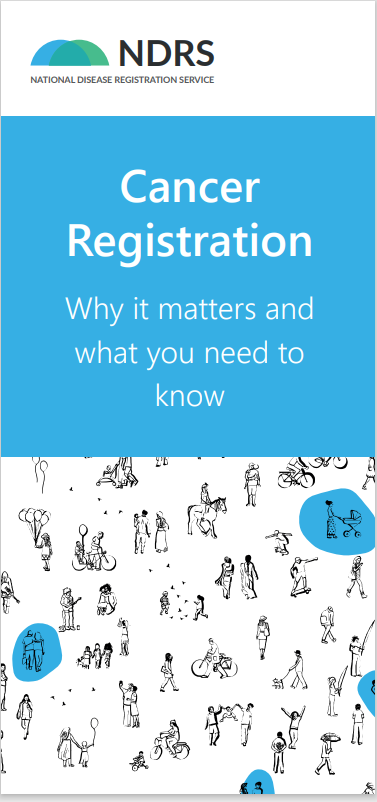
Cancer registration leaflet updated |
We have now updated our cancer registration leaflet.
Thank you to trusts and organisations for your continued support in distributing the cancer registration patient information leaflets to ensure patients are aware of their data being collected and the right to opt-out.
We will be in touch with trusts already distributing to organise delivery. If you do not already stock our leaflets, please reach out to us on [email protected] and we can guide you to the form to order leaflets. |
|
First page of the cancer registration leaflet |
|
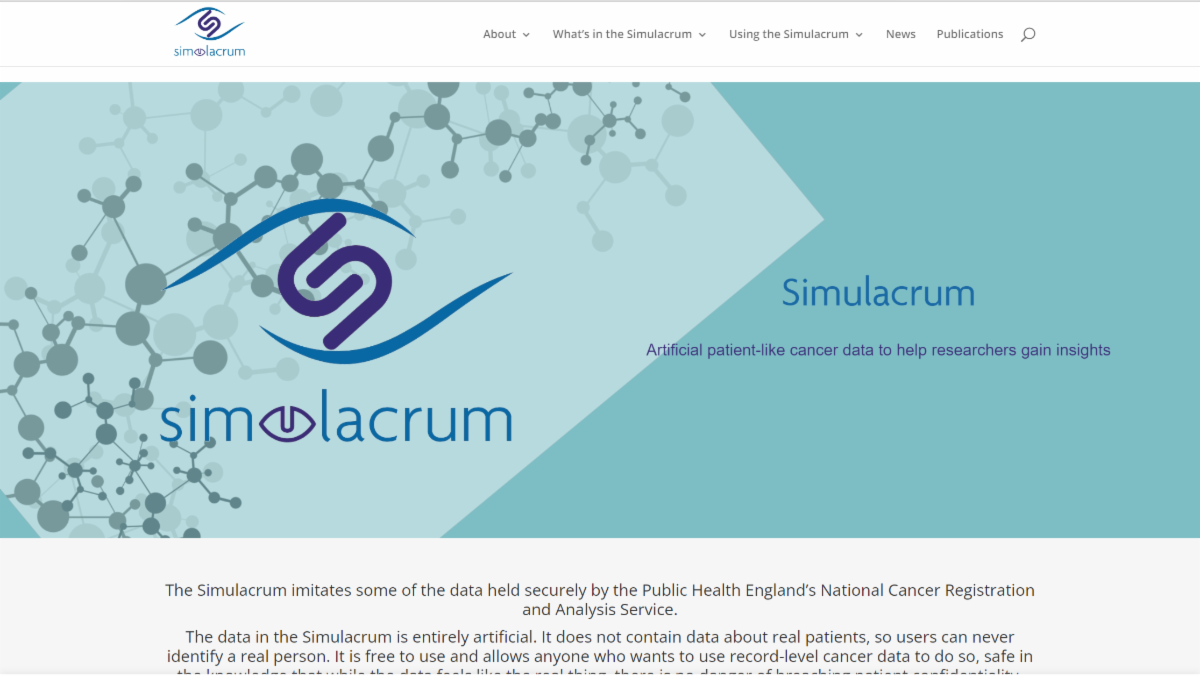
Health Data Insight CIC and the National Disease Registration Service (NDRS) are pleased to announce the release of Simulacrum v2, a collection of synthetic datasets generated from patient records held within the NDRS Cancer Analysis System (CAS). The Simulacrum has similar data structure and statistical properties to the real data, but contains no real patient information. Simulacrum v2 adds the radiotherapy dataset (RTDS) and genomics dataset to the previous collection of cancer registration data and systemic anti-cancer therapy dataset (SACT), and so can support a wider range of research by enabling users to explore data structures and simple properties, without risk to patient privacy.
|
|
An image showing homepage of the Simulacrum website |
|
Upcoming Spring webinars series |
|
Our next series of lunchtime webinars, began on 29 March. The webinar series consists of 6 sessions covering a range of NDRS activities, including a closer look at some of the datasets, our work on congenital anomalies and rare diseases and highlighting recent partnership projects. All sessions will be recorded and available on the NDRS website so you can watch at another time, with the SACT and Health Inequalities recordings available now.
Please click on each link below for more information and to register for free.
Wednesday 26 April 1-2pm
Wednesday 10 May 1-2pm
Thursday 18 May 1-2pm
Wednesday 24 May 1-2pm
|
|
Thank you for reading. If you have any questions or queries please get in touch. We would welcome your feedback on this newsletter too, and if you wish to unsubscribe please follow the link below. |
|
|
|
|
|
|
|