Each month we share the latest news from the National Disease Registration Service (NDRS) including recent publications, data releases and upcoming events.
This month we wanted to raise awareness of bladder cancer for bladder cancer awareness month which is in May. NDRS published two Cancer Drug Fund reports and also updated the Cancer Quality of Life Survey dashboard.
Please share this newsletter with networks and colleagues
Others can sign up to our newsletter here.
|
|
Bladder cancer awareness month |
May is bladder cancer awareness month. At NDRS we wanted to use this opportunity to tell you about the Get Data Out (GDO) programme which publishes in-depth, anonymous data about cancer to support research
The GDO programme publishes detailed statistics on Bladder, Urethra, Renal Pelvis and Ureter. Statistics are presented on small groups of patients, defined both by characteristics of the patients (such as their age and sex) and by features of their tumours (such as the stage or location). The GDO groups present information on incidence, treatment, routes to diagnosis and survival for all these groups. For bladder cancer, groups are defined by the behaviour of the tumour, whether the tumour is urothelial or not, whether the tumour is muscle invasive or not, and for early stage tumours the grade of the tumour. This was developed by working with clinicians and charities. The full information and tree diagram can be found on our website.
We are keen to work with researchers and analysts to understand what this data tells us further, and would love to hear about your experiences of using data to better understand bladder cancer.
|
|
Data releases and publications |
|
NDRS publishes two Cancer Drug Fund reports – evaluating treatments using real world data |
Since July 2016 ,the National Institute for Health and Care Excellence (NICE) has been appraising all new cancer drugs, including those made available through the new Cancer Drugs Fund (CDF). The CDF aims to make promising treatments available to patients while NICE decides whether treatments should be approved routinely on the NHS.
A fundamental element, integral to the success of the CDF, is the cancer data partnership between NHS England and NHS Improvement and NHS Digital. The partnership provides insights into patient outcomes, including duration of treatment and survival, based on routinely reported data, including data from the Systemic Anti-Cancer Therapy dataset (SACT).
Our CDF reports, together with clinical trials data, inform NICE committee decision making on whether a drug should be made available to patients routinely on the NHS.
|
|
|
National Audit of Breast Cancer in Older Patients (NABCOP) 2022 Annual Report and 2022 Patient and Public Report published |
The NABCOP is a national clinical audit run by the Association of Breast Surgery (ABS) and the Clinical Effectiveness Unit (CEU) of the Royal College of Surgeons of England (RCS). NDRS provide the English data to the NABCOP. The 2022 NABCOP Annual Report and 2022 NABCOP Patient and Public Report were published on 12 May 2022. The reports are available to view here along with supplementary materials.
This year the NABCOP has reported on:
- Characteristics and care among women newly diagnosed with breast cancer from 2014–2019
- Primary care prescriptions among women diagnosed with breast cancer in England from 2014–2019 (Endocrine therapy, Bisphosphonate, Anticoagulant and Dementia-related prescriptions from the Primary Care Prescriptions Dataset)
- Diagnosis and treatment patterns across 2020 into 2021 (using the Rapid Cancer Registration Dataset for the English data)
- Frailty-fitness assessment for older women in the breast clinic
- Reflections on the NABCOP’s achievements
|
|
|
Get Data Out programme has released new detailed statistics |
The Get Data Out programme has released new detailed statistics on Routes to Diagnosis and survival for cancer patients diagnosed between 2013 and 2018, for all of the current GDO cancer sites. 2013 to 2019 incidence data has also been released for a new GDO cancer site for Skin tumours. The data is available in an open format for anyone to access and use. You can find the data on skin tumours and the other sites – which cover Bladder, Brain, Eye, Head and neck, Kidney, Oesophageal and stomach, Ovary, Pancreas, Prostate, Sarcoma and Testicular tumours - on the GDO website
|
|
|
Cancer Quality of Life Survey dashboard updated |
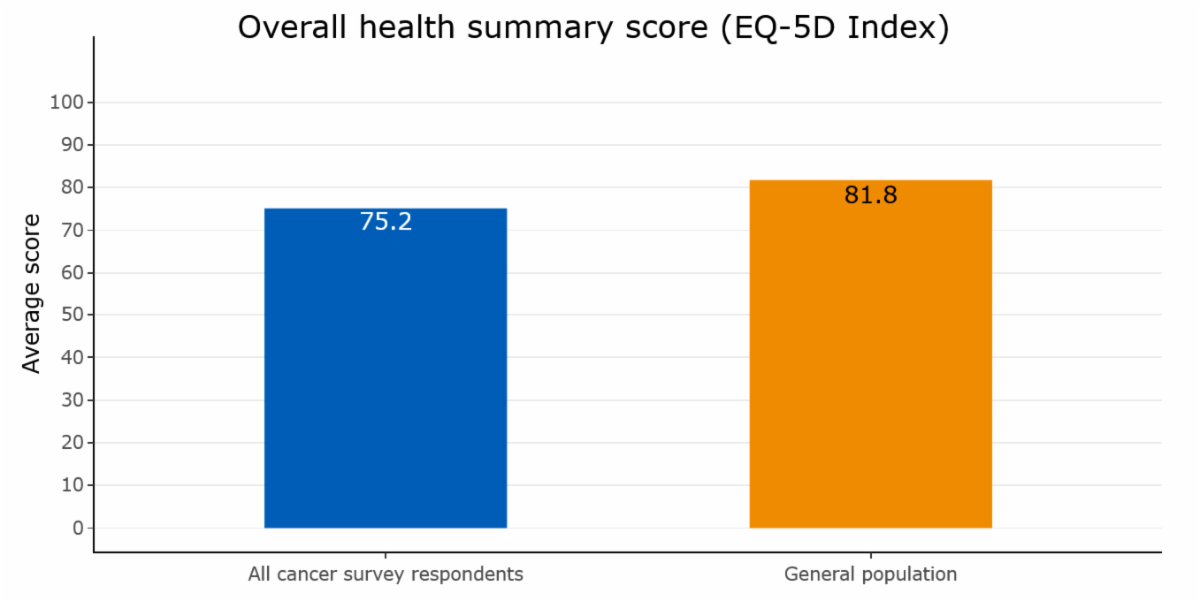
The Cancer Quality of Life Survey aims to find out how quality of life may have changed for people diagnosed with cancer, to help the NHS improve the way it supports people to live as long and as well as possible after a cancer diagnosis. Results from the survey are published in our Cancer Quality of Life Survey dashboard, which was recently updated to report survey results from breast, colorectal and prostate cancer patients invited up to January 2022. The recent release added data for a further 6 months of invites, with an additional 15,805 responses. |
|
A graph from the Cancer quality of Life dashboard showing health summary scores |
|
Thank you for reading. If you have any questions or queries please get in touch. We would welcome your feedback on this newsletter too, and if you wish to unsubscribe please follow the link below. |
|
|
|
|
|
|
|