NDRS Newsletter │21 January 2022
NDRS News
Each month we share the latest news from the National Disease Registration Service (NDRS) including recent publications, data releases and upcoming events. 
  
This month, NDRS published the case-mix adjusted percentage of cancers diagnosed at stages 1 and 2 by CCG in England report. This newsletter also includes the National Lung Cancer Audit (NLCA) annual report and National Prostate Cancer Audit (NPCA) Annual Report.

The National Disease Registration Service is part of NHS Digital and collects data from the NHS about cancer, rare diseases and congenital anomalies in England.

NDRS is made up of the National Cancer Registration and Analysis Service (NCRAS) and the National Congenital Anomaly and Rare Diseases Registration Service (NCARDRS). NDRS uses data provided by patients and collected by the NHS as part of their care and support. NDRS uses this data to detect changes in the health of the population and to help the NHS improve the diagnosis and treatment of these diseases.

Please share this newsletter with networks and colleagues
Others can sign up to our newsletter here.
Updates from NDRS
Wishing you a happy and healthy 2022
A priority for NDRS at the start of this year is to recruit to our vacancies and we are pleased to announce tht the first group of vacant positions are now live on the NHS Digital jobs site. There will be more posts advertised in the coming weeks. Please do take a look and if you have any questions about a position please contact NHS Digital HR or [email protected]
Data releases and publications
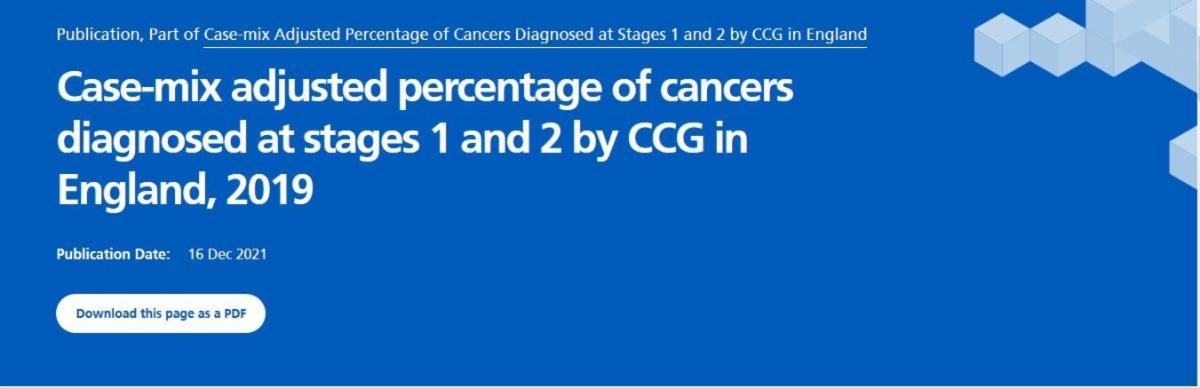
Case-mix adjusted percentage of cancers diagnosed at stages 1 and 2 by CCG in England report
The case-mix adjusted percentage of cancers diagnosed at stages 1 and 2 by CCG in England report and data tables were published on 16th December. An interactive tool on CancerData is also available.
The publication presents the 1 and 3 year unadjusted and case-mix adjusted percentage of all cancers diagnosed at stages 1 and 2 indicator nationally and at Clinical Commissioning Group (CCG) level. The most recently available results are for cancers diagnosed in 2019, with data available from 2013. The unadjusted percentage of cancers diagnosed at each stage is also provided by cancer site/group and deprivation quintile. It also presents the 1 year rolling unadjusted percentage of all cancers diagnosed at stages 1 and 2 indicator (known as the ‘75% ambition’ indicator) nationally and at Cancer Alliance level, for 2013 to 2019.

Get in touch at [email protected] if you have any further questions or any feedback on the report.
Case-mix adjusted percentage of cancers diagnosed at stages 1 and 2 by CCG in England report
CDF report published for Pembrolizumab for adjuvant treatment of completely resected stage 3 melanoma
Since July 2016 ,the National Institute for Health and Care Excellence (NICE) has been appraising all new cancer drugs, including those made available through the new Cancer Drugs Fund (CDF). The CDF aims to make promising treatments available to patients while NICE decides whether treatments should be approved routinely on the NHS.

A fundamental element, integral to the success of the CDF, is the cancer data partnership between NHS England and NHS Improvement and NHS Digital. The partnership provides insights into patient outcomes, including duration of treatment and survival, based on routinely reported data, including data from the Systemic Anti-Cancer Therapy dataset (SACT).

Our CDF reports, together with clinical trials data, inform NICE committee decision making on whether a drug should be made available to patients routinely on the NHS.


Following a recent NICE re-appraisal, the NDRS team have had a report published along with the NICE committee papers: Pembrolizumab for adjuvant treatment of completely resected stage 3 melanoma. This report show how the SACT dataset provides essential real-world evidence to inform committee decisions.
An icon of a drug

National Lung Cancer Audit (NLCA) Annual Report
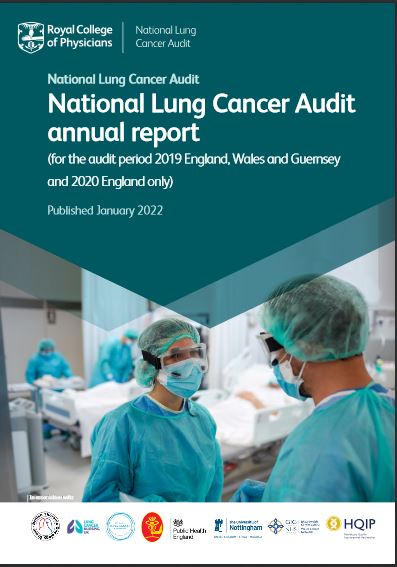
The NLCA Annual Report is now available and includes data from patients diagnosed in 2019 in England and Wales and 2020 in England. The NDRS is the data collection partner for the English data.
The report utilises the NDRS rapid cancer registration dataset for England which makes data available more quickly. Key findings:
  • the one year survival of patients in England and Wales in 2019 was at least 40.7% (compared to 39% in 2018). This is the highest achieved so far and shows that initiatives prior to the pandemic were improving lung cancer outcomes.
  • in 2019 in England, curative treatment rates of Non-Small Cell Lung Cancer (NSCLC) patients with stage I/II and good performance status were 81%. This metric fell significantly to 73% in 2020 with a drop in surgical resection rate from 20% to 15%.
  • compared with 2019, lung cancer patients diagnosed in England in 2020 had worse performance status, were more likely to be diagnosed via emergency presentation and less likely to have a pathological diagnosis.
First page of the National Lung Cancer Audit Report
National Prostate Cancer Audit (NPCA) Annual Report
The NPCA Annual Report is published and can be downloaded from the website.
The report covers process and outcome measures for all men diagnosed with prostate cancer between 1st April 2019 – 31st March 2020 in England and Wales including:
  • patient demographic information and key aspects of the diagnostic and staging process they underwent and the treatments they received.
  • treatment outcomes (up to two years post-treatment) for men in England and Wales undergoing radical prostatectomy (RP) or radical external beam radiotherapy (EBRT) in 2018.
  • the variation in treatment for men with low-risk, localised disease and high-risk/locally advanced disease in Wales only.
  • the impact of COVID-19 on the diagnosis of prostate cancer, receipt of radical treatment and systemic therapy in England only.
An icon of data

Metric summaries from the fourth National ‘Blood in Pee’ campaign in England published
The Be Clear on Cancer (BCoC) team has published the final two metric summaries from the fourth National ‘Blood in Pee’ campaign in England.

The outstanding metrics of ‘Emergency presentations’ and ‘One-year net survival’ formed part of a selection of metrics that were used to evaluate the impact of the fourth national Blood in Pee awareness campaign.

These evaluations are a powerful means of accessing the tangible impact of cancer campaigns and generating evidence to inform future campaign strategies.
The Be Clear on Cancer logo
Latest 30-day mortality post systemic anti-cancer therapy (SACT) workbook published
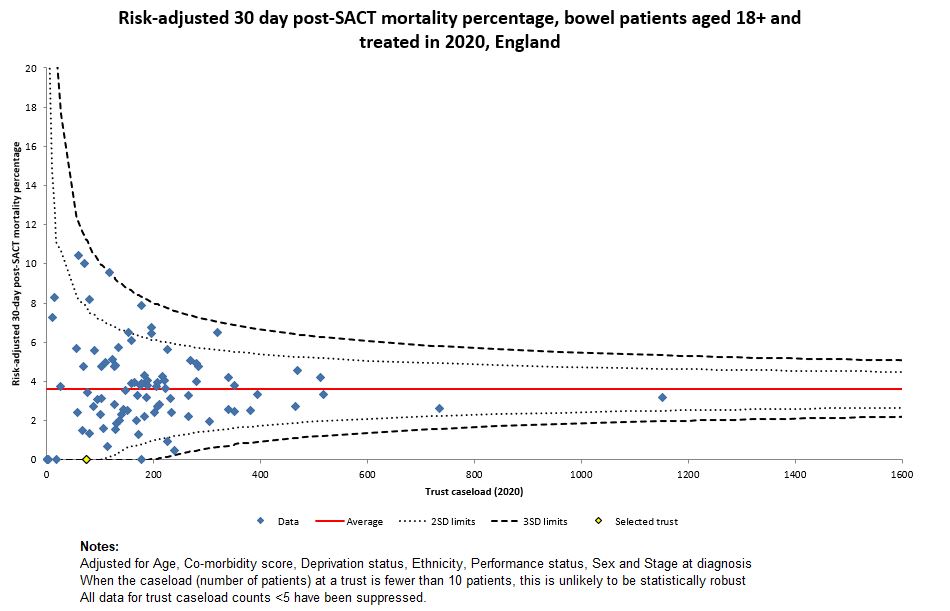
We published our latest 30 day mortality following Systemic Anti-Cancer Therapy (SACT) workbook is now available on the SACT dataset website. The new workbook contains case-mix adjusted mortality rates for patients diagnosed between 2010 and 2020.

We have included patients being treated for bowel or lung cancer, who receive SACT treatment in 2020 and 2019-2020 respectively, as reported by NHS trusts in England through their monthly routine SACT data uploads. This output is a deliverable of a partnership between NHS Digital and NHS England and NHS Improvement on SACT data.

The rates are adjusted for key variables which means that rates can be compared between trusts and within trusts over time. The latest workbook provides more recent mortality data for two cancer sites featured in earlier workbooks. Further details are provided in the companion brief and toolkit.
A graph included in the workbook
Updates to Rapid Cancer Registration Data
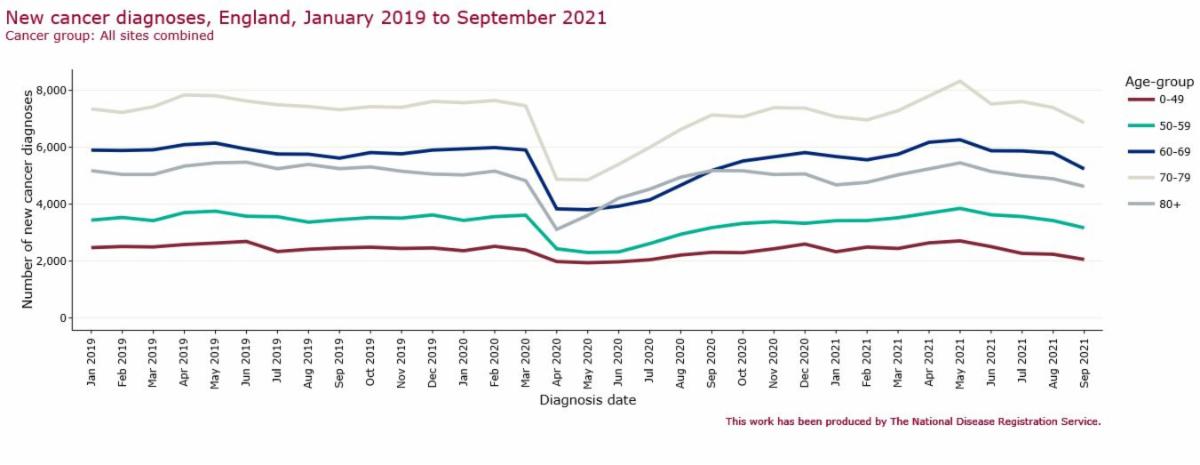
We continue to make monthly updates to the two Rapid Cancer Registration Data (RCRD) COVID-19 Incidence and Treatment dashboards. These always include a full refresh of the data to the latest available, which may include data based on improvements to the RCRD methods so that RCRD provides a better estimate of the gold-standard cancer registration data. The latest data update (CAS2112) included diagnoses up to September 2021. The dashboards are available at: CancerData (publicly available) and CancerStats2 (requires a secure HSCN connection to access). We continue to welcome feedback on the content or functionality of either dashboard.
A graph showing new cancer diagnoses in England from January 2019 to September 2021 from RCRD
Thank you for reading. If you have any questions or queries please get in touch. We would welcome your feedback on this newsletter too, and if you wish to unsubscribe please follow the link below.