Each month we share the latest news from the National Disease Registration Service (NDRS) including recent publications, data releases and upcoming events.
This month we highlight the cancer survival statistics and share details of a new study using data from both NCRAS and NCARDRS investigating immune responses to the COVID-19 vaccine.
Please share this newsletter with networks and colleagues
Others can sign up to our newsletter here.
|
|
In November we welcomed Kate Fleming as the new Head of Analysis. Kate is an epidemiologist by background and joins us after nearly 20 years of working in academia and NHS Arm’s length bodies, and has vast experience using health data for research in a variety of clinical, public health and methodological areas.
“Thank you for the warm welcome into NDRS and NHS Digital. Things you might like to know about me: I was born, live and work in Liverpool; I have 3 school aged children (13,10,6) and work flexibly to accommodate my caring responsibilities; I am a huge Eurovision song contest nerd; and I aspire to the motto of my beloved Everton FC “nil satis nisi optimum”. I’m really excited by the possibilities that are in front of us regarding new data linkages, new methods of data visualisation and more. I will be working with the excellent team here on how we can improve our use of cancer, congenital anomaly and rare diseases data, and ultimately use the knowledge and expertise within NDRS to show the utility more broadly of well collected, quality assured health data to provide accessible intelligence for action.”
|
You may be aware at the current time access requests for NDRS data are either being processed via the UKHSA Office for Data Release (ODR) or in some instances via the NHS Digital Data Access Request Service (DARS) and colleagues across both organisations are working hard to process applications.
We acknowledge that the current hybrid arrangement is not sustainable, and we are exploring how we can bring the data release of NDRS data entirely in-house to NHS Digital over the coming months and to review the existing processes to create a user need based service.
We will bring your further updates as this work progresses. In the meantime, if you require further information regarding the current routes for NDRS data release please contact [email protected]
|
|
Data releases and publications |
|
Cancer survival in England, cancers diagnosed 2015 to 2019, followed up to 2020 report released |
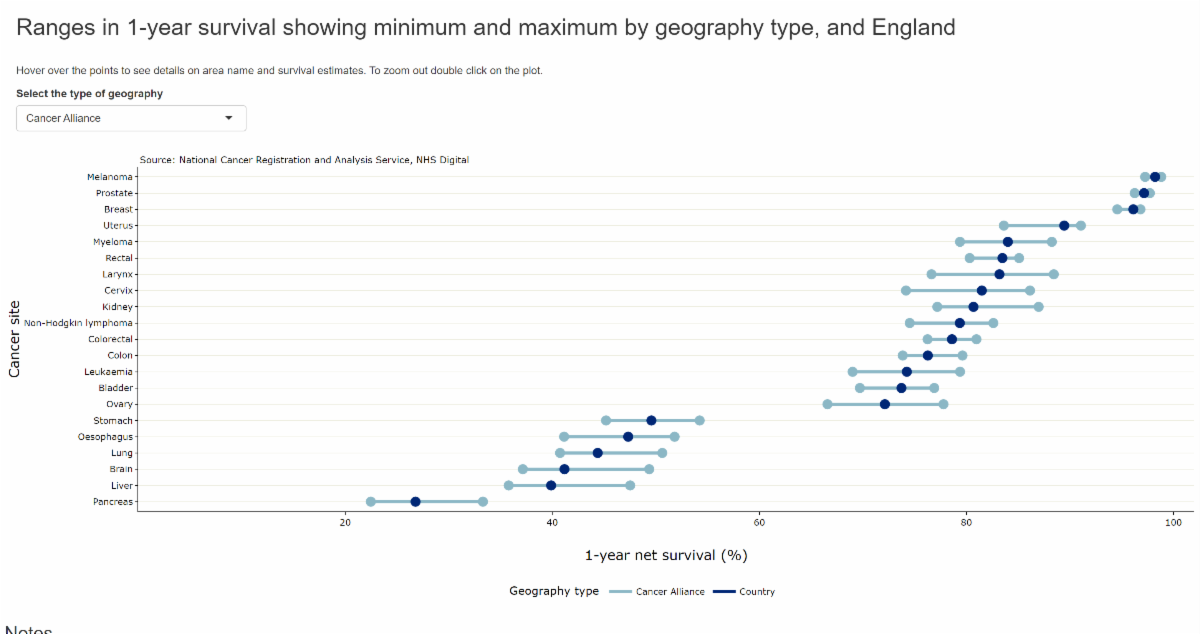
This release summarises the survival of adults diagnosed with cancer in England between 2015 and 2019 and followed to 2020. Adult cancer net survival estimates are presented by cancer group, age, gender, stage at diagnosis and geography. For the first time, adult survival by Index of Multiple Deprivation quintile is presented. Also presented are overall survival estimates for children diagnosed with cancer in England between 2002 and 2019 and followed to 2020.
|
|
A graph showing ranges in 1 year survival showing minimum and maximum by geography type
|
|
Cancer Survival Statistics media coverage |
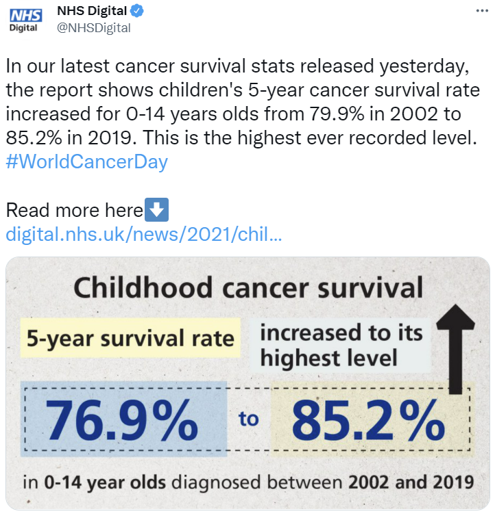
On World Cancer Day, with the support of colleagues in NHS Digital Communications, we are delighted to have achieved an impressive level of media coverage including pick up with The Guardian and on social media channels where 73 users sent 80 tweets which generated over 666,000 impressions.
Liz Earle MBE retweeted NHS Digitals post “Wonderful news to share #postivity. Let’s hope children’s cancer rates continue to improve ever upwards!”
We had lots of cancer charities responding including Little Princess Trust, Youth Cancer Trust Forward, Candle Lighters and Grace Kelly Childhood Cancer Trust.
We also shared the news item through to our newsletter subscription list and of those that opened the newsletter 94.4% clicked through to the report
|
|
A tweet by NHS Digital on World Cancer Day |
|
Rapid Cancer Registration Data dashboards |
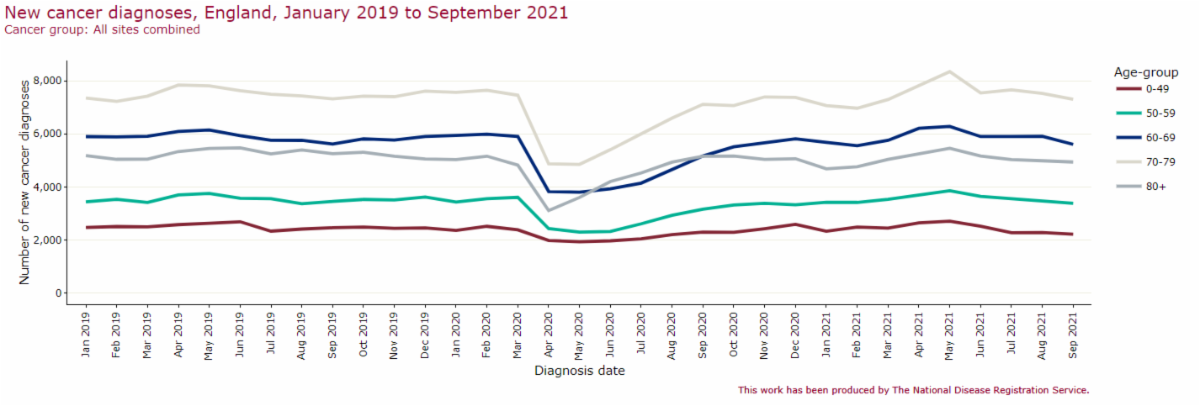
We continue to welcome feedback on the content or functionality of the two Rapid Cancer Registration Data (RCRD) COVID-19 Incidence and Treatment dashboards.
The latest monthly update included diagnoses up to September 2021 and updated data on the proportion of patients recorded as receiving chemotherapy or radiotherapy. The dashboards are available at: CancerData (publicly available) and CancerStats2 (requires a secure HSCN connection to access).
|
|
A graph showing new cancer diagnoses in England, from January 2019 to September 2021 |
|
The MELODY study is recruiting more than 35,000 immunocompromised people to determine their immune response to Covid-19 vaccination and future risk of infection, hospitalisation and survival over six months. Using data held by the National Disease Registration Service 12,000 people with rare autoimmune diseases and 12,000 people with blood cancers have begun to be invited to participate in the study. The study is already open to people who have had organ transplants.
It is being funded by the Medical Research Council in collaboration with several health charities including Kidney Research UK, Blood Cancer UK, Vasculitis UK, and the Cystic Fibrosis Trust, and it is led by researchers at Imperial College London.
Immunocompromised people tend to be the least likely to develop an antibody response following vaccination against Covid-19, but there are huge variations between individuals and different immune conditions.
Dr Aisling McMahon, executive director of research, innovation and policy at Kidney Research UK said, “On behalf of all of the charity partners, we are thrilled to be supporting this important research to identify patients who remain unprotected after three or four doses of Covid-19 vaccine. While vaccination has demonstrated significant benefits in reducing risk for many patients, it is vital that we identify patients who are still vulnerable to Covid-19 to allow healthcare professionals to suggest alternative protective measures and to highlight those patients who may benefit from new prophylactic treatments.”
|
|
|
Thank you for reading. If you have any questions or queries please get in touch. We would welcome your feedback on this newsletter too, and if you wish to unsubscribe please follow the link below. |
|
|
|
|
|
|
|