Each month we share the latest news from the National Disease Registration Service (NDRS) including recent publications, data releases and upcoming events.
This month we wanted to raise awareness of bowel cancer for bowel cancer awareness month which was in April. We also share updates to some of our tools and dashboards on CancerData and CancerStats2.
Please share this newsletter with networks and colleagues
Others can sign up to our newsletter here.
|
|
Bowel cancer month awareness |
April was bowel cancer awareness month. At NDRS, we wanted to share a recent publication that emphasises that the improvement of patients’ experiences of cancer care is a high priority for the national cancer strategy in England.
This study shows the importance of having specific clinical nurse specialists and how this leads to better care experiences for the patient and subsequent survival. The study showed differences in survival were observed between the patients with excellent and non-excellent experience among all cancers and were more pronounced among patients with colorectal cancer. The study used NCRAS data linked with National Cancer Patient Experience Survey (CPES) data.
|
|
Data releases and publications |
|
Urgent suspected cancer referrals interactive tool updated |
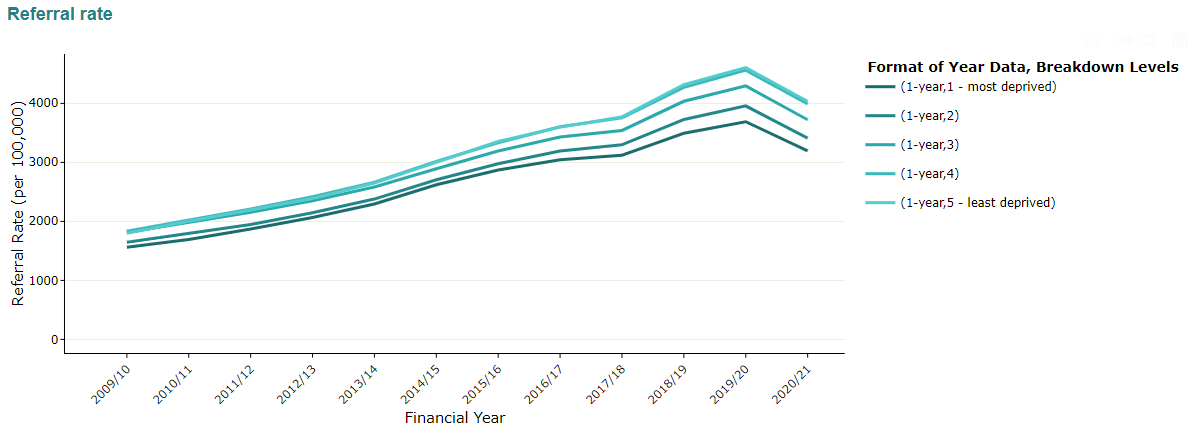
We updated our urgent suspected cancer referrals interactive tool on CancerData, which provides referral rate, conversion rate and detection rate data, by geography, suspected cancer type or cancer site and demographic groups. This release adds data for the April 2020 to March 2021 financial year. For the first time, it also includes breakdowns by ethnic groups, for England and for all cancer sites combined for NHS regions. It also updates the methodology used for the deprivation breakdown.
NDRS, in partnership with CADEAS, are considering running a webinar for the tool - please complete this short survey if this would be of interest to you. |
|
Graph showing referral rate for urgent suspected cancers referrals, for England from April 2009 to March 2010 onwards
|
|
Cancer prevalence dashboards updated |
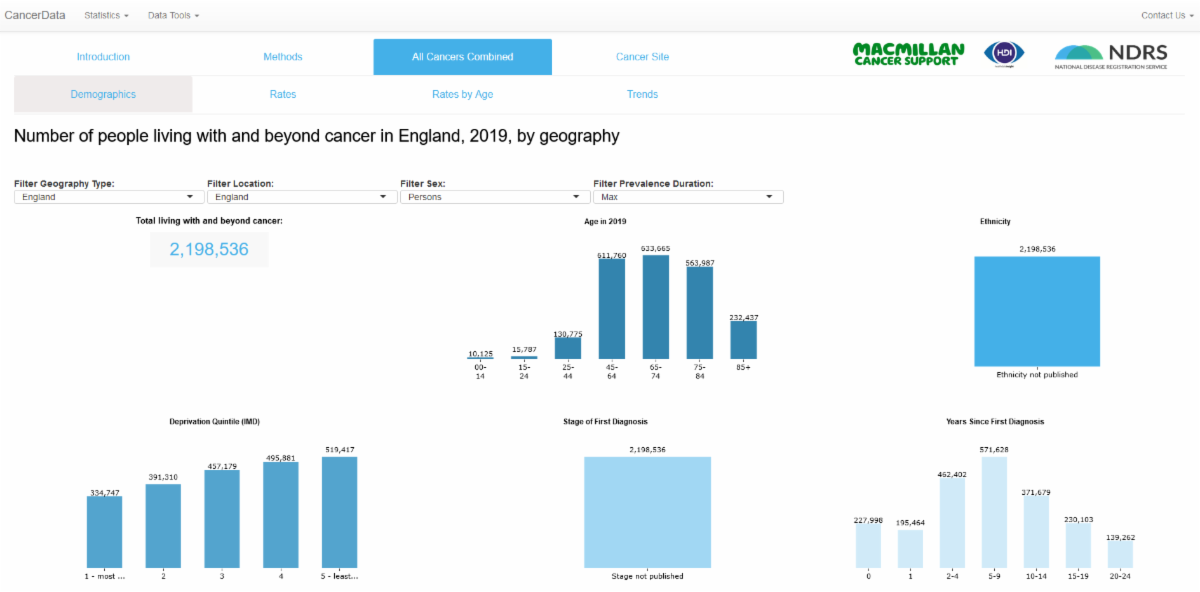
On 21 st April dashboards on both the CancerData website and CancerStats2 web-portal were updated to provide figures for 25 year observed (or limited duration) cancer prevalence in England. This was a joint project between Health Data Insight CIC, Macmillan Cancer Support and NDRS. These data count the number of people that were diagnosed with a cancer between 1995 and 2019 and were still alive on the 31st December 2019, showing that close to 2.2 million people were living with and beyond a cancer diagnosis in England at the end of 2019; an increase of almost 90,000 people on 2018. The dashboard presents prevalence counts and rates for Clinical Commissioning Groups, Sustainability and Transformation Partnerships and Cancer Alliances in England, broken down by population demographics and for different cancer sites. For the first time, top level prevalence counts are also provided for Local Authorities in England.
|
|
Bar charts on CancerData showing number of people living with and beyond cancer in England, 2019 |
|
Cancer survival: Index for Clinical Commissioning Groups, 2004 to 2019 report released
|
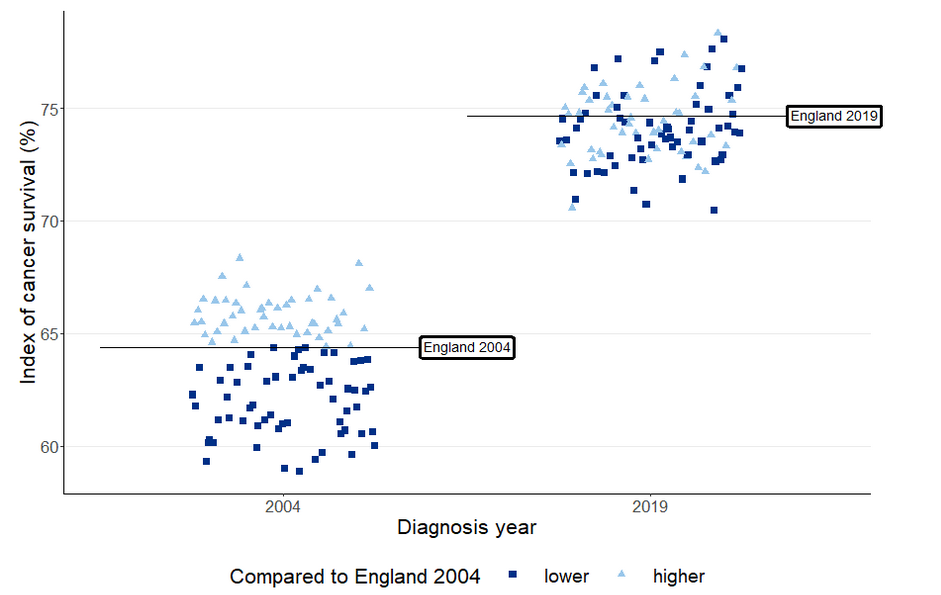
The publication presents the 1 year cancer survival by Clinical Commissioning Group (CCG) for all cancers combined from 2004 to 2019 and followed up to 2020. The index of cancer survival provides a convenient, single number that summarises the overall pattern of cancer survival for each calendar year. We additionally present 1 year net survival estimates for breast, colorectal and lung cancers.
Get in touch at [email protected] if you have any further questions or any feedback on the report.
|
|
Index of cancer survival for CCGs in England compared to index of cancer survival for the whole of England, 2004 and 2019 |
|
Impact of the third national ‘Be Clear on Cancer’ Breast Cancer in Women over 70 Campaign paper published |
The main findings of the paper were that the third national campaign was associated with an increase in urgent cancer referrals, and therefore mammograms and ultrasounds performed. This was associated with an increase in breast cancers diagnosed.
|
|
|
Short-term mortality in ovarian, fallopian tube and primary peritoneal carcinomas across England |
|
|
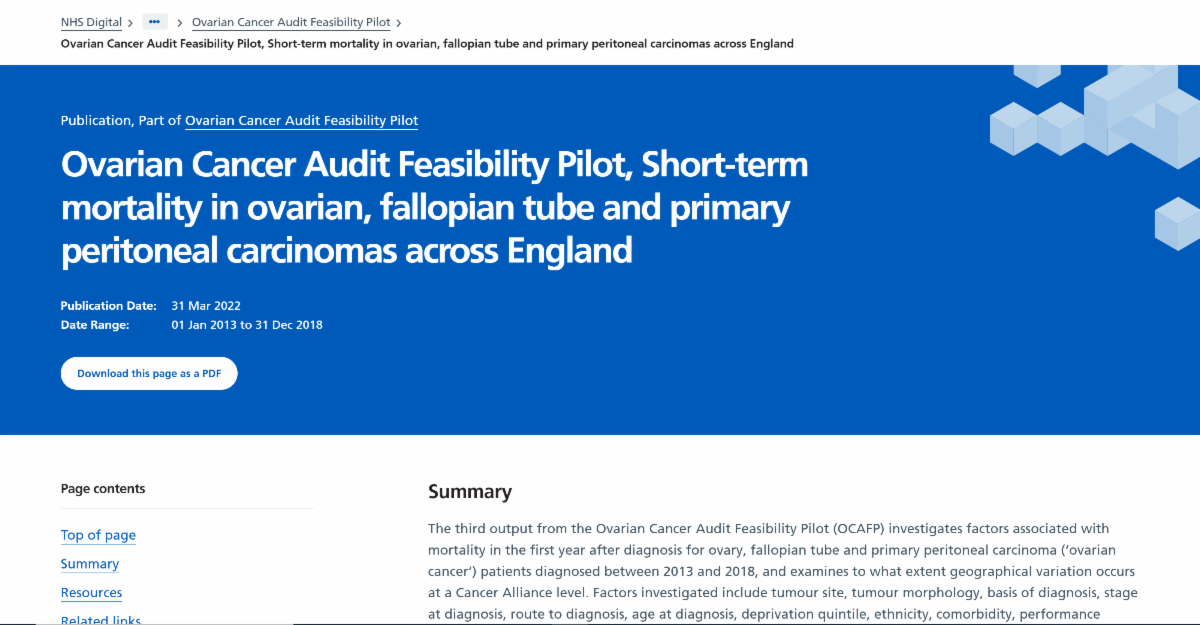
The Ovarian Cancer Audit Feasibility Pilot published a report that investigates factors associated with mortality in the first year after diagnosis for ovary, fallopian tube and primary peritoneal carcinoma (ovarian cancer) patients diagnosed between 2013 and 2018, and examines to what extent geographical variation occurs at a Cancer Alliance level.
Results from these analyses show that the short-term mortality rate for ovarian cancer patients in England remains high but indicate a modest overall improvement over the last decade compared to previous NCIN publications. Adjusted mortality rates were higher for older women, those who were diagnosed at a later or unknown stage of disease, had an unknown morphology, were diagnosed following an emergency presentation or non-urgent route, had a greater burden of comorbidities or resided in an area of low socioeconomic status. Crude and case-mix adjusted results indicated that some variation in short-term mortality may exist at a Cancer Alliance level, but much of this variation is likely due to different patient case-mix or that while variation may exist at a more local level, this has evened out by the time data is analysed at Alliance level. The report was picked up by the media.
|
|
First page of the Short-term mortality in ovarian, fallopian tube and primary peritoneal carcinomas across England publication
|
|
Detailed cancer statistics from Get Data Out – 2013-2018 routes to diagnosis and survival data, plus new cancer site ‘Skin tumours’ |
The Get Data Out programme has released new detailed statistics on Routes to Diagnosis and survival for cancer patients diagnosed between 2013 and 2018, for all 14 of the current GDO cancer sites, plus a new GDO cancer site ‘Skin tumours’. 2013-2019 incidence data has also be released for the new GDO cancer site ‘Skin tumours’.
The data is available in an open format for anyone to access and use. You can find the data in the usual place on the GDO website
|
|
|
Risk factors and prognostic implications of diagnosis of cancer within 30 days after an emergency hospital admission (emergency presentation) |
The Lancet Oncology has recently published research examining the risk factors and prognostic implications of diagnosis of cancer within 30 days after an emergency hospital admission (emergency presentation). This was conducted within the International Cancer Benchmarking Partnership collaboration of NDRS with University College London and CRUK, together with colleagues in the cancer registries of Scotland, Northern Ireland, Wales and other countries.
Data was collected from 857, 068 patients from 14 jurisdictions in 6 countries, and results showed that emergency presentations are fairly common across 6 high-income countries: for 8 selected cancer sites combined the proportion varies from 24% to 43%, though some of this variability reflects subtle differences in definitions of EP use. However, patterns of variation by type of cancer, and increasing association with older age and advanced stage are similar to England, as is the increased risk of dying within one year of diagnosis. This research projects the pioneering work carried out routinely in the last 10 years in England to another 5 high-income countries, and we hope that emergency presentation will become incorporated into cancer intelligence more broadly in an international context. The paper was picked up by the press, including coverage in The Guardian, Sky News, ITV News and The Daily Mail
|
|
An Icon showing diagnosis |
|
Thank you for reading. If you have any questions or queries please get in touch. We would welcome your feedback on this newsletter too, and if you wish to unsubscribe please follow the link below. |
|
|
|
|
|
|
|